
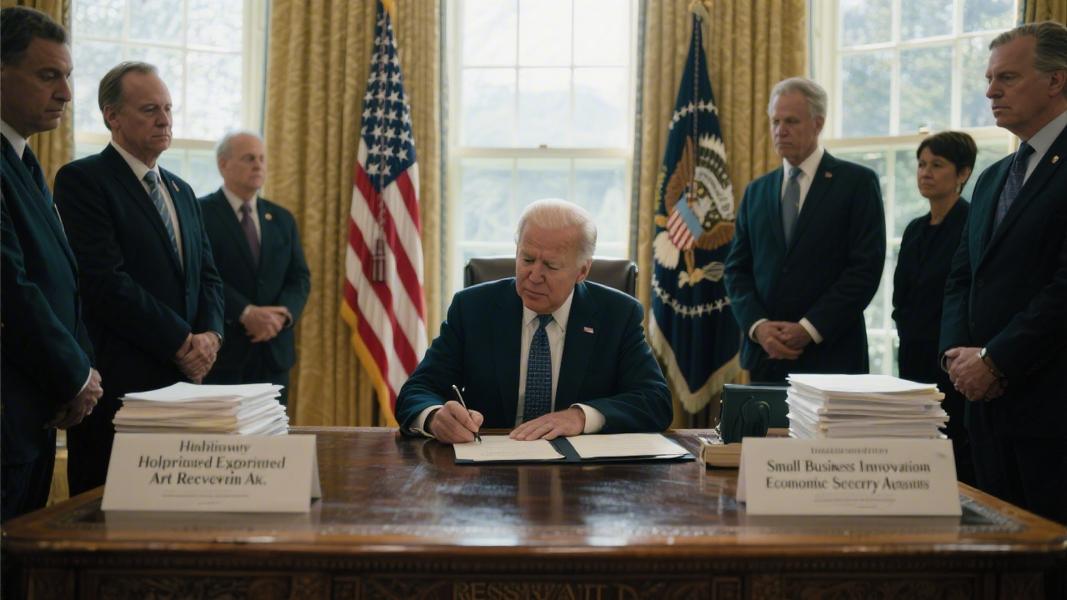
President Trump signed two pieces of legislation into law on April 13, 2026 — one aimed at closing a long-standing gap in justice for Holocaust survivors, and another that could shape the future of American innovation for years to come.
The dual signings, which drew relatively little fanfare compared to the administration’s louder legislative battles, carry real weight. Together, they extend federal protections for art stolen during the Nazi era and pump fresh life into two federal programs that have quietly become cornerstones of the country’s small-business research ecosystem.
Holocaust Art Recovery Gets Permanent Teeth
First, there’s S. 1884, the Holocaust Expropriated Art Recovery Act of 2025. The law permanently extends and expands judicial authority originally granted under the 2016 Act — a statute that gave federal courts more power to hear claims from Holocaust survivors and their heirs seeking to recover art and property seized by the Nazis. The White House confirmed the signing alongside the second bill.
The original 2016 law was widely seen as a step forward, but it came with an expiration date — a flaw that left advocates anxious every time reauthorization came up. Making the authority permanent removes that uncertainty. For families who’ve spent decades navigating foreign courts, statute-of-limitations traps, and bureaucratic dead ends, it’s not a small thing.
SBIR and STTR: A Lifeline for Small Innovators, Extended
The second bill is where the economic stakes get larger. S. 3971, the Small Business Innovation and Economic Security Act, reauthorizes the Small Business Innovation Research (SBIR) and Small Business Technology Transfer (STTR) programs through Fiscal Year 2031. These aren’t obscure government grant programs buried in some agency’s back office — they’re among the primary mechanisms the federal government uses to fund early-stage research at small companies working on everything from defense technology to biomedical breakthroughs.
The bill was introduced by Sen. Joni Ernst (R-Iowa) on March 3, 2026 — the same day the Senate passed it. The House followed on March 17, and it was presented to the President on April 2, according to legislative records. Bipartisan support was evident from the start.
House Small Business Committee Chairman Roger Williams (R-TX) and Ranking Member Nydia M. Velázquez (D-NY), alongside Science Committee Chairman Brian Babin (R-TX) and Ranking Member Zoe Lofgren (D-CA), issued a rare joint statement after passage. The bill, they said, “reauthorizes the SBIR and STTR programs through September 30, 2031, while strengthening research security within the programs, modernizing and streamlining the programs to reduce administrative burdens, and accelerating innovation to advance cutting-edge technology.”
That last phrase — research security — is worth pausing on. The inclusion of explicit security provisions signals a broader anxiety in Congress about foreign interference in federally funded research, particularly from adversarial nations. It’s a thread that’s been running through tech and science policy debates for years now, and it’s showing up here too.
Why These Programs Matter
So what exactly do SBIR and STTR do? In plain terms, they provide critical early-stage funding to small businesses developing technologies in sectors vital to national security and economic competitiveness. Think startups working on quantum computing, advanced materials, or medical diagnostics that wouldn’t survive long enough to attract private venture capital without a government lifeline in the earliest, riskiest phase of development. Advocates had been pushing hard for reauthorization — the programs had been operating under a cloud of uncertainty as their authorization lapsed and was extended on a patchwork basis.
The House passage in March finally put that uncertainty to rest. As the Association of American Medical Colleges noted at the time, the vote cleared the path for a clean, long-term reauthorization — something the small business research community had been lobbying for aggressively.
Still, five years isn’t forever. The programs will be back up for renewal before the decade is out, and the political landscape could look very different by then. For now, though, small businesses with big ideas have a clearer runway than they did a month ago.
Two bills, one signing ceremony, and a quiet reminder that not every consequential piece of legislation arrives with a Twitter war attached.
