
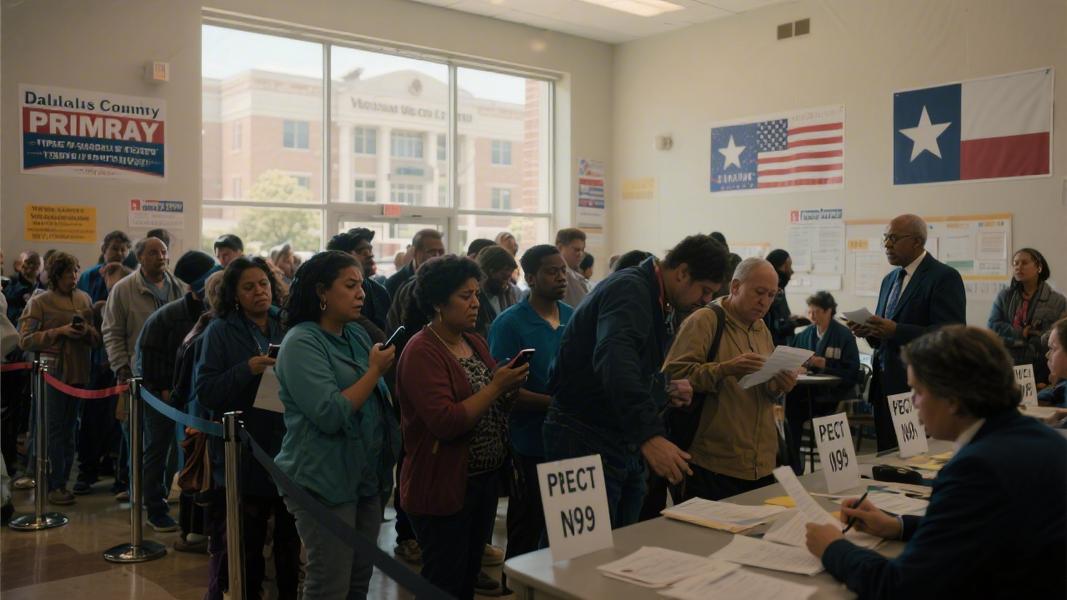
Hundreds of voters showed up to their usual polling places on March 3, 2026, only to be turned away. What followed has become a case study in how election logistics — and political maneuvering — can quietly disenfranchise people before a single vote is counted.
The confusion unfolded in Dallas County, where the Republican Party made a unilateral decision to shift from countywide voting to precinct-only voting for the primary election. The result: long lines, frustrated voters, and roughly 30,000 people redirected to different locations — with no clear accounting of how many ultimately cast a ballot, or simply gave up and went home. Now, Texas Democratic lawmakers are pushing legislation to make sure it doesn’t happen again, and the political fallout is still very much unfolding.
A Decision That Left Voters in the Dark
Dallas County GOP Chairman Allen West has been unapologetic. He argues the changes were hardly a secret — published on the party’s website and announced 60 days in advance. “This was something that was well known,” West said. “We had all of these changes in locations published on the Dallas County Republican Party website. I think that the chairman of the Democrat Party, Mr. Coleman, knew very well what we were doing, as well as across this county.”
That’s the catch, though. A party website isn’t exactly where most working voters spend their Tuesday evenings. Dallas County reportedly spent $1 million on voter education ahead of the primary — and still, the confusion was widespread enough to draw congressional attention. Whether that’s a failure of outreach, of planning, or of political will depends largely on who you ask.
Lawmakers Push Back With New Bills
U.S. Rep. Julie Johnson isn’t waiting for the next election cycle to act. She’s filed the VOTE Act, which would require election operators to notify voters at least seven days before any changes to their polling locations — by letter, by email, or by public posting. “The voters didn’t know,” Johnson explained. “I think that’s really the bigger problem. Our bill would require specific notifications to voters when their precinct locations were going to change from the historical places that they had voted. By letter. By email. By posting.”
It’s a straightforward enough proposal. But it’s also a pointed one — essentially codifying the idea that “we posted it online” doesn’t constitute adequate notice to the public.
State Rep. John Bucy is going further. His bill would allow each county party to independently determine the format of its own primary, stripping away the cross-party veto power that currently exists in Texas election law. The problem, as Bucy frames it, isn’t just what happened in Dallas — it’s a structural one that also affected Williamson County. “No more veto power,” Bucy stated. “No cross-party control because voting is fundamental, and it should never depend on decisions from people you didn’t elect and can’t hold accountable.”
A Reversal — But Only After the Damage Was Done
Here’s where it gets interesting. Despite West’s defense of the precinct-only system, Dallas County Republicans quietly reversed course ahead of the May 26 runoff, reverting to countywide voting to align with municipal elections. The reversal came over internal party opposition — including, notably, a no-confidence vote within the party itself. West has acknowledged that the threat of litigation was a factor in the decision.
Still, West didn’t exactly frame it as a concession. “I think that’s appropriate, because again, why should we be tied to Democrat processes and procedures when this is a Republican primary?” he told reporters — a remark that captures the broader tension here. The argument isn’t really about logistics. It’s about who controls the mechanics of democracy, and whose voters bear the cost when those mechanics fail.
What’s at Stake Beyond Dallas
Hundreds of voters were turned away from their usual polling sites on Election Day — a fact that has drawn scrutiny well beyond Texas. The ripple effects have reached federal lawmakers, and the legislative response now underway suggests this episode is being treated as a warning sign, not an isolated incident.
Whether the VOTE Act or Bucy’s independence bill can clear a Republican-controlled legislature remains very much an open question. But the debate they’ve sparked cuts to something fundamental: in a state that already faces persistent scrutiny over voting access, the idea that party officials can restructure polling infrastructure with minimal public notice — and face no legal obligation to tell voters directly — is one that won’t sit quietly.
Thirty thousand redirected voters, $1 million in public education spending, and a party chair who needed the threat of a lawsuit to change course. If that’s what “well known” looks like, Texas lawmakers on both sides of the aisle might want to reconsider what they mean by the word.
