
A sitting U.S. president calling the newly elected pope “WEAK on Crime” isn’t something you see every day. But here we are.
President Donald Trump took to Truth Social this week to lambaste Pope Leo XIV, accusing the pontiff of being soft on Iran’s nuclear ambitions and hostile to American military action against Venezuela — and the backlash from the Catholic community, from the pews to the pulpit, has been swift and pointed.
A Post That Struck a Nerve
Trump’s broadside was characteristically blunt. “I don’t want a Pope who thinks it’s OK for Iran to have a Nuclear Weapon,” he wrote. “I don’t want a Pope who thinks it’s terrible that America attacked Venezuela, a Country that was sending massive amounts of Drugs into the United States and, even worse, emptying their prisons, including murderers, drug dealers, and killers, into our Country.” The post, written in Trump’s signature all-caps-and-grievance style, framed the pope’s calls for peace not as spiritual leadership but as a foreign policy liability.
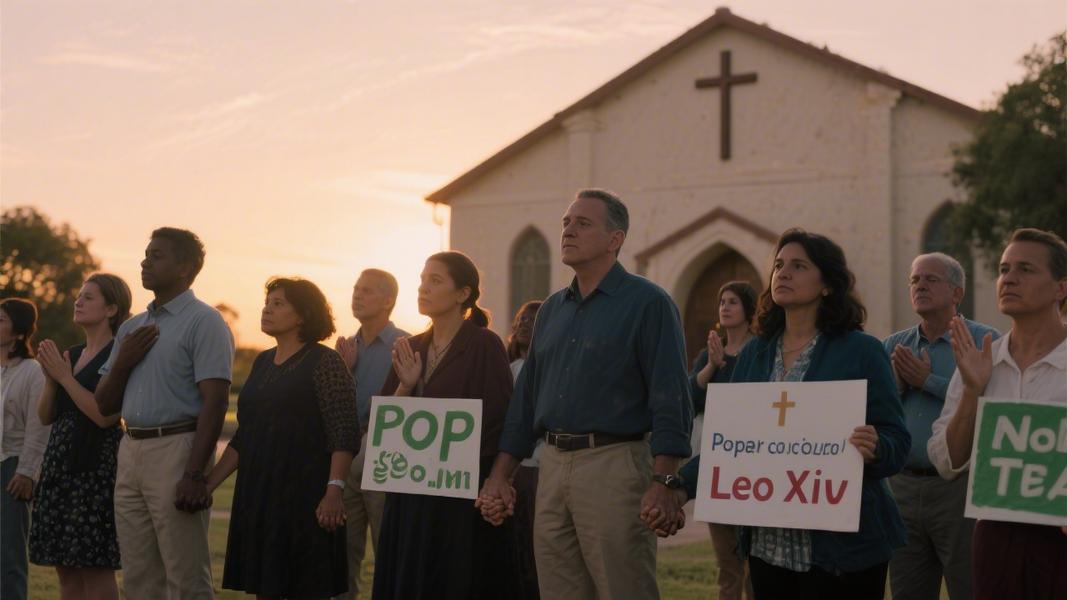
That framing didn’t sit well with Catholics across North Texas — or with their bishop.
Bishop Michael Olson of the Catholic Diocese of Fort Worth pushed back with unusual directness, arguing that Trump’s comments fundamentally misread the nature of the papal office. “It is the responsibility of the papal office as the vicar of Christ to speak in service of Christ, who is the Prince of Peace, and to speak about matters of justice and morality,” Olson said. “That also involves war and ‘just wars’.” The bishop warned that Trump’s post risks drowning out a message of peace at a moment when the world needs it most.
Faithful and Frustrated
For ordinary Catholics in the pews, it wasn’t just a political dispute — it felt personal. Johnny Santos, a North Texas Catholic, didn’t mince words. “I think they’re extremely disrespectful to the Christian faith as a whole, his comments about Pope Leo,” Santos told reporters. That sentiment echoes what many in the congregation are feeling: that the president’s comments crossed a line from policy disagreement into something more corrosive — an attempt to drag the church’s moral voice into a partisan mud fight.
Still, it’s worth noting that Trump has long cultivated strong support among white evangelical Christians, and even some conservative Catholics have aligned with his administration on issues like abortion and religious liberty. The reaction to his Leo XIV posts suggests that coalition may have limits.
The Pope’s Response: Unbothered, Unambiguous
So how did the pope himself respond? Calmly, clearly, and without flinching.
Pope Leo XIV addressed the controversy head-on Monday, refusing to be drawn into Trump’s framing. “The things that I say are certainly not meant as attacks on anyone,” the pontiff said, “and the message of the Gospel is very clear: ‘Blessed are the peacemakers.'” He went further, making explicit what some might have expected him to leave implicit. “I have no fear of the Trump administration, or speaking out loudly of the message of the Gospel, which is what I believe I am here to do, what the church is here to do. We are not politicians, we don’t deal with foreign policy with the same perspective he might understand it, but I do believe in the message of the Gospel, as a peacemaker.”
It was a measured response — but make no mistake, it was a response. Leo didn’t retreat. He clarified, restated his position, and essentially told one of the most powerful political figures in the world that the church doesn’t answer to him.
A Bigger Question Underneath It All
But it’s not that simple, either. Trump’s posts — whatever their tone — reflect a genuine tension that’s been building for years between the Catholic Church’s increasingly outspoken stance on global peace, migration, and diplomacy, and a strand of American nationalism that views those positions as naïve at best and dangerous at worst. The war with Iran has only sharpened that divide.
Bishop Olson’s warning that the president’s comments “distract” from the pope’s peace message is, in some ways, the most telling detail here. Because distraction may be precisely the point. When the loudest voice in the room starts shouting about foreign policy credentials, it becomes harder for anyone to hear the quieter call for ceasefire, negotiation, or mercy.
Pope Leo XIV, for his part, doesn’t seem particularly interested in being quiet about it. “Blessed are the peacemakers” — he said it like a man who means it, and isn’t planning to stop.
