
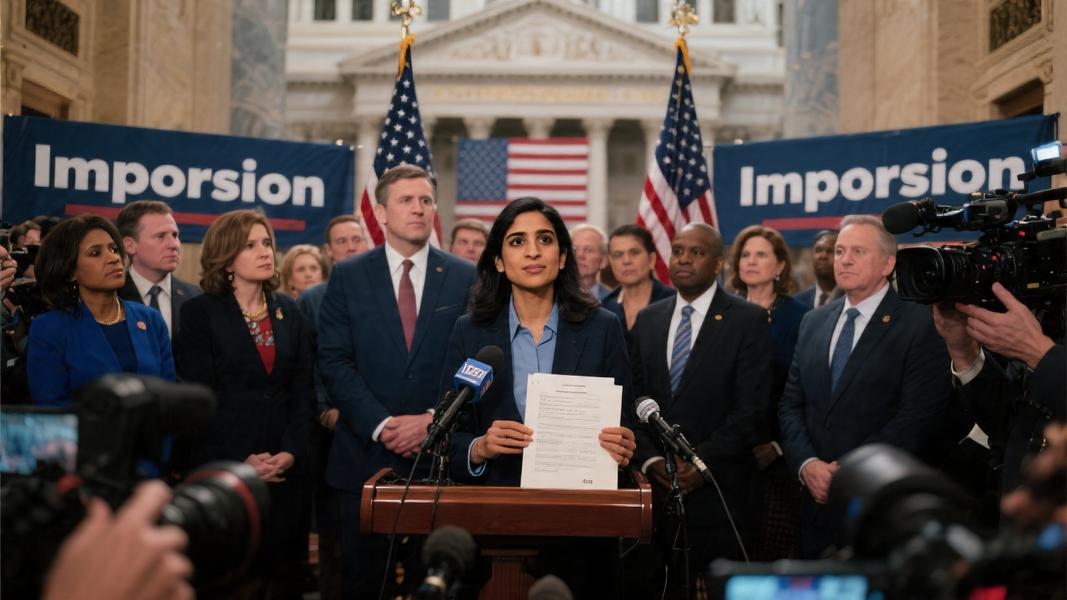
House Democrats have filed articles of impeachment against Defense Secretary Pete Hegseth, citing what they call a pattern of constitutional violations, reckless conduct, and potential war crimes — all unfolding against the backdrop of an unauthorized military campaign in Iran.
The resolution, introduced by Rep. Yassamin Ansari of Arizona, lays out six specific charges against Hegseth in a seven-page document that reads more like an indictment than a legislative filing. It accuses him of ordering or enabling strikes on civilian targets in Iran without congressional authorization, obstructing oversight, abusing his office, and bringing disrepute to the United States Armed Forces. The legislation was co-sponsored by eight House Democrats, including Rep. Shri Thanedar of Michigan, who separately introduced his own impeachment articles against the defense secretary.
A Girls’ School in Minab
The most striking allegation — and the one likely to draw the most international attention — involves a strike on a girls’ school in Minab, Iran. Ansari didn’t mince words. “Pete Hegseth broke his oath to the Constitution, put U.S. troops at grave risk through the unauthorized disclosure of classified information, engaged in abuse of office, and carried out unlawful military actions despite his obligation to refuse — including strikes on civilians and a girls’ school in Minab, Iran,” she said in a press release.
That’s not a peripheral claim. That’s the center of the war crimes allegation. The resolution argues that Hegseth was legally obligated to refuse unlawful orders and that his failure to do so makes him directly culpable for the resulting civilian casualties. Ansari went further, suggesting that President Donald Trump is actively threatening additional war crimes in Iran — and that Hegseth is, in her words, “complicit” in those actions.
Signalgate, Again
Then there’s the other scandal that just won’t die. The impeachment resolution also takes direct aim at what’s become known as “Signalgate” — the now-infamous episode in which Hegseth shared sensitive details about a Yemen airstrike operation in a Signal group chat that included, among others, Vice President JD Vance, Secretary of State Marco Rubio, and — in what may be the most surreal detail in recent government history — the editor-in-chief of The Atlantic.
The inclusion of an unauthorized civilian journalist in a chat discussing active military operations isn’t just embarrassing. Democrats argue it constitutes a serious breach of national security protocol and a reckless endangerment of U.S. service members in the field. The resolution treats it as a standalone article of impeachment — not a footnote.
How bad does it have to get? That seems to be the animating question behind the entire filing. Democrats are pointing to a string of what they describe as compounding failures: the Iran strikes conducted without a formal declaration of war or congressional authorization, the Signal leak, and what the resolution characterizes as systematic obstruction of congressional oversight. Taken together, Ansari and her colleagues argue, these aren’t isolated lapses. They’re a pattern.
The Political Math
Still, the resolution faces a steep and probably insurmountable climb in the current Congress. Republicans control the House, and there’s been no indication that any GOP members are prepared to break with the administration over Hegseth’s conduct. The likelihood of the articles advancing to a full vote — let alone succeeding — is, by most assessments, extremely low.
That said, the political calculus here isn’t purely about winning. Democrats are building a record. They’re forcing colleagues on both sides of the aisle to go on the record about civilian casualties in Iran, about a defense secretary sharing war plans in a group chat with a magazine editor, about whether Congress has any meaningful role left in authorizing the use of military force. The push is, at least in part, about making that discomfort visible and durable.
Ansari, who has been among the most vocal critics of the Iran campaign since it began, framed the effort in stark constitutional terms. The resolution she introduced argues that Hegseth violated his oath not once, but repeatedly — and that Congress has both the authority and the obligation to respond. Whether her colleagues agree, or whether the moment passes quietly in a chamber dominated by the other party, remains to be seen.
But the charges are now formally on the table: unauthorized war, civilian deaths, a leaked group chat, and a girls’ school in a city most Americans couldn’t find on a map — until now. History has a way of caring about these things, even when the present doesn’t.
