
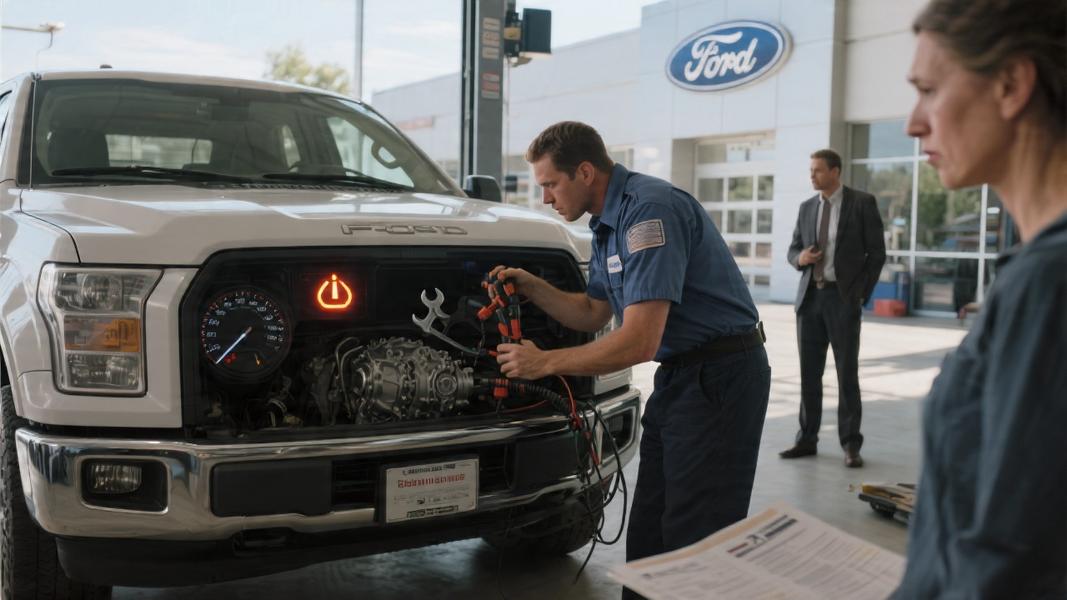
Millions of Ford F-150 owners may be driving a ticking time bomb in their driveways — and federal regulators are no longer willing to look the other way. A sweeping recall of nearly 1.4 million F-150 pickup trucks is now underway, targeting a gearshift defect that can trigger sudden, violent downshifts at highway speeds.
The issue centers on a faulty signal connection between the transmission range sensor and the powertrain control module. When that signal drops, the truck doesn’t coast or stutter — it downshifts without warning, potentially throwing drivers into a dangerous loss of control. Ford has confirmed the recall, acknowledging at least two injuries and one crash tied directly to the defect.
What’s Breaking — and When It Was Built
The affected vehicles are F-150s equipped with a six-speed automatic transmission, manufactured between March 12, 2014, and August 18, 2017. That’s a wide production window — and a lot of trucks still very much on the road. The specific transmission in question, Ford’s 6R80, has been under scrutiny for its Output Shaft Speed sensor, which can suffer signal loss due to degraded electrical connections.
When the OSS sensor fails, the results can range from an unexpected upshift to something far more alarming. At speeds between 35 and 64 mph, Ford’s own internal “shift map” shows the worst-case scenario is a downshift all the way to second gear — a sixth-to-second event that the company has acknowledged may also cause temporary wheel lockup. That’s not a minor glitch. That’s a crash waiting to happen.
How Bad Can It Get?
Pretty bad, apparently. During a federal investigation that opened on January 30, 2026, the National Highway Traffic Safety Administration reviewed more than 140 complaints from F-150 owners. One account stands out: an Ohio driver reported their truck automatically shifted from sixth gear all the way down to first — while traveling at 70 miles per hour. At that speed, a sudden drop to first gear isn’t just jarring. It can spin out a vehicle before a driver has any chance to react.
“Signal loss from the TRS can cause the transmission to shift to neutral, upshift, or downshift unexpectedly,” the NHTSA noted in its investigation summary. The agency’s probe covers roughly 1.27 million model year 2015–2017 F-150s — a separate but related population to the broader recall cohort.
This Isn’t Ford’s First Rodeo With This Problem
Here’s where things get uncomfortable. The NHTSA’s 2026 investigation didn’t emerge from nowhere — it was opened specifically because a prior recall of 552,188 units failed to fully fix the underlying issue. Ford’s earlier recall, designated 24S37, addressed intermittent OSS sensor failure in 2014 F-150s. According to Ford’s own documentation, that defect could cause “an unintended downshift to first gear,” risking rear tire slide and loss of vehicle control.
Still, the fix apparently didn’t hold — or didn’t reach enough vehicles. Regulators went back in, expanded the scope, and now the numbers have ballooned to nearly 1.4 million trucks. It’s a pattern that safety advocates have long criticized: a partial recall, a lingering defect, and then a second wave of regulatory pressure to finish the job.
What Owners Should Do Now
Ford began notifying affected owners starting April 27, directing them to bring their trucks to authorized dealerships for component updates or replacements. The fix, depending on the vehicle, may involve updating the powertrain control module software or replacing degraded electrical components tied to the OSS sensor. Owners can also check their Vehicle Identification Number on NHTSA’s recall database to confirm whether their specific truck is included.
That said, “wait for the letter” isn’t always the safest advice when the defect in question can lock up your wheels on a highway. If you own a 2014–2017 F-150 with a six-speed automatic and you’ve noticed any unusual shifting behavior — hesitation, unexpected lurches, a sudden jolt at speed — don’t wait. Call your dealer.
The F-150 is the best-selling vehicle in the United States, year after year. It’s a truck millions of Americans rely on for work, for family, for long hauls down open roads. The idea that a degraded electrical connection could turn any of those drives into an emergency is exactly why recalls like this one can’t be treated as routine paperwork — because for the driver doing 70 on an Ohio interstate when their truck drops to first gear, it was anything but.
