
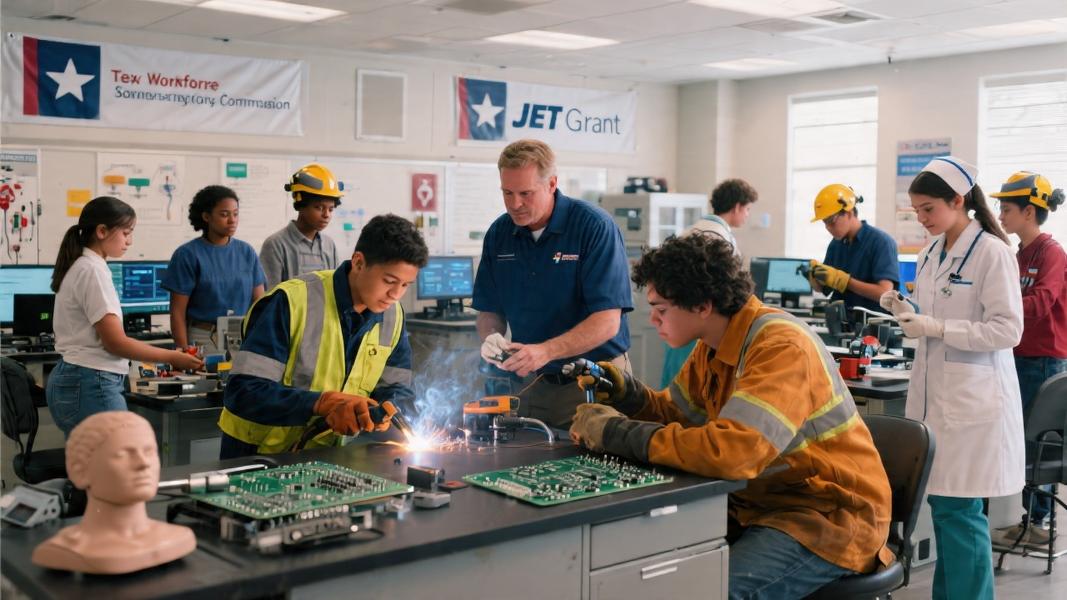
Texas is writing checks — and this time, the beneficiaries are students with welding torches, medical equipment, and career ambitions that don’t require a four-year degree.
Governor Greg Abbott announced more than $1.7 million in Jobs and Education for Texans (JET) grants directed at six schools across Southeast Texas, a move designed to expand career and technical education programs for roughly 410 students in occupations where employers are actively, urgently hiring. The funding comes through the Texas Workforce Commission and represents another push in what Abbott’s office has framed as a long-term commitment to building the state’s workforce from the ground up — not just recruiting companies to relocate here, but making sure there are trained workers waiting when they arrive.
Matching Students to the Jobs That Are Actually Available
The pitch from state officials is pretty straightforward: too many training programs teach skills that look good on paper but don’t match what local employers actually need. JET grants, they argue, are different. TWC Chairman Joe Esparza put it directly, saying the grants are “a great example of aligning industry demand with curriculum, which ensures Texas employers have access to skilled talent to meet their business needs.” Six schools. More than 400 students. In-demand occupations. That’s the formula, at least on paper.
Abbott struck a broader note in his announcement, calling young Texans the state’s “greatest resource” and framing the grants as more than just vocational funding. “Together, we are strengthening our state by investing in our workforce of tomorrow,” he said — the kind of line that reads like a stump speech but carries real policy weight when attached to a $1.7 million check.
How the JET Program Actually Works
Worth explaining, because it’s not as simple as the state handing schools a lump sum and wishing them luck. The JET grant program is funded by the Texas Legislature on a biennial basis, and it’s specifically designed to cover start-up costs — the expensive, front-loaded burden of launching or expanding a career and technical education program. That means equipment, curriculum development, instructor training. The kinds of costs that stop a community college or school district from ever getting a program off the ground in the first place.
Eligible institutions include public community colleges, state and technical colleges, school districts, and open-enrollment charter schools. In other words, it’s built for the institutions closest to the students who need it most — not flagship universities with endowments and donor networks to fall back on.
The Bigger Play: Texas Jobs Council and a Workforce-First Economy
So why Southeast Texas? And why now? Part of the answer is simply geography — the region’s industrial and energy economy creates real demand for technically skilled workers in fields like process technology, healthcare, and advanced manufacturing. But the grants also slot into something larger that Abbott’s office has been building quietly: the Texas Jobs Council, a broader initiative aimed at stitching together education pipelines, employer partnerships, and state investment — including apprenticeships and technical training programs — into something more coherent than the patchwork that exists today.
Abbott has been blunt about what’s driving the strategy. “Texas dominates the nation in job creation thanks to the strength of our young, skilled, diverse, and growing workforce,” he’s said — and whether you read that as boosterism or genuine policy confidence, the numbers on Texas job growth have generally backed it up. The state has led the country in employment gains for years running, and officials are betting that workforce investment is a key reason why.
Still, the Proof Is in the Placement
That’s the catch. Grant announcements are easy. Measuring whether those 410 students actually land jobs — good-paying, stable ones — is harder, and the state doesn’t always make that data easy to track. JET grants have a solid track record in Texas, but the real test of any career training program isn’t what happens in the classroom. It’s what happens six months after graduation, when a student either has a job that uses what they learned or doesn’t.
For now, six Southeast Texas schools are about to get a significant infusion of resources to build something new — or expand something that was already working. For students who can’t wait four years and can’t afford to guess wrong about their career path, that’s not nothing. That might actually be everything.
