
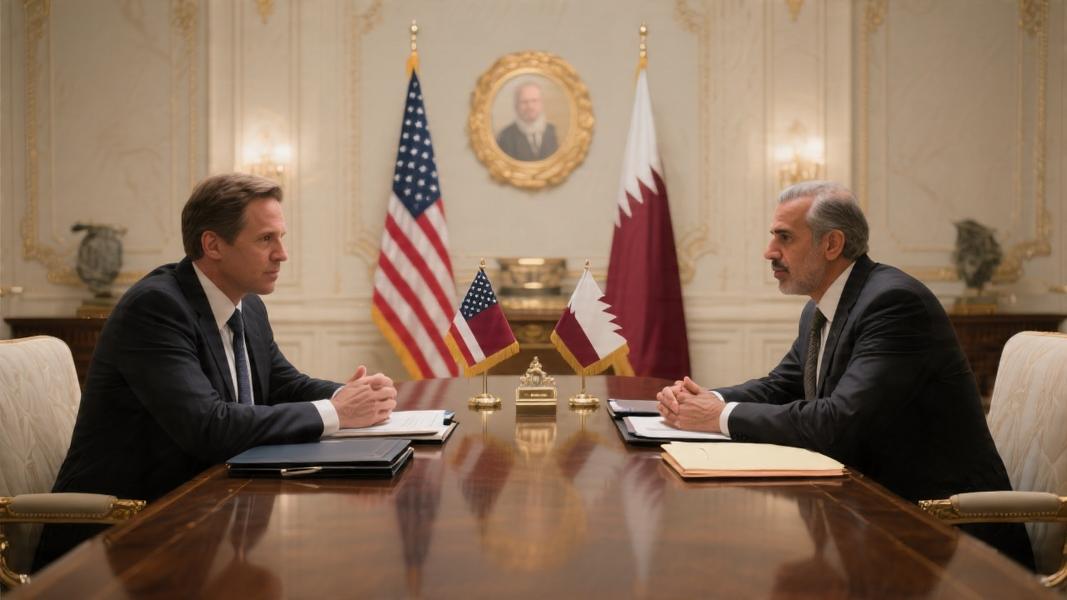
Scott Bessent sat down with Bahrain’s top finance official in Washington on Friday, and the conversation ranged from Iranian missile threats to the future of digital currency — a meeting that underscores just how tangled economic and security interests have become across the Middle East.
Treasury Secretary Bessent met with Bahraini Minister of Finance and National Economy Shaikh Salman bin Khalifa Al-Khalifa on April 19, 2026, at the Treasury Department. The sit-down covered the breadth of the U.S.-Bahrain relationship — military defense, illicit finance, energy stability, and an emerging regulatory conversation around digital assets. It’s the kind of meeting that rarely makes front pages, but often shapes the policies that do.
Gratitude, Deterrence, and a Message to Tehran
Minister Al-Khalifa opened with something that doesn’t happen every day in a finance meeting: a formal expression of thanks for military protection. He acknowledged the United States for its defense of Bahrain against attacks by Iran — a pointed gesture that set the tone for everything that followed.
Bessent didn’t sidestep the issue. He emphasized that Washington is actively working to deter future Iranian assaults and, critically, to ensure that energy markets aren’t further destabilized in the process. That last part matters more than it might sound. The global oil supply is already walking a tightrope, and any escalation in the Gulf has a way of making itself felt at gas stations from Houston to Hamburg.
Still, the conversation wasn’t purely defensive. Bessent also thanked Bahrain for its ongoing cooperation in cracking down on Iranian illicit financing — a quiet but consequential front in the broader pressure campaign against Tehran. Manama has been a reliable partner on that front, and the Secretary made clear that Washington noticed.
Oil Could Flow Again — Fast
Here’s where things get interesting. In a candid moment that has drawn attention beyond the bilateral readout, Bessent revealed the substance of broader conversations he’s been having across the region. “So I’ve been meeting with a lot of my Middle Eastern counterparts, the finance ministers, and they all say that once the streets are open, they can start pumping again within one week,” he said.
One week. That’s a remarkably short runway, and it tells you something about the nature of the current disruption — it’s not a production problem, it’s a security problem. The infrastructure is ready. The question is whether the conditions will be.
Bessent has been doing a significant amount of diplomatic groundwork lately, including addressing global markets and international financial cooperation during the IMF and World Bank spring meetings — a forum where finance ministers from across the world take the temperature of the global economy and, sometimes, quietly hammer out the details that formal summits never quite get to.
Digital Finance Enters the Room
That said, it’s not all geopolitics and crude oil. One of the more forward-looking elements of Friday’s meeting was a discussion about digital finance. Bessent welcomed updates on Bahrain’s efforts to build out a robust regulatory framework for the sector — including, notably, for stablecoins. The Treasury noted the Secretary’s interest in Bahrain’s regulatory approach as the broader international community continues to grapple with how to govern digital assets without either stifling innovation or leaving the door open to abuse.
Bahrain has been quietly positioning itself as a regional hub for fintech and digital finance, and Washington’s willingness to engage on those terms — rather than lecture — suggests a degree of mutual respect that goes beyond the standard ally-and-client dynamic.
A Partnership That Runs Deeper Than Most
The overall framing from both sides emphasized the strength of the U.S.-Bahrain partnership, which — given the host of topics on the table — is perhaps an understatement. Defense cooperation, financial intelligence sharing, energy market coordination, and digital regulatory alignment: that’s not a bilateral relationship, that’s a full-spectrum alliance dressed up in finance minister clothes.
The readout from Treasury was brief, as these things usually are. But read between the lines, and what emerges is a picture of two governments trying to hold a volatile region together with a combination of sanctions, deterrence, and — perhaps most surprisingly — a shared interest in the future of digital money.
If the Middle East’s finance ministers are right, the oil could flow again within a week of stability returning. The harder question, the one no readout answers, is how long stability itself will take.
