
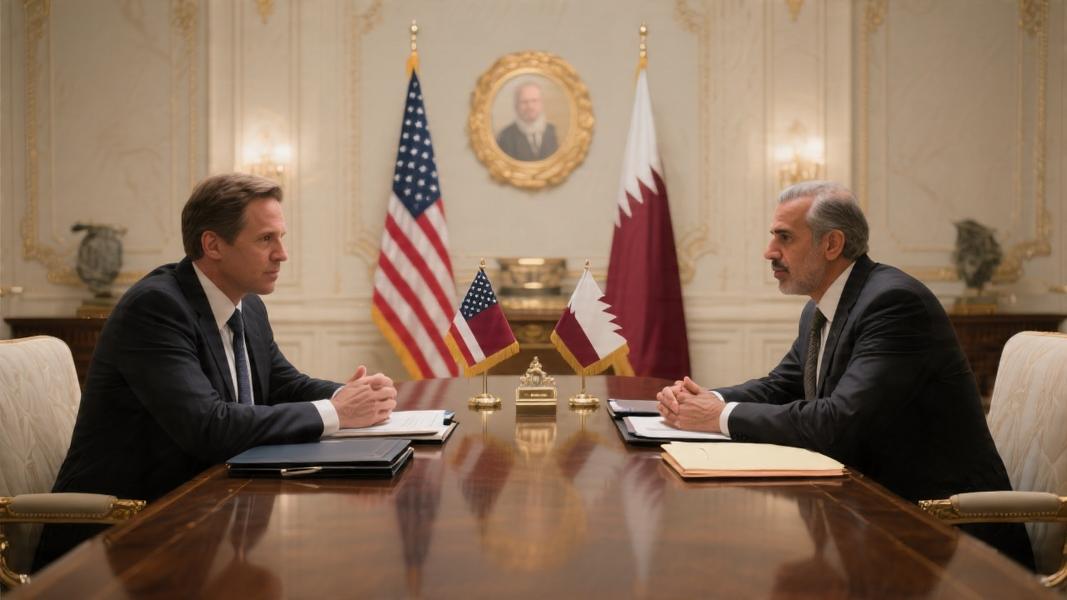
Scott Bessent and South Korea’s top economic official sat down in Washington this week with a packed agenda — and a shared concern about a currency that’s been giving markets heartburn.
Treasury Secretary Bessent met with South Korean Deputy Prime Minister and Finance Minister Koo Yoon-cheol on April 19, 2026, for wide-ranging talks tied to the implementation of the U.S.-Korea Trade and Investment Agreement. The meeting covered everything from critical minerals supply chains to artificial intelligence ambitions — but it was the frank conversation about the Korean won that may carry the most immediate weight for investors and policymakers watching the bilateral relationship.
A Currency Under the Microscope
The won has been a recurring point of tension. Back in January, during an earlier session between the two officials, Bessent flagged that the currency’s recent depreciation wasn’t adding up. The Secretary stated that the slide “was not in line with Korea’s strong economic fundamentals” — a pointed remark that sent a clear signal Washington was paying close attention to Seoul’s exchange rate dynamics.
Fast-forward to April, and the message hasn’t softened much. Bessent and Koo agreed that “excessive volatility in the Korean won is not desirable,” committing to keep the lines of communication open on foreign exchange market developments. It’s the kind of language that sounds diplomatic on the surface but lands with considerable force in financial circles. Volatility language from a sitting Treasury Secretary isn’t thrown around casually.
Still, both sides appear intent on keeping the dialogue constructive rather than confrontational. The January meeting was framed around the full implementation of President Trump’s Korea Strategic Trade and Investment Deal, and this latest session suggests that framework is very much still in motion — with currency stability treated as one of its unspoken prerequisites.
Critical Minerals: A Framework Finally Lands
Beyond the currency talk, there was a notable milestone to announce. The two officials finalized a U.S.-Korea critical minerals framework — something Bessent expressed clear satisfaction over. “Secretary Bessent noted that he was pleased to see the U.S.-Korea critical minerals framework finalized, which will pave the way to deepen critical minerals collaboration between the United States and South Korea, enhance market-based principles, and address non-market policies and unfair trade practices,” according to the Treasury’s readout of the meeting.
That last phrase — “non-market policies and unfair trade practices” — is doing a lot of work in that sentence. It’s widely understood as a reference to China’s dominance in the critical minerals processing sector, where state-backed enterprises have long shaped global supply chains in ways that market-oriented economies struggle to compete with. The U.S. and South Korea, both heavily dependent on secure mineral flows for semiconductors, electric vehicles, and defense manufacturing, have strong mutual incentives to coordinate here.
AI Ambitions and G20 Momentum
South Korea’s push to position itself as a global hub for artificial intelligence also made it onto the agenda. It’s an ambitious goal for a country that already punches above its weight in semiconductor manufacturing and consumer electronics. The two officials discussed how Seoul’s AI strategy could contribute to broader G20 productivity gains and economic growth — a conversation that fits neatly into the current global scramble to set the terms of AI governance and industrial leadership before the technology fully matures.
How seriously Washington takes that ambition remains to be seen. But the fact that it earned a mention in a bilateral Treasury meeting suggests it’s no longer just a domestic talking point for Korean officials — it’s becoming part of the economic diplomacy vocabulary between the two allies.
A Relationship With Real Stakes
Taken together, the April meeting paints a picture of a U.S.-Korea economic relationship that’s intensely active right now — and not without friction. The won concerns, the minerals race, the AI competition for global influence: none of these are simple files that get closed after a single meeting. They require the kind of sustained, institutionalized attention that these back-to-back Bessent-Koo sessions seem designed to provide.
The January and April meetings, occurring just three months apart, signal that both governments consider this relationship too consequential to manage on autopilot — especially in a global environment where trade deals, supply chains, and currencies are all moving targets. Whether the momentum holds will depend on what happens next, both on the trading floors watching the won and in the mining corridors where the next critical minerals deal gets made.
For now, two of the world’s most economically intertwined democracies have agreed, at minimum, on this much: turbulence isn’t good for anyone — and talking is better than not.
