
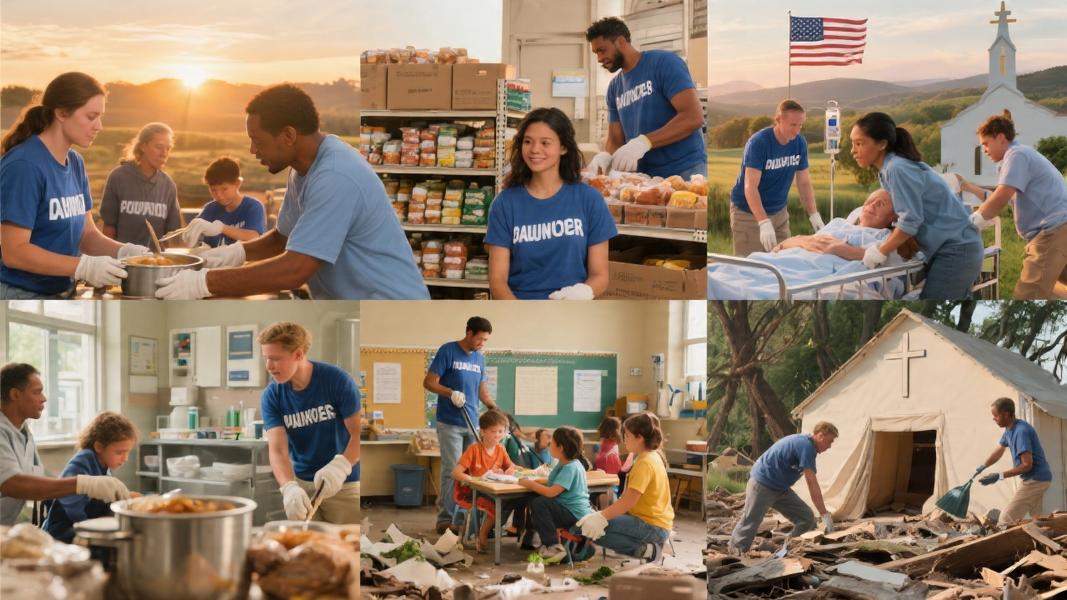
Every April, millions of Americans quietly show up — to food banks, to school yards, to hospital waiting rooms — not because they’re paid to, but because they choose to. That choice is what National Volunteer Week was built to celebrate.
Observed annually during the third week of April, the week-long recognition is one of the country’s most enduring civic traditions. In 2026, it runs from April 19 to 25, coinciding with Global Volunteer Month and drawing renewed attention to the role ordinary people play in holding communities together. As the organizers at Points of Light describe it, the week is “an opportunity to recognize the impact of volunteer service and the power of volunteers to tackle society’s greatest challenges, to build stronger communities and be a force that transforms the world.” That’s a tall order. But the history behind it suggests the ambition isn’t new.
A Half-Century of Showing Up
It started with a presidential pen stroke. In 1974, President Richard Nixon signed Presidential Proclamation 4288, officially establishing National Volunteer Week — a move that, whatever else history says about that particular administration, planted something that’s lasted. The week has grown considerably since then, now encompassing thousands of projects and special events scheduled across the country each April.
Then came the poetry. In 1989, President George H.W. Bush delivered a speech invoking the image of “a thousand points of light” — a call for Americans to volunteer and serve. It wasn’t just rhetoric. The following year, the Points of Light Foundation was created to institutionalize that vision, and it remains one of the most recognized volunteer-advocacy organizations in the country more than three decades later.
What’s Happening in 2026
So what does the week actually look like on the ground? Across the country, it varies wildly — community gardens, literacy drives, neighborhood clean-ups, blood donation events. The scope is as local as a single block and as broad as a national coordinated effort.
One of the more distinctive additions to the 2026 calendar: the Department of Justice will host what it’s calling “Heroism at Home Service Week” — a public celebration and volunteer experience designed to honor public safety professionals. The initiative includes community clean-up and beautification activities centered around courthouses, police departments, and correctional facilities. Details were outlined as part of the administration’s broader Freedom250 commemorations.
That’s a notable expansion of the week’s traditional footprint. Whether it signals a longer-term shift in how federal agencies engage with volunteer programming — or whether it’s more ceremonial than structural — remains to be seen.
Why It Still Matters
Still, the core idea hasn’t changed much since Nixon signed that proclamation. Volunteerism, at its most basic, is a bet on human decency — a belief that people will give time and energy to something larger than themselves without a paycheck attached. That bet, against all odds, keeps paying out.
The week’s staying power across more than fifty years — through recessions, political upheavals, a pandemic — says something. It’s not a flashy program. It doesn’t come with a major federal budget line or a prime-time broadcast. It’s just a reminder, once a year, that the country runs on a lot of unpaid hours.
And maybe that’s the point. Not every civic institution needs a spotlight to function. Some of them just need people willing to show up.
