
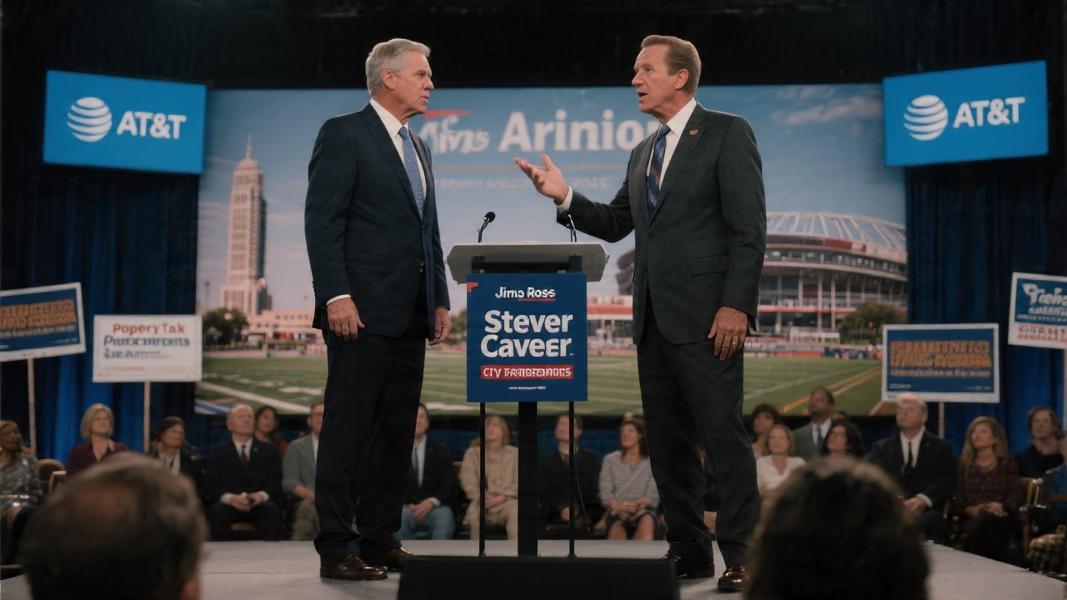
The race for Arlington’s top job is getting personal — and it’s about more than just who runs City Hall.
With early voting underway as of April 20 and Election Day set for May 2, Arlington residents are choosing between two sharply different visions for the city’s future: an incumbent mayor defending a record he calls proof of progress, and a challenger who says that record has a few things the mayor would rather not discuss. The contest between Mayor Jim Ross and challenger Steve Cavender has evolved from a standard municipal race into a pointed, sometimes bruising debate over taxes, transparency, personal finances, and who — if anyone — the mayor is really accountable to.
Ross Makes His Case: “We Are Thriving”
Ross, who was first elected in June 2021, is seeking a third term and doesn’t sound like a man who thinks the race is close. His pitch is straightforward: Arlington is in better shape than it was when he took office, and voters should let him keep going. Reported by CBS News Texas, the mayor has leaned hard into the city’s economic development record and job growth figures. “If it ain’t broke, don’t fix it,” Ross said. “Arlington is anything but broke now. We are thriving.”
Still, not everyone is buying the “thriving” framing — especially when the city recently faced a $25 million budget shortfall and responded, in part, with a property tax rate increase of three cents, pushing the rate to nearly 63 cents per $100 valuation. For the average homeowner, that’s an extra $147 a year. Ross has pushed back on the characterization that the hike reflects mismanagement. He points the finger squarely at the Tarrant Appraisal District, which he says delayed new home assessments and created the fiscal gap. The city did cut $15 million to help close it — and Ross was firm that police, fire, trash, and water services were left untouched.
“What people don’t want to talk about is, for the first three years I was mayor, we lowered property tax,” Ross said. He also points to Arlington’s ranking on WalletHub’s 2025 best-run cities list — second in Texas, behind only Lubbock, and tops in North Texas — as external validation that the city’s fundamentals are sound.
The Challenger: From Supporter to Opponent
Here’s the thing about Steve Cavender — he used to be on Ross’s side. Five years ago, he supported the man he’s now trying to unseat. What changed? Cavender says he watched the mayor operate up close and didn’t like what he saw. “I saw some things I didn’t like, and it was completely different than what he had told everybody he would do before he ran for mayor,” Cavender told reporters, citing what he describes as a lack of transparency and a habit of making decisions without consulting others.
Cavender is no political outsider. He’s a Marine Corps veteran, a member of the Army Reserves, a longtime Arlington resident, and currently serves as board president of the River Legacy Foundation. He also played a significant role in bringing the National Medal of Honor Museum to the city’s Entertainment District — a project that carries real civic weight. According to KERANEWS, he entered the race after being urged to do so by civic leaders and small business owners who were fed up with budget shortfalls and rising taxes.
He also came in with notable backing. Former mayors Jeff Williams and Richard Greene both endorsed him early. “For some time, many Arlington citizens and business owners have been asking for an honest, ethical mayor — someone with real business experience — who puts citizens first. Steve Cavender checks every box,” Williams stated in his endorsement. That’s a pointed message — especially coming from someone who held the office himself.
A Forum That Got Uncomfortable Fast
Whatever civility existed at the start of this race largely evaporated at a recent mayoral forum. The candidates clashed over a range of issues, but the most charged exchange centered on Ross’s reported $174,000 IRS back tax debt. Ross says it’s been paid. Cavender says the existence of the debt at all raises serious questions about fitness to lead a city. “Especially (developments) that are up against residential subdivisions that the mayor’s girlfriend tried to get zoned here recently in south Arlington,” Cavender said at the forum. “We don’t need that type of product in our neighborhoods, in housing, and it needs to stop.”
That quote landed hard. Cavender was connecting two threads at once — the affordable housing debate and what he characterized as a troubling proximity between the mayor’s personal relationships and city zoning decisions. The forum, covered by KERANEWS, made clear that Ross wasn’t going to absorb those shots quietly. He fired back at Cavender’s own financial history and raised the challenger’s ties to former Mayor Jeff Williams and to Moritz Development’s apartment projects — essentially arguing that Cavender’s backers have their own interests in how housing gets developed in Arlington.
Ross also staked out a policy position on affordable housing, advocating for creative solutions like form-based code — a zoning approach that focuses on the physical form of buildings rather than their use, which proponents say can encourage more flexible, context-sensitive development. But that nuance may have gotten lost in what was, by most accounts, a forum that turned personal quickly.
What Voters Are Actually Deciding
So what is this race really about? On the surface, it’s a debate over property taxes, budget management, and housing policy. But underneath, it’s a referendum on something harder to quantify: whether Arlington residents trust the man who’s been running their city for the past five years — and whether the version of events he’s been telling them holds up under scrutiny.
Ross’s argument is essentially that context matters. The tax hike was the appraisal district’s fault. The budget shortfall was managed responsibly. The city is ranked among the best-run in Texas. Give him credit, not grief. Cavender’s counter is simpler and more visceral: a mayor who ran on transparency and fiscal discipline, then raised taxes, accumulated federal tax debt, and allegedly steered zoning decisions toward people close to him, has some explaining to do. As discussed in recent coverage, those questions aren’t going away before Election Day.
Early voting runs through April 28, with the general election on May 2. Arlington is a city of roughly 400,000 people — the largest in the country without a commercial airport, as locals like to note — and whoever wins will be steering it through what promises to be a complicated fiscal and developmental stretch ahead. The stakes, in other words, are real.
Ross may be right that Arlington isn’t broke. But if Cavender has his way, voters will decide that the man who kept it solvent charged a little too much for the service.
