
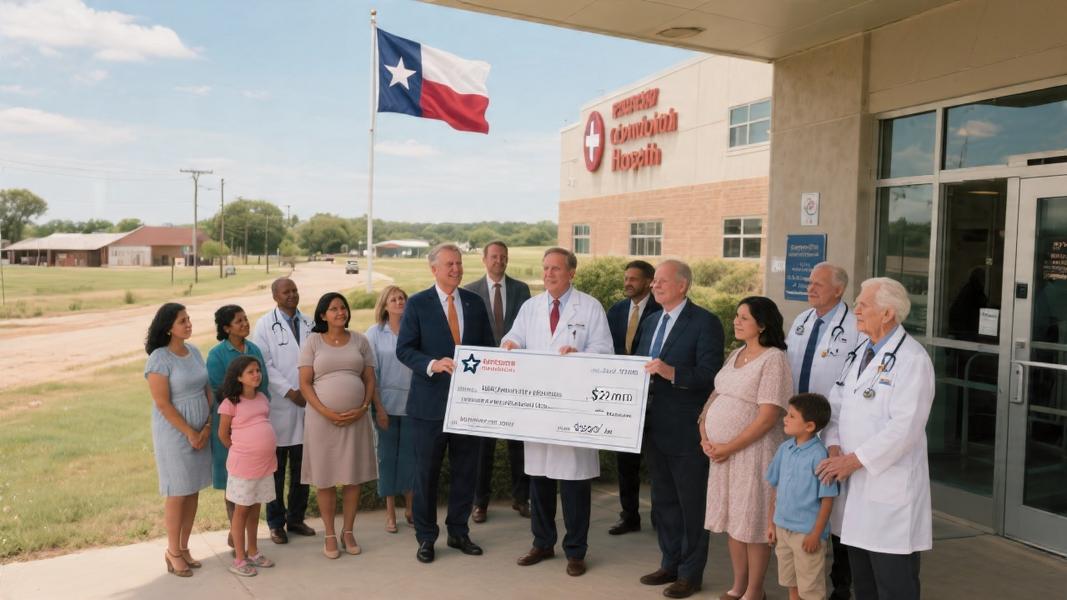
Texas is about to receive a staggering infusion of federal and state dollars aimed at fixing one of the most stubborn problems in American healthcare: keeping rural hospitals alive. And the numbers are hard to ignore.
At the heart of it is a $281 million federal allocation — the largest in the country — flowing to Texas in the first year of the new Rural Health Transformation Program, a five-year, $50 billion national fund. Paired with separate state-level investments, the combined effort represents one of the most aggressive pushes in recent memory to shore up healthcare access for Texans living far from major medical centers. Governor Greg Abbott and U.S. Health and Human Services Secretary Robert F. Kennedy Jr. made the announcement together, a joint appearance that underscored just how politically significant — and urgent — the rural hospital crisis has become.
A Crisis That’s Been Building for Years
Rural hospitals across Texas have been quietly bleeding out for over a decade. Thin margins, physician shortages, aging populations, and long distances from specialty care have pushed dozens of facilities to the brink. Some have already closed. The question isn’t whether this is a problem — it’s whether anyone’s willing to pay to fix it.
Apparently, they are. Texas will receive more than $281 million annually for five consecutive years under the federal program, with funds targeted specifically at strengthening the rural health workforce and expanding access to technology. That’s a sustained commitment, not a one-time check — which matters enormously for communities that have watched short-term grants come and go without lasting impact.
Kennedy didn’t mince words about the stakes. “More than 60 million Americans living in rural areas have the right to equal access to quality care,” he said in a news release. “This historic investment puts local hospitals, clinics, and health workers in control of their communities’ healthcare.” It’s the kind of language that sounds like a campaign slogan — but the dollar figures behind it are real.
Abbott’s $25 Million Hospital Grant Program
Separate from the federal windfall, Governor Abbott announced that the Texas Health and Human Services Commission is making $25 million in grant funding available to eligible hospitals serving rural communities. It’s a more targeted pot of money, designed to expand access to essential services and improve health outcomes at the local level — the kind of granular, on-the-ground investment that federal programs sometimes struggle to reach.
“A strong rural health system is critical to help ensure that Texans across our state get the care they need,” Abbott said. “This $25 million investment will support rural hospitals, expand access to essential services, and improve health outcomes for families in these communities.” He credited the Texas Legislature and healthcare partners for making it happen — a nod to the coalition-building that got the funding across the finish line.
Tackling Cancer in Underserved Communities
Still, money for hospital operations only goes so far. One of the more striking line items to emerge from the 89th Texas Legislature was a $25 million appropriation under House Bill 500 directed to Texas Tech University Health Sciences Center. The funds are earmarked to establish a Rural Cancer Collaborative — a dedicated effort to bring cancer screening, treatment, and research resources to rural and underserved communities that have historically had little access to oncology care.
That’s not a small thing. Rural Texans are disproportionately diagnosed with late-stage cancers, in part because they simply don’t have the same access to early detection that urban residents take for granted. A collaborative anchored at a major health sciences center could change that dynamic — if it’s implemented well and funded consistently beyond the initial appropriation.
The Bigger Picture
What’s notable about this moment isn’t just the dollar amounts — it’s the convergence. Federal funding, state appropriations, and university-level investment are all landing at roughly the same time, creating an opportunity that Texas rural health advocates have been pushing toward for years. Whether the systems exist to absorb and deploy that money effectively is, of course, a separate and genuinely open question.
That’s the catch. Funding announcements and actual outcomes are two very different things. Rural healthcare infrastructure is fragile, and the workforce pipeline — nurses, primary care physicians, specialists willing to practice in small towns — doesn’t rebuild overnight. The money helps. It doesn’t solve everything.
But for the first time in a long time, rural Texas has the attention of people with very large checkbooks. Whether that translates into a hospital that stays open in a county seat two hours from the nearest city — that’s the only metric that will matter to the people who live there.
