
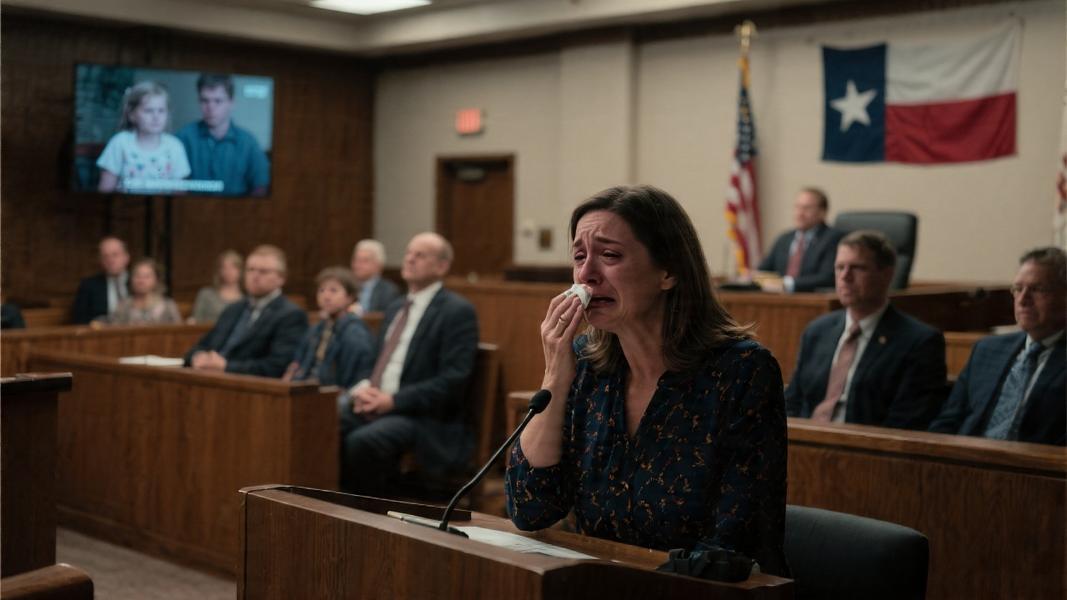
A mother took the stand and said she wants to “tear his a– up.” That mother was talking about her own son — the man who confessed to killing a 7-year-old girl.
Day 9 of the Tanner Horner capital murder trial unfolded Tuesday in a Wise County courtroom with raw testimony from family members, a forensic psychologist, and a medical examiner — all part of the defense’s effort to spare Horner from the death penalty. Horner has already pleaded guilty to the kidnapping and murder of Athena Strand, a 7-year-old girl he abducted on November 30, 2022, while delivering a FedEx package to her family’s home. The only question left for the jury: death, or life without the possibility of parole.
A Mother’s Grief — and Fury
Horner’s mother delivered some of the most emotionally volatile testimony of the trial so far. She described her son’s diagnosis of Asperger syndrome, the meltdowns he suffered as a child, bullying that drove him to self-harm, and what she described as his behavior as a father. But she was not there to defend him — not entirely. “I’m so mad at him. I want to just tear his a– up,” she reported saying through tears. “She was just a baby.”
It’s a complicated thing to watch — a mother trying to humanize a son she’s simultaneously furious with, in front of a jury that holds his life in their hands. She also opened up about her own turbulent past, describing a young adulthood defined by heroin, methamphetamine, heavy drinking, dropping out of school, and working as a stripper. She was deep in that life, she testified, when she discovered she was eight to nine weeks pregnant with Tanner. When asked what she was doing at the time she found out, her answer was blunt: “Drink. Drink heavily,” she said.
That admission is significant. The defense has signaled it intends to argue that fetal alcohol exposure — along with childhood lead exposure and a range of diagnosed mental illnesses — should weigh as mitigating factors in sentencing. It’s a strategy that won’t bring Athena back, and the jury knows that. But mitigating factors don’t have to justify. They just have to matter.
Family Dysfunction, on the Record
Horner’s great-aunt, identified in court as Dottie, also took the stand. She painted a picture of a fractured household — Tanner and his father bouncing between relatives, a father with drug problems and stretches in jail, and a boy she described as rambunctious. It’s the kind of childhood that defense attorneys point to not as an excuse, but as a context the jury is legally required to consider, noted the Star-Telegram.
Still, context is a hard sell when the crime involves a first-grader.
What the Science Says — and Doesn’t
The defense also called Dr. John Edens, a psychologist and professor at Texas A&M University, to testify about developmental disorders including autism spectrum disorder — the condition formerly classified as Asperger syndrome — as well as personality disorders and the risk factors associated with violent behavior in prison populations. His testimony appeared aimed at two goals: helping jurors understand Horner’s neurological profile, and making the case that a man with his diagnoses could be managed within the prison system rather than executed.
How much weight will the jury give that? Hard to say. Expert testimony in capital cases can cut both ways — it can humanize a defendant or, depending on the jury, simply feel like a clinical detour from the horror at the center of the case.
‘I Think She Did’
Earlier in the trial, Dr. Jessica Dwyer, a medical examiner, testified that Athena Strand died as a result of blunt force injuries, smothering, and strangulation. She was asked directly whether she believed the child suffered. “Yes, I think she did,” she testified. Three words. The courtroom didn’t need more than that.
Athena was taken from her family’s Wise County home on the day Horner delivered a package there. She was seven years old. Horner later confessed to both the abduction and the killing. The guilty plea removed any question of whether he did it. What remains — the only thing the jury is now deciding — is whether he lives or dies for it.
The defense is expected to continue presenting mitigating evidence in the days ahead, including additional testimony about Horner’s autism spectrum disorder diagnosis and the circumstances of his upbringing. Prosecutors, meanwhile, have already laid out the facts of what happened to Athena in methodical, unflinching detail. The jury has heard both. They’ll carry all of it into the deliberation room.
A mother who loves her son and wants to tear him apart. A little girl who, according to the doctor who examined her, suffered before she died. Somewhere between those two realities, twelve people will have to make a decision that no formula — legal, scientific, or moral — can make for them.
