
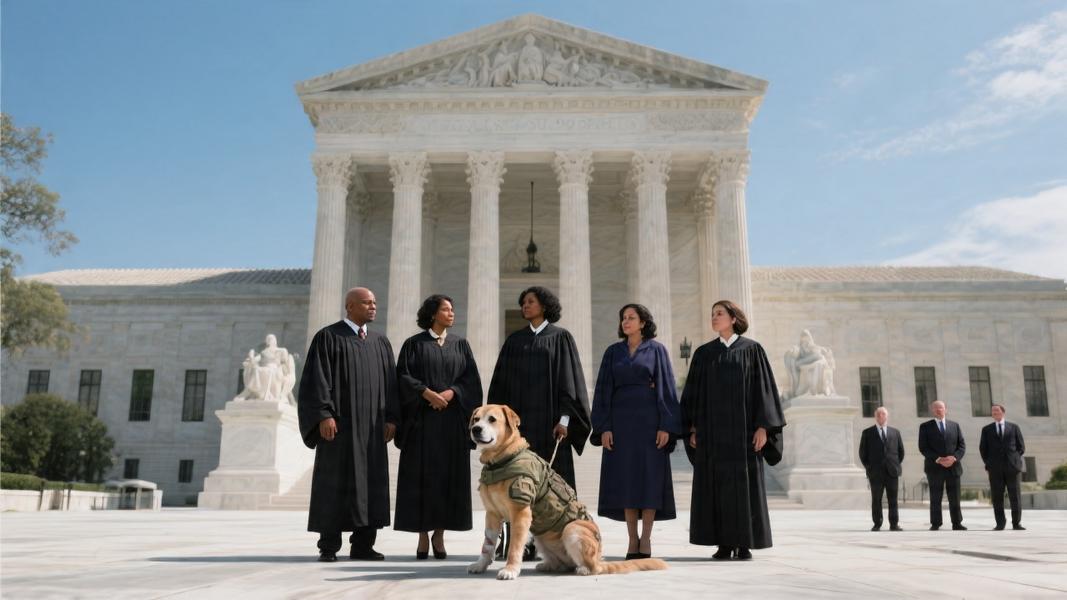
The courts have been busy — and for thousands of American veterans, that’s finally starting to mean something in their favor.
In a string of landmark rulings and hard-fought legal battles stretching from state courthouses to the U.S. Supreme Court, veterans and their families are winning cases that once seemed like long shots. The decisions touch everything from contractor negligence on a warzone airfield to employment discrimination back home on American soil. Taken together, they signal a broader legal reckoning over how this country treats the men and women it sends into combat — and what happens when the system fails them afterward.
A Wounded Soldier, a Private Contractor, and a 6-3 Decision
Start with Army Specialist Winston Hencely. In 2016, he was wounded in a suicide bombing at Bagram Airfield in Afghanistan — one of the deadliest and most strategically sensitive U.S. military installations in the region. He survived. But then came the legal fight. Hencely sued Fluor Corporation, the private contractor operating at the base, alleging the company’s conduct contributed to the conditions that allowed the attack. For years, that lawsuit went nowhere.
Until the Supreme Court stepped in. In a 6-3 ruling, the justices revived Hencely’s case, allowing it to proceed — a decision that drew a sharp line between military command decisions and contractor misconduct. As the Court noted, “Hencely, by contrast, sued Fluor for conduct that was not authorized by the military and was allegedly contrary to federal instructions.” In other words, if a contractor goes rogue — or negligent — the government’s immunity shield doesn’t automatically extend to them. That’s a significant carve-out, and one that could reshape how future litigation against warzone contractors proceeds.
Back Home, Another Battle
But surviving the war is only half the fight, isn’t it? Plenty of veterans come home and walk straight into a different kind of conflict — one fought in HR offices and courtrooms instead of forward operating bases.
Retired Capt. LeRoy Torres knows that better than most. Torres served in Iraq and returned with serious injuries. When he sought accommodations from his employer — the Texas Department of Public Safety — he was allegedly met with discrimination rather than support. The case wound its way through the courts for years, raising a foundational question: can a private individual actually sue a state employer for violating the Uniformed Services Employment and Reemployment Rights Act? The Supreme Court examined that very question in Torres v. Texas Department of Public Safety, wading into the murky waters of state sovereignty and federal employment protections.
A Nueces County jury ultimately awarded Torres $2.49 million in 2023 for the discrimination he faced. His attorneys described the verdict as a pivotal moment — not just for Torres personally, but for every service member who has ever been penalized professionally for the injuries they sustained in uniform.
Nine Thousand Veterans. One Unanimous Decision.
Then there’s the ruling that may carry the most sheer weight — in raw numbers, at least. On June 12, 2025, the Supreme Court ruled unanimously in favor of more than 9,000 combat-disabled veterans who had been denied full retroactive Combat-Related Special Compensation. These weren’t fringe claimants. These were men and women who qualified for benefits under existing law and were still, somehow, shortchanged.
The National Veterans Legal Services Program, which celebrated the decision, called it a long-overdue correction. A unanimous ruling from the Supreme Court is rare enough under any circumstances. Getting nine justices to agree — in this political climate, on any topic — borders on extraordinary. The fact that it happened here, for a group of veterans who’d been quietly waiting years for money they were owed, carries its own kind of weight.
What It All Adds Up To
Still, it would be too easy to read these cases as proof that the system works just fine. Each of these veterans spent years — in some cases, nearly a decade — fighting legal battles that never should have been necessary in the first place. The wins are real. So is the exhaustion it took to get there.
That’s the catch. The courtroom victories are meaningful, but they’re also a reminder of how many veterans lack the legal resources, the stamina, or simply the luck to push a case all the way to the nation’s highest court. For every Winston Hencely or LeRoy Torres who makes it into a published ruling, there are countless others whose cases never get that far.
The law, it turns out, is catching up. Slowly, unevenly — but catching up. Whether the institutions that veterans depend on will follow suit is the question that still doesn’t have a clean answer.
