
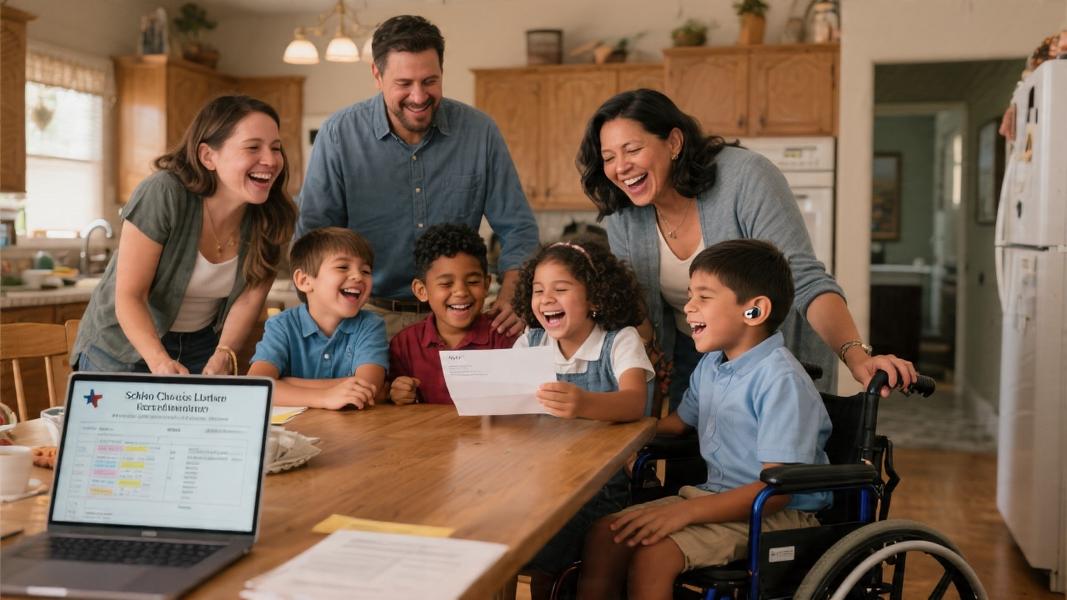
More than 42,000 Texas families got some rare good news this week — a letter telling them their children had been selected in the state’s first-ever school-choice lottery.
Acting Comptroller Kelly Hancock announced Wednesday that more than 42,600 students will receive award notices under the newly launched Texas Education Freedom Accounts program — a sweeping initiative that allows public funding to follow students into private, charter, or home-school settings. It’s the first tangible payout from what supporters call a historic shift in how Texas educates its children, and critics call a slow-motion defunding of public schools.
Who Gets In First
This initial round wasn’t open to everyone. The program’s first phase was deliberately structured to prioritize the most vulnerable students — specifically, children with qualifying disabilities from households at or below 500% of the federal poverty level, as well as their siblings. That’s a wide income net, but the intent is clear: get money to families who’ve long felt left behind by a one-size-fits-all system, as reported by local Houston outlets covering the announcement.
The breakdown of who actually made it in tells its own story. Roughly 63 percent of first-round recipients are students with qualifying disabilities — most of them verified through an active Individualized Education Program, or IEP. The remaining 37 percent are siblings riding in alongside them, a provision designed to keep families from having to split their kids across different schools just because one child has a disability and another doesn’t. That’s a detail that sounds small until you’re the parent managing it.
The Demand Is Coming From Big Cities
Where are these families coming from? Overwhelmingly, the state’s largest urban and suburban districts. Thousands of applications poured in from families zoned to Houston, Dallas, and other major metropolitan school systems — a signal, according to analysts tracking the program, that dissatisfaction with large district schools is a significant driver of demand. Whether that dissatisfaction reflects legitimate unmet needs for special education services or broader ideological preferences for private schooling is, depending on who you ask, very much an open question.
Still, the income data is worth sitting with for a moment. 51 percent of award recipients come from families at or below 200% of the federal poverty level, according to figures cited by the state comptroller’s office. That’s a number program architects will lean on hard when defending the initiative against charges that school vouchers primarily benefit wealthy families who were already paying for private education.
What Comes Next
That’s the catch, isn’t it? The first round was always going to be the easiest sell — disabled kids, low-income households, siblings kept together. Future rounds are expected to broaden eligibility significantly, and that’s when the political fight is likely to get louder. Texas Democrats and many public school advocates have argued from the start that the program will eventually siphon billions from traditional public schools, which still educate the vast majority of the state’s nearly six million students.
For now, though, 42,600 families have a decision to make — and for many of them, it’s the first real choice they’ve ever had. Whether the system built to support that choice can actually deliver is a question Texas is only beginning to answer.
