
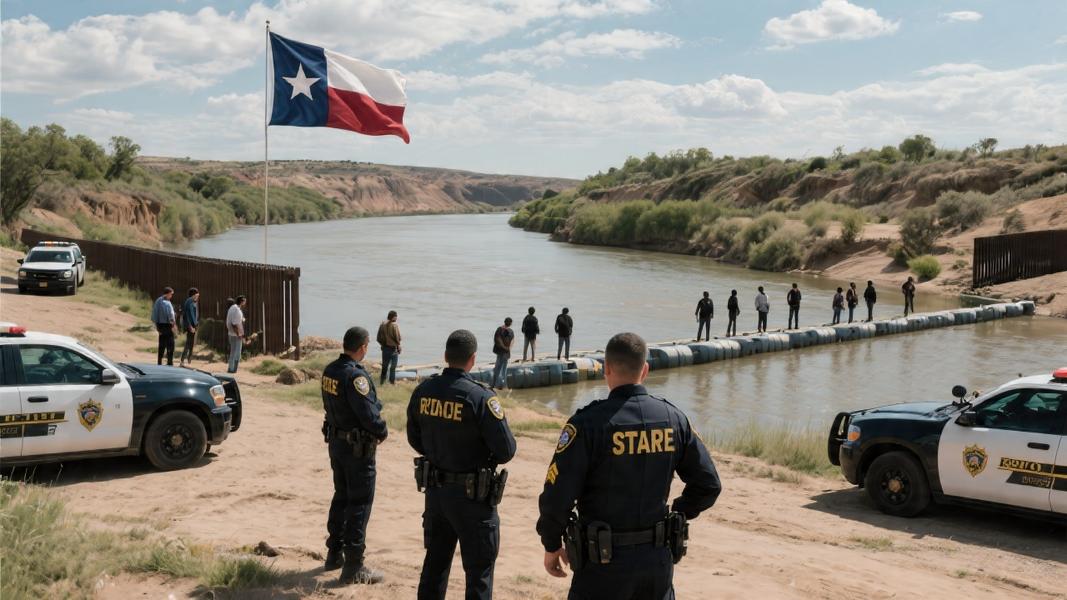
Texas has been fighting to enforce its own immigration law for nearly two years — and the legal battle over whether it can is still far from over.
Senate Bill 4, signed into law as part of Governor Greg Abbott’s sweeping Operation Lone Star initiative, represents one of the most aggressive state-level attempts to police immigration in modern American history. It criminalizes illegal entry into Texas from Mexico, imposes state criminal penalties on noncitizens who cross without authorization, and — most controversially — empowers state and local law enforcement to arrest, detain, and physically remove undocumented immigrants. That last part is what’s kept federal courts busy ever since.
What SB4 Actually Does
Strip away the politics for a moment. At its core, SB4 does something no state law has quite attempted at this scale: it essentially hands Texas its own deportation authority. Under the statute, a noncitizen who unlawfully enters or reenters Texas from Mexico can be prosecuted under state law — not just federal — and courts can order their removal to Mexico upon conviction. It’s a direct challenge to the long-standing principle that immigration enforcement is a federal responsibility, full stop.
Critics didn’t wait long to respond. Civil rights organizations, including the ACLU of Texas, immediately challenged the law in federal court. A district court judge agreed with them, granting a preliminary injunction that put SB4 on ice. “With today’s decision, the court sent a clear message to Texas: S.B. 4 is unconstitutional and criminalizing Black, Brown, Indigenous, and immigrant communities will not be tolerated,” the ACLU of Texas declared at the time.
A Whiplash Legal Journey
That injunction didn’t hold. At least not cleanly. The Fifth Circuit Court of Appeals, one of the most conservative federal appellate courts in the country, initially blocked Texas from enforcing SB4 while it weighed the law’s legality — a small but significant win for challengers. Then, in a 10-7 decision, the same court reversed course and lifted the block entirely, ruling that the parties suing Texas lacked legal standing to bring the case in the first place. The constitutionality of the law? The court didn’t touch it.
Judge James Ho, writing for the majority, took things a step further — framing Texas’s position not just as a policy preference but as a sovereign response. He argued that Texas has the right to respond to what he called “an invasion.” That word choice was deliberate, and it landed like a grenade in an already combustible debate.
Then came the Supreme Court. On March 19, 2024, in a 6-3 ruling, the justices denied applications to vacate the Fifth Circuit’s stay of the district court’s injunction — effectively allowing SB4 to remain operative while litigation continued. Justice Sonia Sotomayor dissented sharply, warning that the decision “invites further chaos and crisis in immigration enforcement.” She wasn’t alone — two other justices joined her objection.
Still No Final Answer
Here’s the thing: after all of that — the injunctions, the stays, the emergency Supreme Court filings — nobody has actually ruled on whether SB4 is constitutional. Not definitively. The Fifth Circuit’s 10-7 decision punted on the question by finding a standing problem instead. The Supreme Court’s March ruling was procedural, not substantive. The core legal question — can a state criminalize illegal entry and order removals when federal law already governs both? — remains officially unanswered.
That’s not an accident. It’s how constitutional litigation often works, moving in fits and starts, through procedural detours that can delay a final ruling for years. But in the meantime, the law’s on-the-ground consequences are anything but abstract. State and local officers in Texas have been revisiting the law’s enforcement framework as recently as January 2026, when the Fifth Circuit took up the question of SB4’s legality once more — a sign that this fight is entering yet another chapter.
The Bigger Picture
What makes SB4 significant beyond Texas is what it signals. If the courts ultimately uphold it, it would effectively license other states to build their own parallel immigration enforcement systems — a prospect that alarms immigration attorneys and civil liberties groups across the country. If it falls, it reaffirms federal supremacy over immigration in a way that could constrain future state-level efforts for a generation.
Neither outcome seems imminent. Courts are still working through the procedural thicket. Texas is still pushing. Challengers are still fighting. And somewhere in the middle, real people — many of them undocumented, many with deep roots in border communities — are living under the uncertainty of a law that may or may not apply to them on any given day.
That’s not a legal abstraction. That’s someone’s life. And the courts are still deciding what to do with it.
