
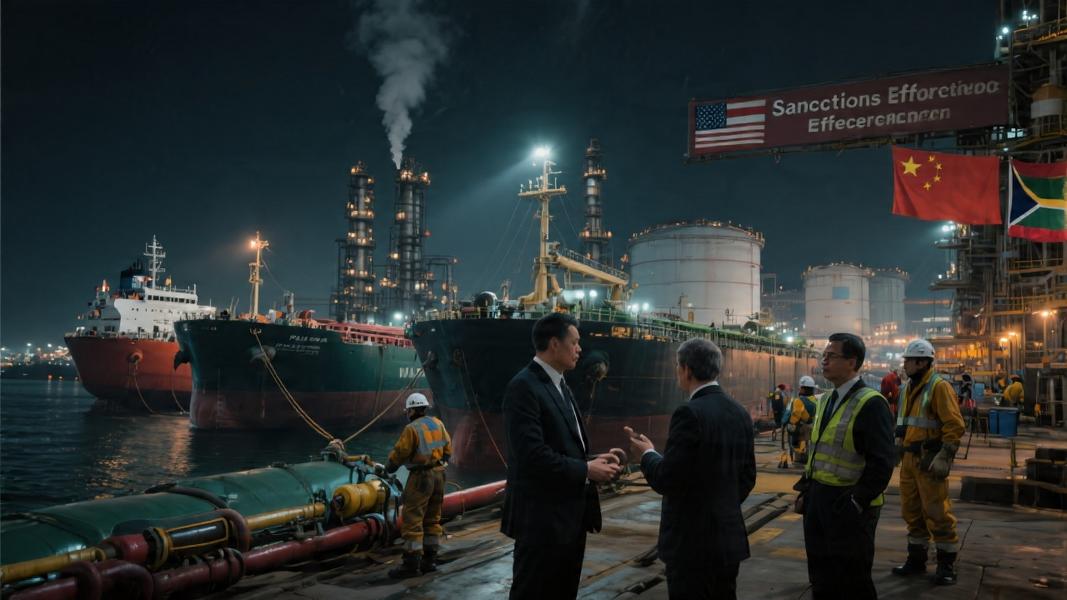
The United States just tightened the screws on Iran’s oil economy — hard. The Treasury Department’s sanctions office hit a major Chinese refinery and roughly 40 ships with new designations on Tuesday, in what officials are calling part of a sweeping financial campaign to strangle Tehran’s revenue streams.
The Office of Foreign Assets Control, known as OFAC, sanctioned Hengli Petrochemical (Dalian) Refinery Co., Ltd. — one of Iran’s single largest crude oil customers — alongside approximately 40 shipping firms and vessels tied to Iran’s so-called shadow fleet. The action is part of the maximum economic pressure campaign operating under NSPM-2, a national security directive that has now produced sanctions against more than 1,000 Iran-related persons, vessels, and aircraft since February 2025 alone. That’s not a typo.
A Chinese Refinery at the Center of It All
Hengli Petrochemical isn’t some minor player. According to Treasury, the Dalian-based company received over five million barrels of Iranian crude oil since at least 2023, delivered by shadow fleet tankers with names like BIG MAG (IMO 9263215), GALE (IMO 9294240), and ARES (IMO 9174397). The money didn’t just line corporate pockets — Treasury says hundreds of millions of dollars flowed back through Sepehr Energy Jahan Nama Pars Company directly to Iran’s Armed Forces. So when you fill up at a pump somewhere in coastal China, the chain of custody gets complicated fast.
Secretary of the Treasury Scott Bessent framed it bluntly: “Economic Fury is imposing a financial stranglehold on the Iranian regime, hampering its aggression in the Middle East, and helping to curtail its nuclear ambitions,” he stated in Tuesday’s release. It’s the kind of line that sounds like it was written for a press conference. But behind it is a genuinely expansive enforcement action with real teeth.
The Ships, Named and Shamed
OFAC didn’t stop at Hengli. The agency sanctioned 19 specific shadow fleet vessels accused of moving billions of dollars’ worth of Iranian petroleum products across global waterways. Among the most notable: the LISBOA (IMO 9257711), which allegedly transported over 2.5 million barrels of naphtha to the United Arab Emirates. Another vessel, LPG SEVAN (IMO 9177806), reportedly moved 750,000 barrels to Bangladesh. These aren’t small hauls.
Then there’s a separate set of 12 vessels and their owners, sanctioned specifically for ferrying Iranian petroleum to fund ballistic missile programs — with U.S. assets frozen and transactions prohibited. Ships like OCEAN KOI (IMO 9255933) and NIBA (IMO 9046784) have been active since at least 2025, hauling Iranian high-sulfur fuel oil, condensate, and LPG to buyers who’d rather not ask too many questions about the origins.
Alongside the vessels, OFAC designated 19 shipping companies operating in Iran’s petroleum sector — including Lisboa Shipping Company Limited and Anka Energy and Logistics Company — blocking any U.S.-held assets and cutting them off from the American financial system entirely.
How Does the Shadow Fleet Actually Work?
Good question. Iran’s shadow fleet is, by design, built to be invisible. It relies on hundreds of aging tankers operating under flags of convenience — think Panama, the Marshall Islands — with deliberately obscured ownership structures layered across multiple jurisdictions. Vessels routinely disable their AIS transponders, the maritime equivalent of turning off your phone’s GPS, and conduct ship-to-ship transfers in international waters to muddy the paper trail. By the time the oil hits a Chinese refinery, tracing it back to Iran requires the kind of forensic digging that most commercial banks simply aren’t equipped — or incentivized — to do.
China’s so-called teapot refineries — independent, smaller-scale processors operating outside the major state energy companies — have become key enablers. They’re less exposed to Western financial systems, less worried about secondary sanctions risk, and very willing to buy discounted Iranian crude no one else will touch. It’s a system that has allowed Tehran to export billions in oil even as official sanctions have mounted for decades.
Still, Cracks in the Net
Still, enforcement has its limits. Despite the scale of Tuesday’s action, at least 26 shadow fleet vessels have reportedly bypassed U.S. naval pressure in recent weeks, continuing to export Iranian oil using identity-switching tactics and so-called “dark tracking” — periods when vessels go completely off the grid. The persistence of these exports raises a fair question: how much can sanctions actually accomplish when the buyers, the shippers, and the flag states are all operating outside Washington’s direct reach?
That’s the catch. Sanctions are a tool, not a solution. They impose real costs — on the companies named, on the financial institutions that might do business with them, on Iran’s ability to convert oil into usable hard currency. But the shadow fleet didn’t emerge overnight, and it won’t disappear because forty more ships got added to a list in Washington. Tehran has spent years building redundancy into this network precisely because it knew the pressure would keep coming.
What Comes Next
The Biden administration imposed its own waves of Iran-related sanctions. The Trump administration, now back in office and leaning hard into maximum pressure rhetoric, appears intent on going further and faster. More than 1,000 designations in roughly three months suggests a pace that’s aggressive even by historical standards. Whether that translates into meaningful behavioral change in Tehran — or in Beijing — remains, as it always has, the harder question.
As one senior Treasury official might put it off the record: the goal isn’t just to squeeze Iran. It’s to make every company, every ship captain, every flag registry in the world do the math and decide the business isn’t worth the risk. Sometimes that works. Sometimes the math comes out different — and the oil moves anyway.
