
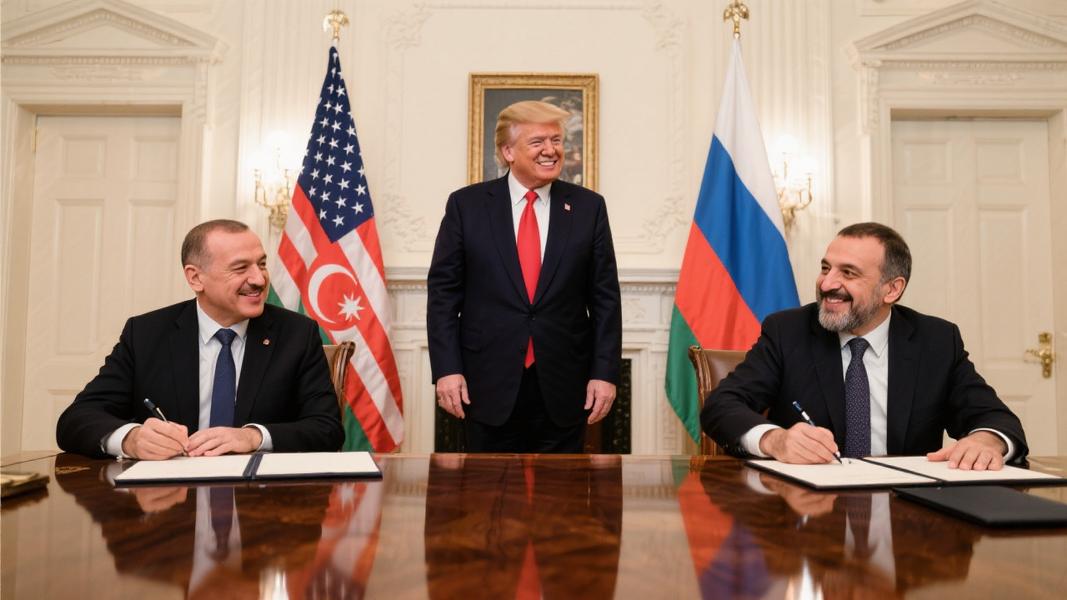
In a stunning breakthrough, President Donald Trump has brokered an historic peace agreement between longtime adversaries Azerbaijan and Armenia, ending a bitter conflict that has spanned more than three decades. The deal, signed at the White House on August 8, 2025, includes the establishment of a transit corridor to be named the “Trump Route for International Peace and Prosperity.”
The landmark accord marks a dramatic shift in regional dynamics, as both countries appear to be pivoting away from Moscow’s sphere of influence and toward the West. It also adds to Trump’s growing portfolio of international peace deals secured during his presidency.
Decades of Conflict End with White House Ceremony
“For more than 35 years, Armenia and Azerbaijan have fought a bitter conflict that resulted in tremendous suffering for both nations… Many tried to find a resolution… and they were unsuccessful. With this Accord, we’ve finally succeeded in making peace,” President Trump declared at the signing ceremony, according to a White House statement.
The agreement wasn’t just ceremonial. It included substantive economic deals covering trade, transit, energy, infrastructure, and technology development in the South Caucasus region. Perhaps most notably, it establishes the Trump Route — a major transit corridor that will operate under Armenian law while being subleased to a consortium for development and management, as reported by European media.
Trump later boasted on his Truth Social platform that “Many leaders have tried to end the war, with no success, until now, thanks to Trump.” It’s the kind of self-congratulatory remark that has become his trademark — but in this instance, even the leaders involved seem to agree with his assessment.
Regional Leaders Heap Praise on Trump’s Mediation
Azerbaijani President Ilham Aliyev was effusive in his praise during the ceremony. “It’s a day which will be remembered by the people of Azerbaijan with a feeling of pride and gratitude to President Trump… Within several months, he managed to put an end to conflicts in Asia, in Africa, and now in South Caucasus — what we could not achieve for more than 30 years,” Aliyev said, adding: “We will turn the page of standoff, confrontation, and bloodshed, and provide a bright and safe future for our children.”
Armenian Prime Minister Nikol Pashinyan struck a similar tone. “Today, we have reached a significant milestone in Armenian and Azerbaijani relations. We are laying a foundation to write a better story than the one we had in the past,” he remarked. “This breakthrough would simply not have been possible without President Trump’s personal engagement and his resolute commitment to peace.”
During the signing, Trump appeared touched by having the corridor named after him, though he insisted the honor was unexpected. “This declaration establishes what they are calling a great honor for me. I didn’t ask for this. The Trump route for international peace and prosperity, which is a special transit area that will allow Azerbaijan to get full access to its territory of Nchvien while fully respecting Armenia’s sovereignty,” the president explained.
The ‘Trump Route’ — A Geopolitical Game-Changer?
What exactly is this Trump Route that’s at the heart of the agreement? In essence, it’s an innovative solution to a decades-old problem. The corridor will allow Azerbaijan full access to its exclave of Nakhchivan while maintaining Armenian sovereignty over the land. The arrangement involves an exclusive US-Armenian partnership, with American companies handling infrastructure development and a potential lease of up to 99 years.
But there’s more at stake than just transit rights. The decision to sign this agreement in Washington rather than Moscow signals a significant shift in regional alignment. Both countries appear to be consciously reducing their dependence on Russia, which has traditionally wielded considerable influence in the South Caucasus.
This realignment comes at a time when Russian influence is already waning in the region, and Moscow has reportedly been conducting disinformation campaigns against Armenian leadership. Is this yet another sign of Russia’s declining global stature? Many regional experts seem to think so.
A Growing Peace Portfolio
The Armenia-Azerbaijan deal adds to what the White House is now calling Trump’s “peace portfolio” — a growing list of international conflicts he has helped resolve. According to White House publications, these include agreements between Cambodia and Thailand, Israel and Iran, Rwanda and the Democratic Republic of the Congo, India and Pakistan, Egypt and Ethiopia, and Serbia and Kosovo, along with the Abraham Accords from his previous term.
“President Trump is the President of Peace,” the White House has declared, leaning into a narrative that seems designed to reshape the president’s legacy as his term progresses.
Critics might question the long-term viability of some of these agreements, and whether they address the underlying issues that sparked conflicts in the first place. Still, even skeptics acknowledge that getting warring parties to the negotiating table — let alone signing agreements — represents tangible progress.
As for the Armenia-Azerbaijan peace, its ultimate legacy remains to be written. But for now, in a region that has known little but conflict for generations, even an imperfect peace represents something precious: hope.
