
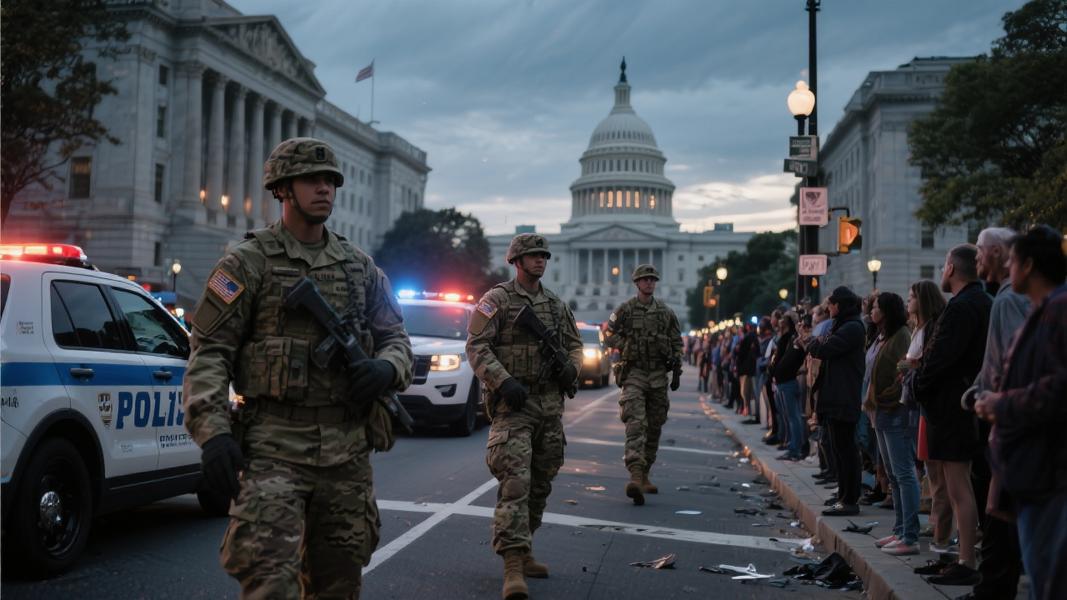
In a dramatic escalation of federal power, President Donald Trump has ordered the mobilization of the National Guard to combat what he describes as an “epidemic of crime” in Washington D.C., effectively seizing control of law enforcement in the nation’s capital.
The presidential memorandum, signed Monday, directs the Secretary of Defense to activate D.C. National Guard members “in such numbers as he deems necessary” to restore order in the city. Trump’s action comes amid his claims that local authorities have “lost control of public order and safety” in the District, announced through both official channels and social media.
Citing Violence Near Corridors of Power
“The local government of the District of Columbia has lost control of public order and safety in the city,” Trump wrote in the memorandum, citing several high-profile incidents, including the May murders of two embassy staffers, a Congressional intern fatally shot near the White House in June, and an administration staffer who was “mercilessly beaten by a violent mob” just days ago. The document states that these incidents demonstrate the District’s violent crime rate “exceeds that of some of the most dangerous places in the world.”
The President’s decision represents an extraordinary intervention in local governance. “As President of the United States and Commander in Chief of the District of Columbia National Guard, it is my solemn duty to protect law-abiding citizens from the destructive forces of criminal activity,” Trump declared in the memorandum text.
How long will troops remain on D.C. streets? According to the order, the National Guard mobilization will continue “until I determine that conditions of law and order have been restored in the District of Columbia.” The directive also authorizes coordination with state governors to bring in additional Guard members if deemed necessary.
Plans to Relocate Homeless Population
Beyond deploying troops, Trump has outlined controversial plans to forcibly relocate homeless individuals from the capital. “The Homeless have to move out, IMMEDIATELY. We will give you places to stay, but FAR from the Capital. The Criminals, you don’t have to move out. We’re going to put you in jail where you belong,” Trump told Fox News on Monday.
The President’s frustration with D.C. crime has been building for weeks. When speaking to reporters in the Oval Office last week, Trump railed against what he described as a “ridiculous” level of crime in the nation’s capital, particularly highlighting the recent assault on a former Department of Government Efficiency (DOGE) staffer earlier this month.
Military analysts suggest the deployment could involve up to 1,000 National Guard troops as early as the end of August. The move effectively “federalizes” law enforcement in the District, creating an unprecedented situation where the President directly controls policing in the nation’s capital.
Constitutional Questions Emerge
Legal experts are already questioning the constitutional basis for such an extensive federal intervention. While presidents have historically deployed the National Guard in D.C. during specific crises, the open-ended nature of this mobilization and the explicit takeover of local policing functions raises significant separation of powers concerns.
Still, Trump appears unmoved by such objections. “I direct the Secretary of Defense to mobilize the District of Columbia National Guard and order members to active service,” the memorandum reads, leaving little ambiguity about the President’s intentions.
This marks perhaps the most significant federal intervention in D.C. governance since the 1968 riots following Martin Luther King Jr.’s assassination. The difference? That deployment had a clear endpoint. This one continues “until I determine” order is restored — a timeline entirely at the President’s discretion.
