
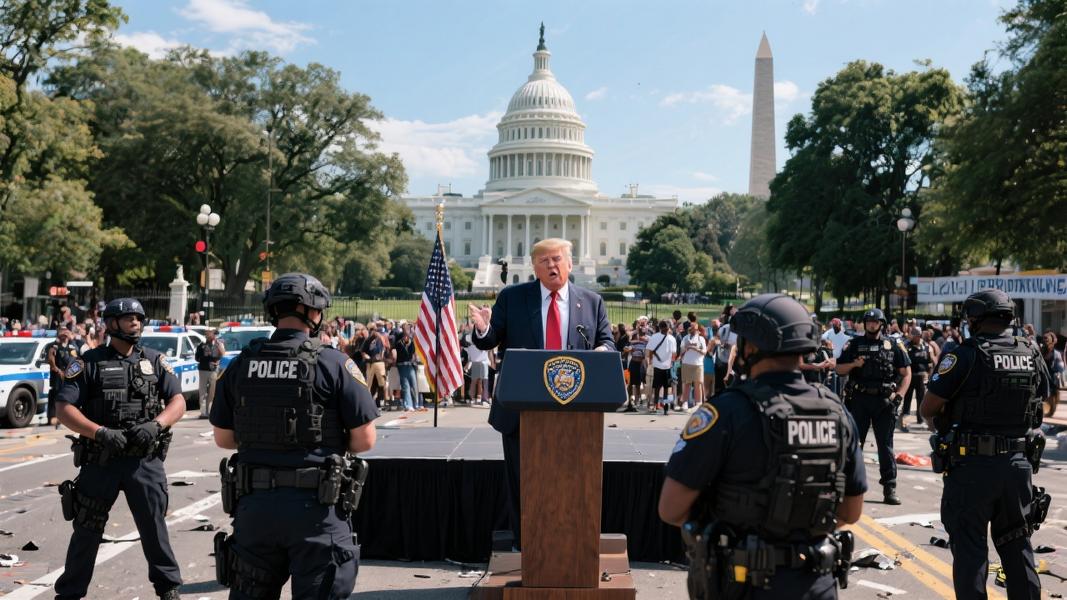
In a dramatic escalation of federal authority, President Donald Trump has declared a “crime emergency” in Washington, D.C., announcing a federal takeover of the city’s Metropolitan Police Department and deploying the National Guard to patrol the streets of the nation’s capital.
“I’m announcing a historic action to rescue our nation’s capital from crime, bloodshed, bedlam and squalor and worse,” Trump declared during a White House news conference. “This is liberation day in D.C., and we’re going to take our capital back.”
The president signed two executive actions on Wednesday — one asserting federal control over the D.C. police force and another directing the Secretary of Defense to deploy National Guard troops throughout the city. The move represents an unprecedented federal intervention into local law enforcement in the District of Columbia.
Emergency Powers Invoked
The executive order, signed during a televised White House briefing, cites the District of Columbia Self-Government and Governmental Reorganization Act as legal justification for the takeover. The order states that “Washington, District of Columbia, is our Nation’s capital and home to the central institutions of American governance. Yet rising violence in the capital now urgently endangers public servants, citizens, and tourists.”
Administration officials detailed the sweeping action during the press conference. “President Trump signed two crucial executive actions to deal with the emergency crime conditions we currently face in the District of Columbia,” a senior official explained at the briefing. “The first of these was an executive order…to take federal control of the DC Metropolitan Police Department… The second major executive action that President Trump signed was a presidential memorandum directing the Secretary of Defense to utilize the National Guard to address the conditions we see on our streets here in DC.”
Is this just the beginning? Trump suggested the D.C. takeover could serve as a blueprint for similar federal interventions in other major cities.
“We’re going to be taking back our capital. It’s going to be a model. And then we’ll look at other cities also, but other cities are studying what we’re doing,” Trump remarked, specifically mentioning Chicago and Los Angeles as potential targets for future federal action.
Constitutional Questions
The White House released a fact sheet justifying the extraordinary measures, stating that “The President has determined that special conditions of an emergency nature exist, requiring the use of the Metropolitan Police Department’s services to maintain law and order, protect Federal buildings, national monuments, and other Federal property, and ensure the orderly functioning of the Federal Government.” The document was published on the White House website shortly after the announcement.
Legal experts and D.C. officials are already questioning the constitutionality of the move, with concerns about federal overreach and the erosion of local governance. The District of Columbia has a unique status — while it has a mayor and city council, Congress maintains ultimate authority over the city.
Still, the scale of this federal intervention appears unprecedented in modern times. Trump framed the takeover as necessary due to what he characterized as the city’s failure to stem rising crime rates.
What remains unclear is how long this federal emergency declaration will remain in effect, and precisely how the chain of command will function with National Guard troops and federalized police operating side-by-side in the nation’s capital.
As residents awoke to news of the takeover, the sight of increased military presence on city streets marked what Trump called “liberation day” — though for many District residents and officials, the day represents something quite different: a profound challenge to the city’s limited self-governance and an extraordinary expansion of presidential power in America’s own backyard.
