
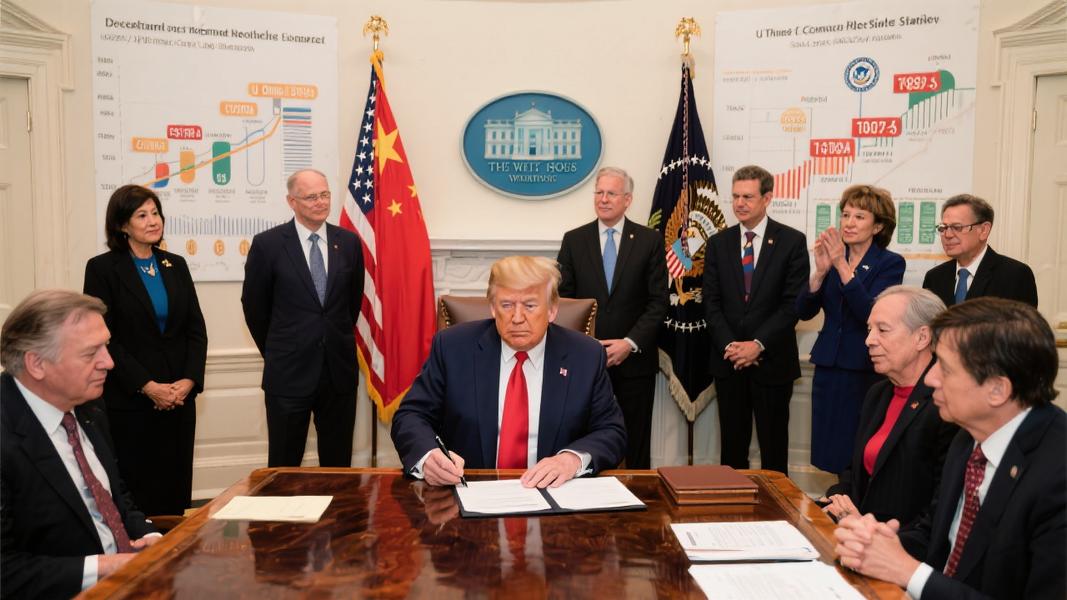
President Trump Extends Tariff Suspension on Chinese Imports Until November
Trade War Put on Ice as Negotiations Continue
President Donald Trump has extended the suspension of additional tariffs on Chinese imports for another 90 days, pushing the deadline to November 10, 2025, as trade negotiations between the world’s two largest economies show signs of progress.
The extension, announced via executive order on August 11, continues the tariff pause that was initially set to expire on August 12. It represents a significant diplomatic maneuver in the ongoing economic chess match between Washington and Beijing that began with Trump’s declaration of a national emergency in April.
“I found that conditions reflected in large and persistent annual U.S. goods trade deficits, including the consequences of those exploding trade deficits, constitute an unusual and extraordinary threat to the national security and economy of the United States,” Trump stated in the original emergency declaration that set the stage for the tariff battle.
What’s behind this sudden cooling in trade tensions? Administration officials point to “significant steps” taken by China to address trade imbalances and national security concerns, though specifics remain largely under wraps. The extension follows a series of high-level discussions between American and Chinese officials.
A Rollercoaster of Tariff Actions
The trade conflict’s latest chapter began on April 2, when Trump imposed initial ad valorem duties on Chinese imports through Executive Order 14257. Beijing quickly retaliated with its own tariff measures, prompting the White House to escalate with additional duties via Executive Orders 14259 and 14266 on April 8 and 9, respectively.
By May, however, the administration changed course. On May 12, Trump suspended the additional duties for 90 days “to encourage progress on trade reciprocity” and address national security concerns. That suspension has now been extended for an additional 90 days.
“Based on this additional information and recommendations from various senior officials, among other things, I have determined that it is necessary and appropriate to continue the suspension effectuated by Executive Order 14298 until 12:01 a.m. eastern standard time on November 10, 2025,” the president declared in the August 11 order.
Whole-of-Government Approach
The implementation of these tariff modifications isn’t a one-department job. The executive order directs a broad coalition of federal agencies to manage the process, including the Departments of Commerce and Homeland Security, and the Office of the U.S. Trade Representative.
These agencies are authorized to “employ all powers granted to the President by IEEPA” — the International Emergency Economic Powers Act — to implement the order. They’re also instructed to consult with numerous other departments and officials, including the Secretaries of State and Treasury, the National Security Advisor, and even the Postmaster General.
Does this mean the trade war is over? Not quite. The baseline reciprocal tariff for Chinese imports remains set at 10%, with various duties still in place on products from mainland China, Hong Kong, and Macau, subject to certain exceptions. The suspension merely delays the implementation of additional tariffs while negotiations continue.
Economic and Political Implications
The tariff suspension comes at a critical time for both economies. U.S. businesses that rely on Chinese imports have been caught in the crossfire of escalating trade tensions, with many facing higher costs that ultimately get passed on to American consumers.
For China, the reprieve offers breathing room as its economy grapples with a property crisis and sluggish post-pandemic recovery. Still, the underlying issues that triggered Trump’s national emergency declaration — “large and persistent annual U.S. goods trade deficits” — remain unresolved.
Trade experts note that the November 10 deadline falls just after the U.S. presidential election, suggesting political calculations may be at play in the timing. The extension effectively pushes any potential tariff escalation beyond Election Day, removing a potential source of economic uncertainty during the campaign’s final stretch.
As negotiations continue behind closed doors, one thing remains clear: the administration is wielding tariffs as both stick and carrot in its complex economic relationship with Beijing, a strategy that has become a hallmark of Trump’s approach to foreign trade.
