
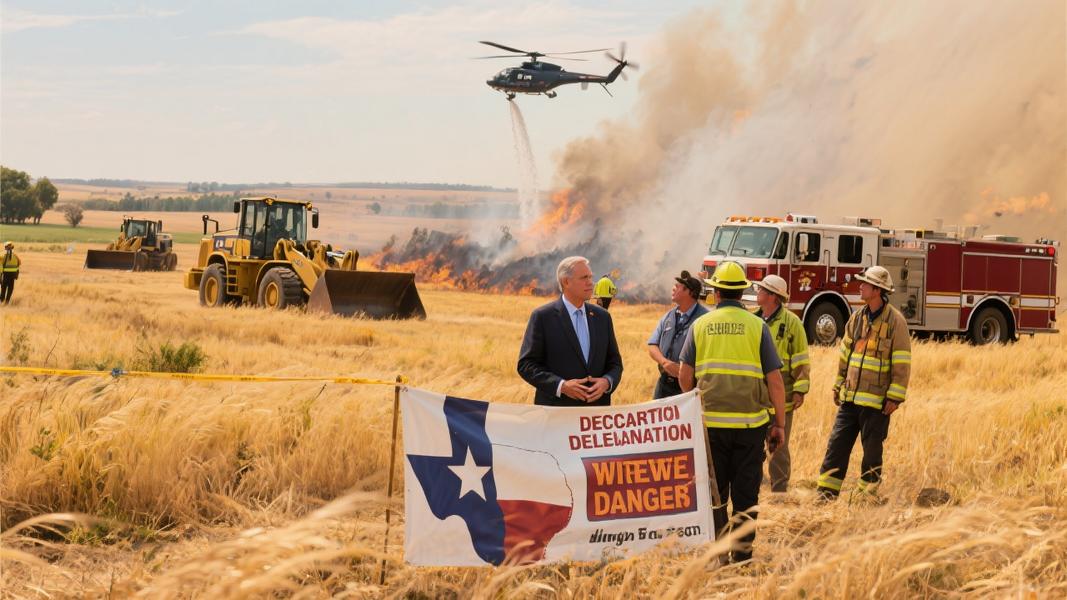
Texas Governor Greg Abbott has issued a sweeping disaster declaration spanning 191 counties as wildfire threats intensify across the Lone Star State amid worsening drought conditions.
The declaration, which comes as temperatures climb and vegetation dries out, directs the Texas Division of Emergency Management to activate crucial resources to support local officials in their firefighting efforts. It represents one of the most extensive pre-emptive wildfire measures taken in recent years.
“Our No. 1 priority is to protect the safety and well-being of Texans across the state,” Abbott said in a statement. “Today, I issued a disaster declaration to provide all necessary resources to communities who could be affected by wildfires. Texans are urged to regularly monitor wildfire conditions and heed the guidance of local officials and emergency management personnel to protect yourselves and your loved ones.”
Rising Threat Levels
The Texas A&M Forest Service has elevated the Wildland Fire Preparedness Level to Level 2, signaling heightened fire danger across multiple regions. This change comes in response to a dangerous combination of warm temperatures, increasingly dry vegetation, and stronger winds that can rapidly spread flames once ignited.
While recent weeks have seen some precipitation, experts warn it hasn’t been enough. “Although most of the state has seen some measurable rain in the past 30 days, it has been 2-3 weeks since any significant rain events have happened in parts of South, Central Texas, and pockets along the Red River and Northeast Texas,” according to a fire update from the Forest Service released this week.
How bad is the drought? According to the U.S. Drought Monitor, conditions ranging from abnormally dry to exceptional drought are currently affecting large swaths of south and southwest Texas. Medina County appears to be ground zero, experiencing what officials classify as exceptional drought — the most severe category on the scale.
Resources Mobilized
At Abbott’s direction, state officials have begun deploying significant firefighting assets to vulnerable areas. The mobilization includes more than 100 firefighters and support personnel from Texas A&M Forest Service, equipped with fire engines, bulldozers, and motor graders essential for creating firebreaks and containing active blazes.
The response also includes federally contracted firefighting aircraft and Texas National Guard helicopters with specialized firefighting capabilities, according to information published by the governor’s office.
These resources don’t come cheap. The Texas A&M Forest Service administers emergency grants to volunteer fire departments — often the first line of defense in rural communities — providing up to $15,000 for equipment repairs and as much as $240,000 for apparatus replacement. The agency has allocated nearly $1.7 million for wildfire-related expenses this fiscal year.
“Having the proper equipment to respond to wildfires is essential,” said Moorehead, who oversees the grant program. “Emergency grants for repair and replacement equipment are expedited to provide assistance as quickly as possible,” he explained.
Looking Ahead
The timing of Abbott’s declaration — coming in August 2025 — suggests officials are bracing for what could become a particularly challenging fire season as summer heat persists and fall winds begin to pick up in the coming months.
For residents in the affected counties, the disaster declaration serves as both a warning and a promise: danger looms, but resources are being positioned to respond.
As Texans have learned from devastating wildfires in years past, when it comes to these fast-moving disasters, preparation isn’t just prudent — it’s essential.
