
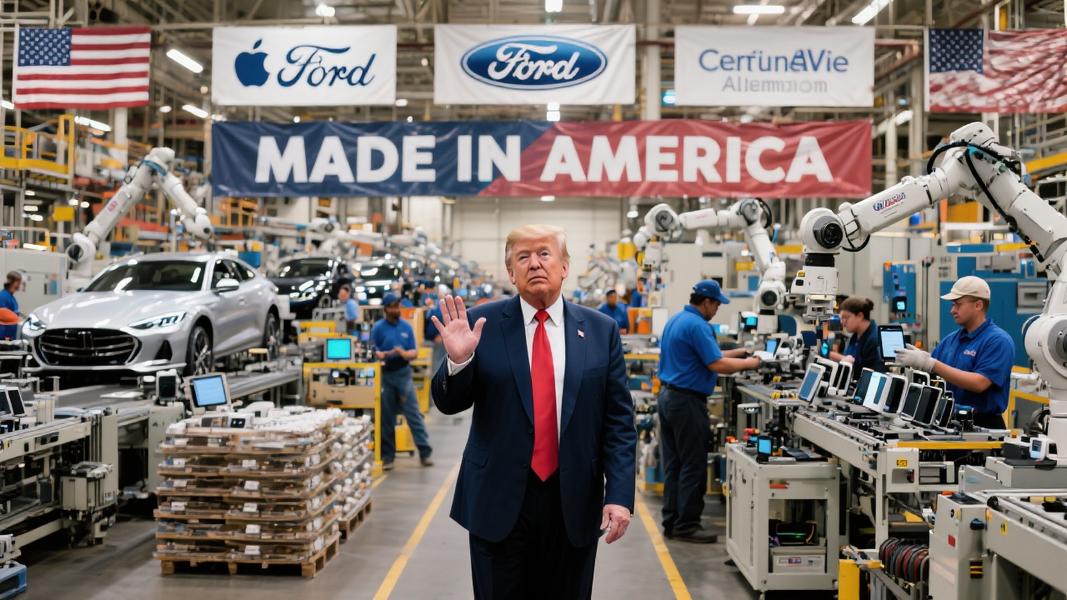
America’s manufacturing sector is experiencing a resurgence as major corporations double down on domestic production with billions in new investments. The trend, bolstered by both private initiatives and government incentives, signals what some analysts are calling a “reshoring revolution” in U.S. manufacturing.
Corporate America Bets Big on Domestic Production
GE Appliances announced plans to inject more than $3 billion into its U.S. manufacturing operations over the next five years, a move that will bring 1,000 jobs back to American soil and expand the company’s facilities across five states. “Altogether, GE Appliances will have invested $6.5 billion in its U.S. manufacturing and distribution network since 2016, adding more than 4,000 jobs – with 1,000 more expected from this latest investment,” the company revealed.
Not to be outdone, tech giant Apple has dramatically upped its commitment to American manufacturing. The company is increasing its U.S. investment pledge to a staggering $600 billion over four years while launching its American Manufacturing Program (AMP). The initiative aims to repatriate significant portions of Apple’s supply chain and advanced manufacturing operations, directly creating 20,000 new jobs across the country.
“Today, we’re proud to increase our investments across the United States to $600 billion over four years and launch our new American Manufacturing Program,” Apple CEO Tim Cook stated in the announcement.
Policy Push Behind the Manufacturing Boom
Why now? The timing isn’t coincidental. These corporate investments align with aggressive policy initiatives from Washington designed to incentivize domestic production.
The Biden Administration’s “Made in America Week 2025” introduced policies to accelerate investments exceeding $1 billion. These include interest deductions on loans for American-made vehicles and 100 percent expensing for new factories, equipment, and machinery — all part of an effort to level the playing field for U.S. businesses and boost domestic production.
“With the enactment of the historic One Big Beautiful Bill earlier this month, we delivered interest deduction for loans on new American-made vehicles, as well as 100 percent expensing for new factories, equipment, and machinery,” the White House announced.
Pharmaceutical giant AbbVie has joined the manufacturing renaissance with a $195 million investment to expand its U.S.-based drug production capacity. The expansion contributes to what the administration has characterized as a manufacturing boom driven by President Trump’s ‘Made in America’ agenda.
Beyond the Numbers
The wave of investment represents more than just figures on a balance sheet. It marks a potential reversal of decades-long offshoring trends that hollowed out manufacturing communities across America’s heartland.
Economic analysts point to several factors driving this shift: rising overseas labor costs, supply chain vulnerabilities exposed during the pandemic, geopolitical tensions, and increasingly attractive government incentives for domestic production.
Still, challenges remain. The U.S. continues to face workforce shortages in manufacturing, with companies reporting difficulty finding skilled labor to fill new positions. Educational institutions and workforce development programs are scrambling to bridge this gap as investments continue to flow.
Whether this manufacturing renaissance proves sustainable will depend on continued policy support and corporate commitment beyond the current investment cycle. But for now, communities that once saw factories shuttered are cautiously optimistic about the return of American manufacturing might.
