
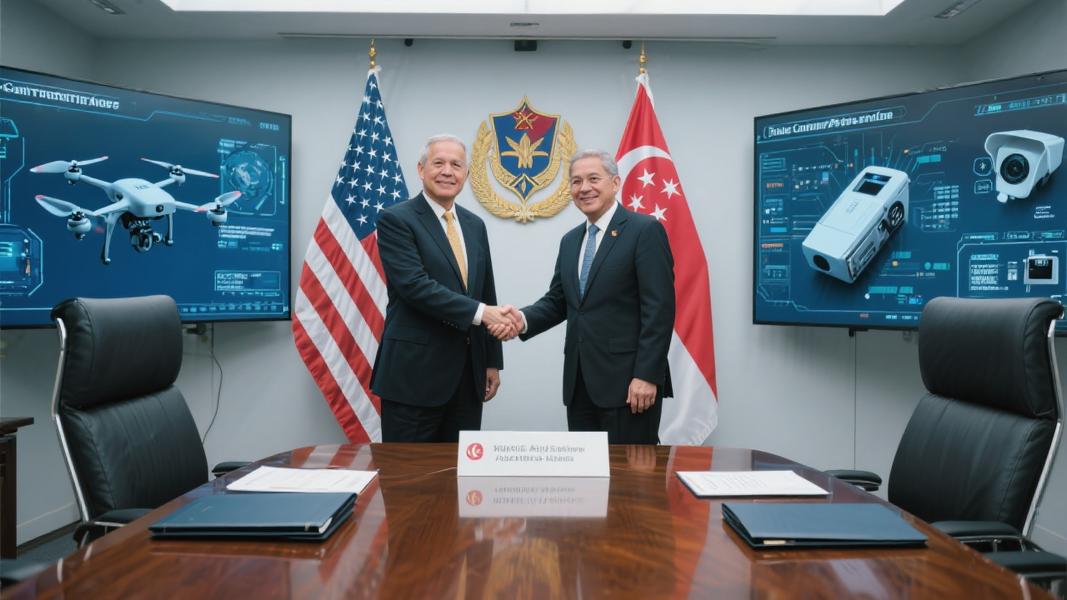
U.S. and Singapore extend counterterrorism agreement through 2036, deepening their decades-long defense partnership as both nations aim to counter emerging threats in the Indo-Pacific region.
The U.S. Department of Defense and Singapore’s Ministry of Defence have signed the third installment of their Combating Terrorism Research and Development Agreement (CTRD), extending the partnership for another decade until March 21, 2036. The agreement, which splits costs evenly between both countries, focuses on developing and testing “novel and emerging technologies” to counter terrorist threats, including those posed by near-peer adversaries in an increasingly complex security landscape.
Strategic Partnership in the Indo-Pacific
Why does this matter now? The renewed agreement comes as the United States continues to strengthen alliances throughout the Indo-Pacific region, where China’s growing influence has reshaped security calculations.
“This agreement, in line with the United States’ Interim National Defense Strategic Guidance, will help accelerate the development of capabilities on a cost-effective basis in the critical Indo-Pacific region,” the Office of the Assistant Secretary of Defense for Special Operations and Low-Intensity Conflict noted in its announcement of the extension.
The partnership isn’t new. Singapore and the U.S. have managed their defense relationship through multiple channels, including annual senior-level policy dialogues and the Enhanced Defense Cooperation Agreement, which provides a framework for collaboration across military, policy, strategic, and technological spheres. Under this structure, the two nations participate in ten distinct bilateral dialogues overseen by the Defense Cooperation Committee, according to the U.S. Embassy in Singapore’s defense cooperation overview.
Beyond Counterterrorism
Singapore has long been recognized as a vital security partner for American interests in Southeast Asia. The State Department’s 2023 Country Reports on Terrorism described Singapore as a “committed, active, and effective” counterterrorism partner, with facilities like the Changi naval base supporting U.S. military operations in the region.
But the collaboration extends far beyond traditional security concerns. In recent years, the partnership has expanded to include emerging technologies that blur the line between conventional military capabilities and next-generation threats.
The two countries have established dialogues on cybersecurity, space cooperation, and most recently, critical and emerging technologies. Last year, they added an annual Critical and Emerging Technology Dialogue focused on artificial intelligence, quantum technology, biotechnology, and defense innovation, according to a Congressional Research Service report.
Regional Context
The renewed CTRD agreement also fits within a broader pattern of U.S. engagement with Southeast Asia. In November 2022, ASEAN and the United States established the ASEAN-U.S. Comprehensive Strategic Partnership during a summit in Phnom Penh, Cambodia, as documented in their plan of action.
This partnership, described as “substantive, meaningful, and mutually beneficial,” reaffirms both sides’ commitment to regional peace and stability at a time when great power competition has intensified throughout the Indo-Pacific.
The CTRD Agreement, overseen by the Secretariat for Special Operations under DoD’s Assistant Secretary of Defense for Special Operations and Low-Intensity Conflict, represents just one facet of this evolving relationship. But it’s a significant one, providing a framework for joint development of capabilities that both nations see as increasingly critical in an era of complex security challenges.
As traditional terrorism threats evolve and blend with state-sponsored activities and emerging technologies, this partnership — now extended for another decade — signals both countries’ recognition that the security landscape of 2036 may look substantially different from today’s.
