
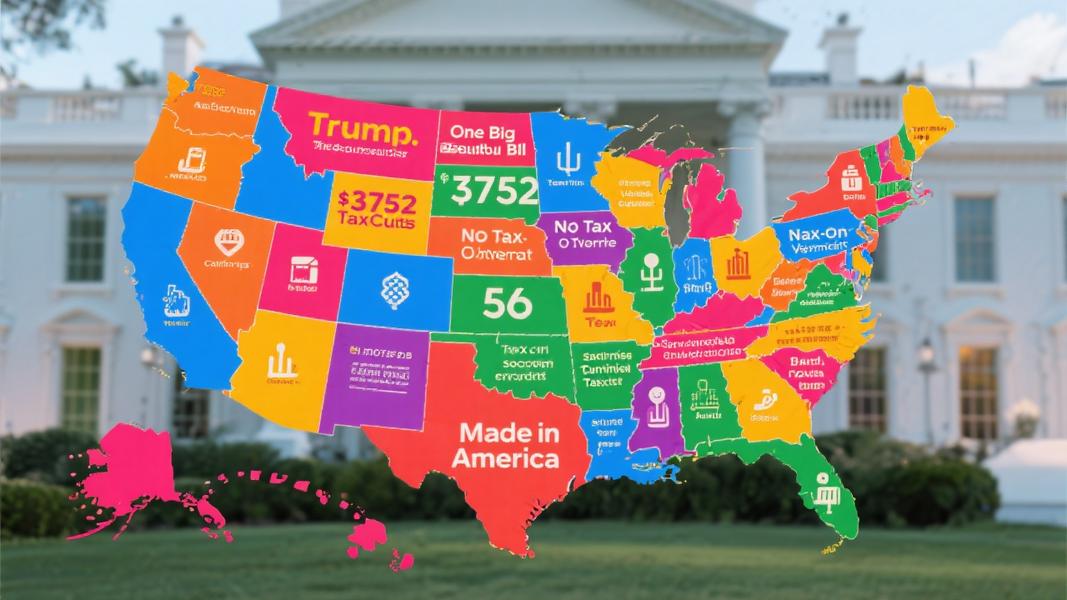
Americans are poised to see an average federal tax cut of $3,752 in 2026 under the One Big Beautiful Bill Act as the legislation moves to permanently extend key portions of the 2017 Tax Cuts and Jobs Act while adding new tax breaks for workers and seniors.
The sweeping tax package, a cornerstone of President Trump’s economic agenda, reduces federal taxes across all income brackets and is expected to create approximately 938,000 full-time equivalent jobs nationwide, according to White House estimates. The employment boost would vary significantly by state, with California potentially gaining over 132,000 jobs and Texas adding 81,000, while smaller states like Vermont would see around 1,700 new positions.
What’s in the bill?
Beyond extending the TCJA provisions, the legislation introduces several new tax breaks aimed at working Americans. Perhaps most notably, it eliminates federal taxes on tips, overtime pay, and Social Security benefits — three measures designed to directly impact service workers, hourly employees, and retirees.
For small businesses — which the administration calls “the backbone of our economy” — the bill increases the small business tax deduction from 20% to 23%, a provision that would affect approximately 26 million entrepreneurs annually, the White House noted. It also restores 100% immediate expensing, allowing businesses to fully write off investments, expansion, and modernization in the year they’re made.
“We estimate the OBBBA will reduce federal taxes on average for individual taxpayers in every state,” the administration stated, highlighting the broad-based nature of the tax relief package.
The overtime deduction explained
One of the more complex provisions is the new overtime tax break. Effective from 2025 through 2028, workers can deduct qualified overtime pay that exceeds their regular rate — specifically, the “half” portion of time-and-a-half compensation required by the Fair Labor Standards Act.
The IRS has clarified that this deduction will be capped at $12,500 for individuals and $25,000 for joint filers. Higher earners should note the benefit phases out for taxpayers with modified adjusted gross income over $150,000 ($300,000 for joint filers).
The bill also expands the Child Tax Credit, though specific details on the expansion weren’t immediately available in the provided information.
The price tag question
But at what cost? The Bipartisan Policy Center projects the legislation will add approximately $3.4 trillion to the federal deficit over the next decade — a figure that swells to more than $4 trillion when accounting for the additional interest on the national debt.
This substantial price tag reflects both the permanent extension of trillions in tax cuts from the 2017 TCJA and the introduction of new tax breaks like the overtime and tip exemptions. Critics will likely question the fiscal responsibility of such a package at a time when the national debt already exceeds $34 trillion.
Supporters counter that the job creation effects — nearly a million new positions by some estimates — and broad-based tax relief will generate economic activity that offsets some of the costs.
“House Republicans’ big, beautiful reconciliation bill is exactly what the country needs to jumpstart the economy and guarantee the safety and prosperity of Americans for decades to come,” reads a statement on the White House website.
The legislation represents one of the most significant tax policy changes in recent years, with implications that will extend well beyond the current administration and affect virtually every American taxpayer — from service workers counting tips to seniors collecting Social Security to small business owners looking to expand operations.
