
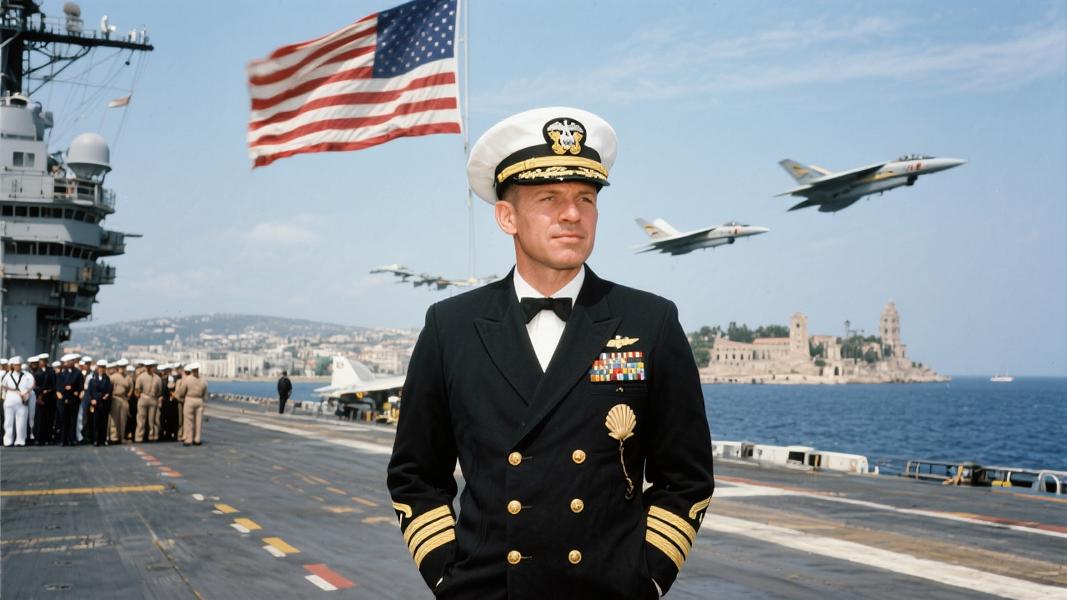
Chief Petty Officer Lee Reese joined the Navy to avoid the Vietnam draft, but ended up witnessing history from the decks of aircraft carriers during some of America’s most turbulent moments — including the Nixon resignation and the failed Iranian hostage rescue mission.
Enlisting in May 1969, Reese made a strategic decision that would shape his life and military career. “I didn’t want to wait and take a chance of going to Vietnam in-country,” he recalled in an oral history now preserved through the Texas Veterans Land Board’s Voices of Veterans program. His family was “very proud” of his choice to join the Navy instead of risking ground combat.
From Boot Camp to the Mediterranean
After completing boot camp in San Diego, where he trained and led prayer groups, Reese became an Aviation Storekeeper. His first major assignment came in 1972 aboard the USS Franklin Delano Roosevelt, which took him throughout the Mediterranean. The Navy’s recruiting promise to “see the world” proved accurate for the young sailor.
“We stopped at Liberty Ports and I got to see some very interesting places,” Reese explained. His deployments included stops in “Barcelona, Spain, Palma on the Island of Majorca, Cannes, France, Nice, Monaco, Naples, Italy, Rome, Pompeii, Athens, Greece, where we went up to the Parthenon, and we were also on the Island of Rhodes.”
But it wasn’t all sightseeing. Reese’s service eventually took him to the Western Pacific aboard the USS Ranger, where he served in the Tonkin Gulf off the coast of Vietnam. Throughout his career, he steadily gained responsibilities, eventually managing approximately 12 personnel as he rose through the ranks to become Chief Petty Officer before his retirement.
Witnessing Historic Moments
Perhaps most striking were the moments when Reese’s naval service intersected with pivotal American history. While stationed in the Tonkin Gulf aboard the USS Nimitz, he witnessed a remarkable demonstration of American military continuity during political crisis.
“We were in the Tonkin Gulf when President Nixon resigned,” he stated. “We were there to say, ‘even though we have problems at home, we can still do our job overseas.'”
Reese also experienced traditional naval rites of passage, including the infamous Shellback Initiation after crossing the equator. He remembered the “riotous” ceremony where new sailors had to “go through the garbage shoot” as part of their initiation.
During Christmas 1979, Reese attended midnight mass at St. Peter’s Basilica in Rome — a spiritual highlight of his naval career. “They opened the church two hours early to get everybody in, and you met people from everywhere!” he shared.
The Iranian Hostage Crisis
How close did Reese come to participating in one of America’s most dramatic rescue attempts? Extremely close. His ship was stationed in the Indian Ocean during the Iranian hostage crisis, and he witnessed the secretive preparations for Operation Eagle Claw — the ill-fated rescue mission.
“After a ‘steel beach picnic’ on the flight deck, all of a sudden, here come all these people in unmarked flight suits… They had armed Marine guards at each door. They were the guys who were gonna go into Iran,” Reese described.
The mission’s failure hit the crew hard. “Our captain… told us the mission failed. The morale of the ship went really low. The only thing that kept us going was knowing that the Dwight D. Eisenhower was on her way to relieve us,” he recounted.
A Military Legacy
Reese’s military service created a legacy that extended to the next generation. His children followed in his footsteps, with his youngest son Timothy Allen serving as a Staff Sergeant reservist with more than 20 years of service. Another son, Kevin, served in the Texas National Guard and completed a tour in Baghdad in 2008-2009, “guarding the green zone,” Reese noted with evident pride.
Stories like Reese’s are now being preserved through the Voices of Veterans oral history program, introduced by Texas Land Commissioner and Veterans Land Board Chairwoman Dawn Buckingham, M.D. The program represents the first veteran oral history initiative by a state agency.
These recorded interviews are permanently archived at the Texas General Land Office, where they join historical documents of Texas icons including Sam Houston, Davy Crockett, Jim Bowie, and William Barret Travis. The collection makes these veterans’ experiences available to the public, historians, genealogists, and researchers for generations to come.
From avoiding the Vietnam draft to witnessing presidential resignation and failed hostage rescues, Reese’s naval career spans a critical period of American history — not from the pages of textbooks, but from the deck of an aircraft carrier, where history unfolded before his eyes.
