
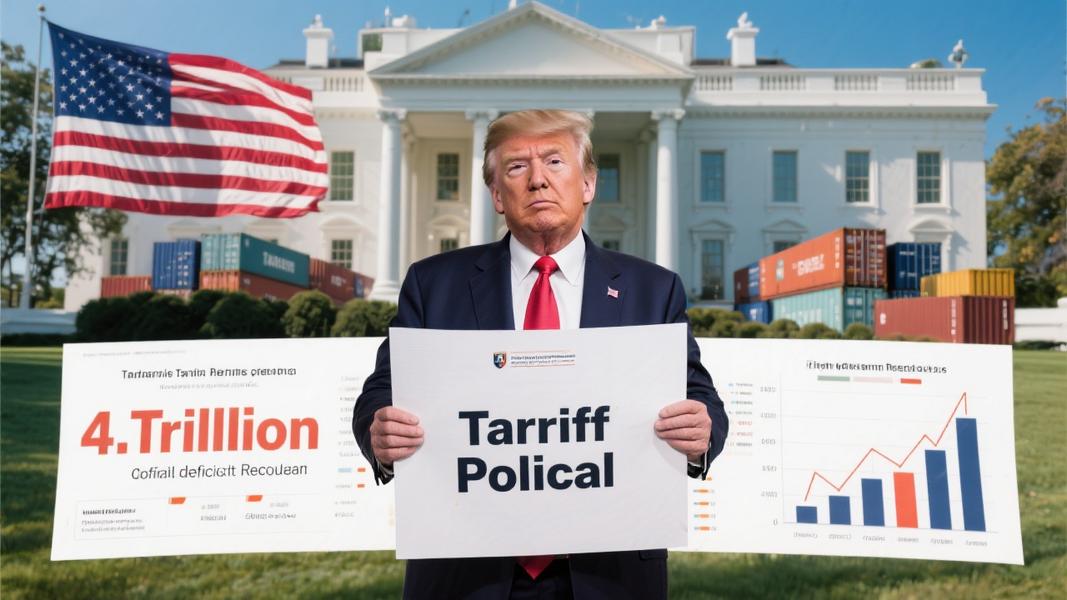
Trump’s proposed tariffs could slash the federal deficit by a staggering $4 trillion over the next decade, according to new projections from the Congressional Budget Office that have energized the former president’s economic messaging.
The nonpartisan CBO’s analysis, released Friday, found that if Trump’s tariff agenda is maintained, it would substantially reduce government borrowing needs through increased revenue. The findings suggest that the effective tariff rate on imported goods has already jumped by 18 percentage points compared to last year.
Primary deficits would fall by $3.3 trillion directly from tariff collections, with an additional $700 billion in savings from reduced interest payments on federal debt — all adding up to the eye-popping $4 trillion figure that Trump has quickly incorporated into his economic narrative.
Breaking Down the Numbers
How exactly do these projections work? The CBO’s June 2025 letter specifically estimates that tariff increases implemented in just the first five months of 2025 would reduce primary deficits by $2.5 trillion over the 2025-2035 period. When accounting for lower interest payments resulting from reduced borrowing, total deficit reduction reaches $3 trillion.
The Committee for a Responsible Federal Budget has gone even further, projecting that all Trump tariffs — including those implemented after mid-May — could reduce deficits by approximately $3.4 trillion over the decade. This comprises $2.7 trillion from tariffs already enacted by May 13, 2025, plus an additional $700 billion from subsequent tariff actions.
“The tariffs are going to be at $4 trillion. They’re going to reduce the deficit by $4 trillion,” Trump declared in recent remarks, also crediting the policy with boosting stock markets. “It’s had a huge impact. And the stock market is way up.”
The former president didn’t hesitate to claim vindication: “I was very happy that today, as you saw, the group that does this, a government group, radical left group, announced that Trump was right, took in $4 trillion worth of tariffs.”
Broader Budget Impact
The tariff revenue appears to be playing a significant role in the White House Council of Economic Advisers’ overall deficit projections. The CEA forecasts deficits will fall from 6.4% of GDP in fiscal year 2024 to 5.2% in 2025, eventually reaching 3.2% by 2034.
Even more striking, the administration projects that primary deficits — which exclude interest payments — will shrink to just 2.0% of GDP by 2026 and actually turn into a small surplus of 0.1% by 2034.
That’s a remarkable turnaround for federal finances that have been deeply in the red for years. The administration’s projections also show overall debt dropping to 94% of GDP by 2034, reversing the upward trajectory that has concerned economists across the political spectrum.
Economic Tradeoffs
Critics have long argued that tariffs function essentially as taxes paid by American consumers and businesses. While the revenue benefits to the federal government appear substantial, the CBO analysis doesn’t fully address potential offsetting economic impacts like higher prices, supply chain disruptions, or retaliatory measures from trading partners.
Still, the sheer magnitude of projected deficit reduction has caught the attention of budget watchers who have been sounding alarms about America’s fiscal trajectory.
The question remains whether these tariffs will be maintained over the full decade as the CBO projections assume. Trade policies have historically been subject to negotiation, modification, and sometimes reversal as economic conditions and diplomatic relationships evolve.
For now, the Trump administration appears fully committed to its tariff strategy, with the deficit reduction projections providing powerful political ammunition for defending what has been a controversial approach to international trade.
