
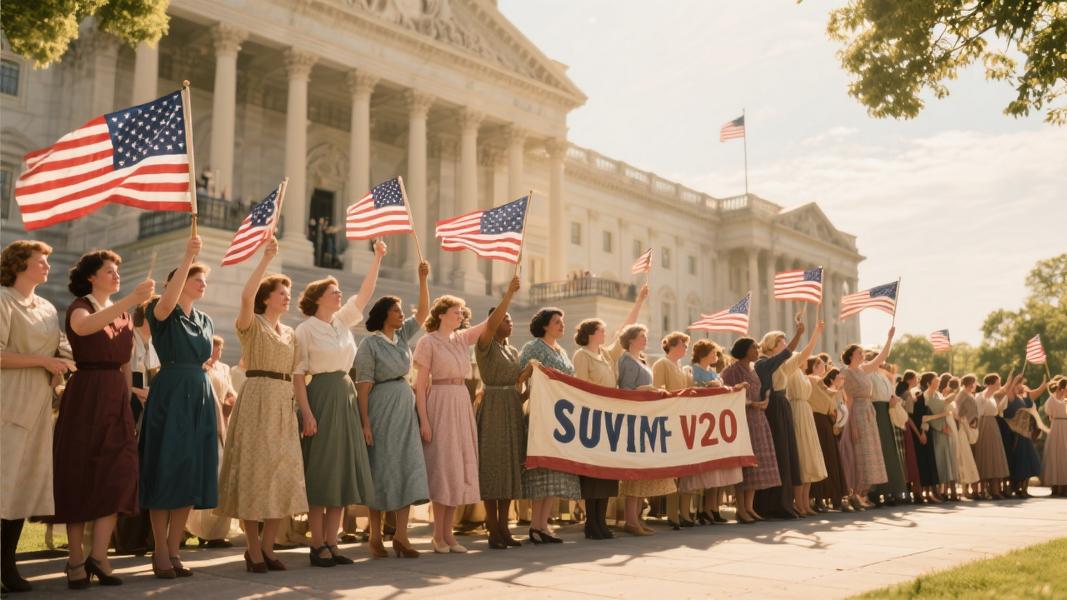
When 24-year-old Harry Burn cast his vote in the Tennessee legislature on August 18, 1920, he couldn’t have known he was about to change American democracy forever. The young lawmaker, swayed by a letter from his mother urging him to “be a good boy” and support suffrage, broke a deadlocked vote that would ultimately secure women’s constitutional right to vote.
A Century-Plus of Suffrage: The 19th Amendment Turns 105
One hundred and five years ago today, on August 26, 1920, the 19th Amendment to the U.S. Constitution was officially certified, enshrining into law that voting rights “shall not be denied or abridged by the United States or by any State on account of sex.” This watershed moment came just days after Tennessee became the crucial 36th state to ratify the amendment, fulfilling the three-fourths requirement for constitutional changes.
The White House’s upcoming Presidential Message on Women’s Equality Day acknowledges the profound significance of this milestone: “On this day 105 years ago, the 19th Amendment of the United States Constitution was officially certified—forever changing the course of history and immortalizing these mighty words: ‘The right of citizens of the United States to vote shall not be denied or abridged by the United States or by any State on account of sex,'” the message states.
A Hard-Fought Battle Decades in the Making
Behind those thirty-nine words lies a struggle spanning generations. The fight for women’s suffrage began in the mid-19th century, requiring what the National Archives describes as “decades of agitation and protest.” Multiple generations of suffragists lectured, wrote, marched, lobbied, and engaged in civil disobedience to achieve what many Americans at the time considered a radical constitutional change.
The momentum built slowly. On June 16, 1919, several states demonstrated their commitment to the cause, with Kansas, Ohio, and New York calling special legislative sessions specifically to vote in favor of the amendment, according to National Park Service records. These early adopters helped build crucial momentum toward the eventual ratification.
Yet the path to certification wasn’t straightforward. Would enough states ratify in time? The question loomed large as suffragists and their opponents descended on Nashville in August 1920, where Tennessee’s special legislative session would determine the amendment’s fate.
“Pro-suffrage activists donned yellow roses, while the opposition wore red,” the Brennan Center for Justice explains. The visual symbolism underscored the high stakes of the moment, as lobbyists from both sides worked feverishly to secure votes.
Beyond the 36: The Long Road to Universal Acceptance
Tennessee’s vote may have secured the amendment’s adoption, but the story didn’t end there. “Though not necessary for adoption, the following states subsequently ratified the amendment,” Wikipedia notes. “Some states did not call a legislative session to hold a vote until later, others rejected it when it was proposed and then reversed their decisions years later, with the last taking place in 1984.”
That’s right — it took until 1984, more than six decades after certification, for the final holdout states to formally embrace the amendment, revealing how deeply contested women’s political equality remained in parts of America.
A Legacy That Continues to Resonate
The 19th Amendment was formally “adopted and officially became part of the U.S. Constitution on August 26, 1920,” as Rock the Vote confirms. Its impact, however, continues to reverberate through American society and politics.
In commemorating the 105th anniversary, the White House message honors “the strong, patriotic American trailblazers who paved the path for women’s suffrage,” adding that the date “stands as an enduring reminder of America’s promise of freedom and equality,” according to the presidential proclamation.
The suffrage movement’s victory represents more than just the right to cast a ballot — it fundamentally altered American democracy by doubling the potential electorate and challenging deeply entrenched notions about women’s roles in public life. And yet, historians are quick to note that the 19th Amendment’s promise wasn’t immediately realized for all women, particularly women of color who faced additional barriers to voting for decades afterward.
As we mark this 105th anniversary, perhaps the most fitting tribute to those suffragists who wore yellow roses in Nashville is not just to celebrate their victory, but to recognize that expanding and protecting voting rights remains an unfinished chapter in American democracy — one that requires the same persistence, courage and vision that turned “Votes for Women” from a radical slogan into constitutional law.
