
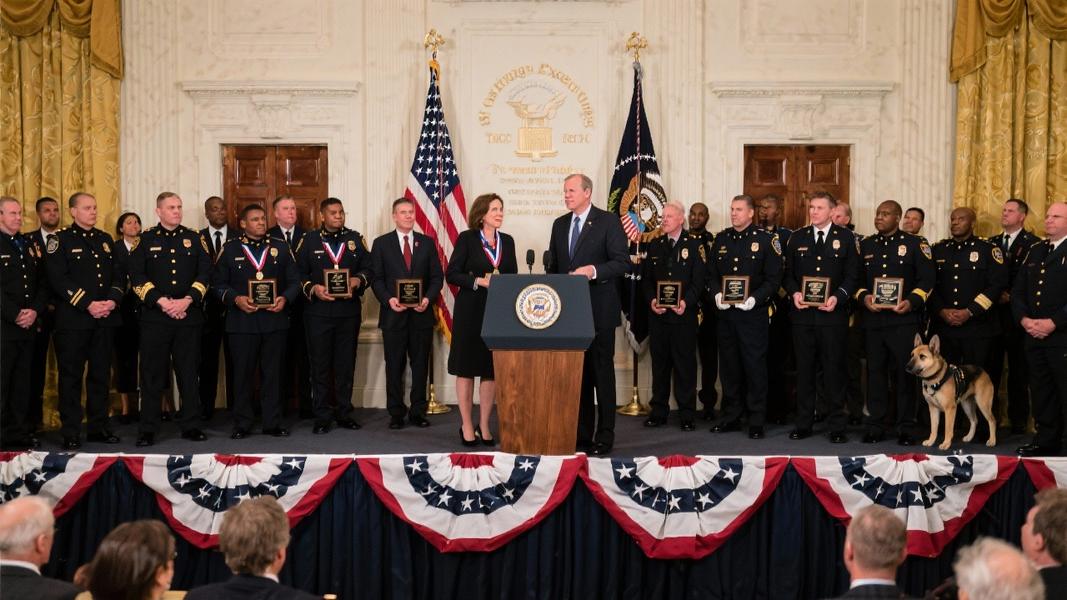
The White House honored key figures in America’s increasingly aggressive fight against drug trafficking Wednesday, celebrating efforts that officials say mark a dramatic shift from defensive to offensive strategies in combating narcotics networks.
“A chemical war is being waged against the American people, and for too long, America has been on the defensive,” said Special Advisor Sara Carter at the U.S. Interdiction Coordinator (USIC) Awards Ceremony. “This Administration has made a clear choice: the time for reactive measures is over. Our new posture is one of persistent and aggressive offense,” she declared during the event held at the Eisenhower Executive Office Building.
Honoring Innovation in Drug Interdiction
The ceremony, presided over by Carter and U.S. Interdiction Coordinator Shannon Kelly, recognized 10 individuals and task forces for what officials characterized as extraordinary contributions to dismantling drug trafficking networks. Among those celebrated was the Bitcoin Fog Government Trial Team, which successfully took down a cryptocurrency mixing service that had laundered over $300 million in illicit funds.
Also receiving honors was the U.S. Coast Guard Cutter Munro and its HITRON Detachment for intercepting more than 3,200 kilograms of cocaine, as well as the CBP Fentanyl Canine Detection Training Team — whose pioneering program has led to an astonishing 860% increase in fentanyl seizures at U.S. ports of entry.
“The actions we honored today represent moments of bravery, hours of painstaking investigation, and a level of dedication that is nothing short of heroic,” Kelly noted during her remarks.
High-Value Return on Investment
What’s driving this new offensive posture? The administration points to the remarkable success of the National High Intensity Drug Trafficking Areas (HIDTA) Program, which has become a cornerstone of federal anti-drug efforts. Last year alone, HIDTA operations seized 4.1 million pounds of fentanyl and other drugs while denying traffickers an estimated $17.7 billion in profits.
Perhaps most striking is the program’s efficiency. “For every dollar invested in the HIDTA Program, the American people get $68.07 in benefits, making HIDTA an effective and efficient use of taxpayers’ money,” according to a White House Office of National Drug Control Policy report released earlier this year.
The Biden administration has backed this approach with substantial funding. “The President’s FY 2025 Budget will provide $290 million to support federal, state, local, and Tribal law enforcement working to stop drug traffickers across all 50 states,” the ONDCP announced in April.
Partnership as Strategic Advantage
Officials repeatedly emphasized that cross-agency collaboration has been crucial to recent successes. “Their success is built on partnership, and it is a powerful reminder that our ability to operate as one unified force is our greatest strategic advantage,” Kelly emphasized.
The ceremony comes at a time when synthetic opioids continue to devastate communities across America. Yet the administration’s messaging suggests a turning point in how federal agencies approach the problem — moving from containment to active disruption of trafficking networks.
Will this more aggressive posture make a measurable difference in American communities? That remains to be seen. But Wednesday’s ceremony made clear that the administration is betting heavily on coordination, innovation, and a more proactive stance against what officials repeatedly described as chemical warfare against U.S. citizens.
As the honorees filed out of the White House complex, they carried with them not just commendations but the weight of an administration’s shifted strategy — one that’s counting on their continued success to stem the tide of a crisis that has claimed hundreds of thousands of American lives.
