
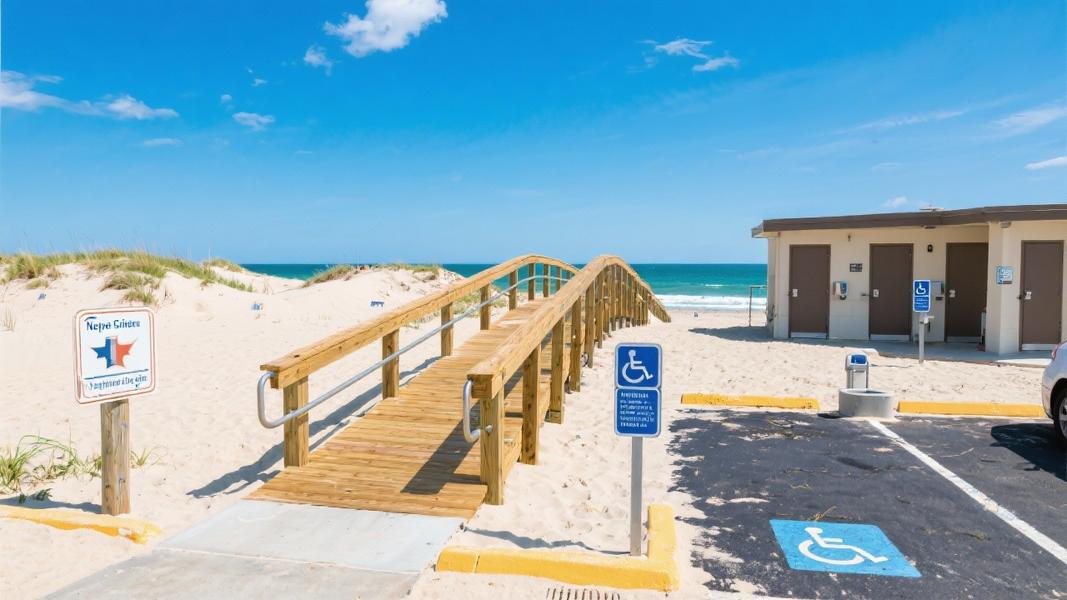
Texas Land Commissioner Dawn Buckingham announced the completion of significant improvements to a popular beach access point on South Padre Island this week, marking another milestone in the state’s ongoing efforts to enhance coastal accessibility and preservation.
The renovations at Neptune Circle, Beach Access #16, include an ADA-compliant dune walkover, permanent restroom facilities, a rinse station, and updated parking—improvements partially funded through the Texas General Land Office’s Coastal Management Program (CMP).
“As a Texan who spent over a decade living on our coast, I am continuously looking for ways to ensure all Texans can enjoy our beautiful beaches with their families and friends during beach season and year-round,” said Commissioner Buckingham in a statement. “It has been a pleasure to work with the City of South Padre to provide an improved beach access point with an ADA dune walkover to this vibrant community.”
Managing Millions for Coastal Protection
The Texas CMP isn’t just about beach access. It’s a federally approved program managed by the Texas Land Commissioner that brings approximately $2.2 million in federal Coastal Zone Management Act funds to Texas annually, with most of that money directed to state and local entities for coastal projects and program activities.
What makes Texas unusual in its approach? It’s one of only a handful of coastal states that pass substantial amounts of these federal funds directly to coastal communities for local projects, according to resources from the Texas General Land Office.
The program focuses on critical coastal priorities including public access, pollution control, hazard mitigation, and habitat protection. Through a competitive grant process, CMP distributes roughly $2 million annually to support both planning and implementation projects that protect and enhance Texas’ coastal resources.
For larger initiatives, an additional funding track—Projects of Special Merit—offers up to $5 million for ambitious coastal projects, supported through the Gulf of Mexico Energy Security Act (GOMESA), as outlined in program documentation.
Recent Funding Success
The impact of these programs extends far beyond a single beach access point. In a recent funding cycle, the GLO awarded approximately $1.695 million to projects across three coastal counties aimed at improving coastal resource management and ecological health.
“Through the GLO’s Coastal Management Program, we are securing the future of our coastline by helping innovative projects get the funding they need to apply unique solutions to the problems facing Texas’s coastal communities and habitats,” Buckingham noted when announcing these grants.
Beyond the CMP’s dedicated funding, the Texas General Land Office coordinates over $80 million annually in federal, state, and local funds for coastal resource management projects. This coordination helps reduce duplication of efforts and ensures more efficient use of resources across various coastal initiatives.
The specifics of the funding structure are notable: The Land Commissioner administers up to $1.8 million annually—representing 90% of federal coastal management grant funds received from NOAA—to local governments and other coastal entities. These grants require matching funds at 40%, with construction projects eligible to receive up to $200,000 in support.
Historic Leadership
Dr. Buckingham herself represents a milestone in Texas history, having become the state’s first female Land Commissioner when she won election in 2022. Her priorities include disaster response, supporting Texas energy, public education funding, veterans’ services, and border security issues.
The South Padre Island improvements reflect the commissioner’s stated commitment to ensuring Texas beaches remain accessible to all residents. “I look forward to delivering more wins for the Texas coast and every Texan who calls it home,” she added.
For coastal communities dependent on both tourism and environmental protection, these ongoing investments represent a balancing act between human access and ecological preservation—one that continues to evolve with each new funding cycle and completed project along Texas’s 367 miles of coastline.
