
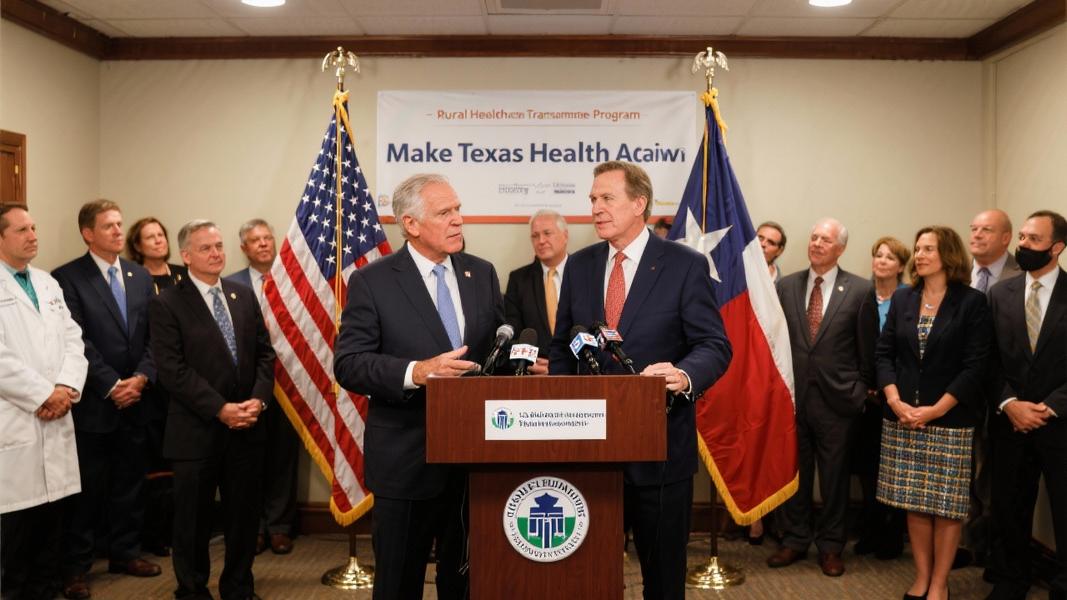
Texas is making a major push to transform its rural healthcare system with the help of federal dollars flowing from the “One Big Beautiful Bill” — a signature achievement of the Trump administration’s second term.
Governor Greg Abbott and U.S. Secretary of Health and Human Services Robert F. Kennedy Jr. ceremonially signed Texas’ Make America Healthy Again (MAHA) legislation at the Texas Capitol in Austin on August 27, 2025. The next day, they held a roundtable discussion focused specifically on rural healthcare initiatives that will leverage billions in federal funding to address critical gaps in service for the state’s 6 million rural residents.
Rural Healthcare Gets a $50 Billion Lifeline
The backdrop for these efforts is the Rural Health Transformation Program, a $50 billion fund created under the One Big Beautiful Bill Act that President Trump signed into law on July 4, 2025. The program aims to offset losses that rural health providers would otherwise experience from other health provisions in the sweeping legislation, which includes Medicaid spending cuts of $911 billion over 10 years.
“Our goal has to be to ensure that every corner of our state is going to be prepared to respond to the health care needs of their community,” Abbott said during the press conference. “More than 190 counties are categorized as rural in this state, and they have more than 6 million Texans. We have an obligation to ensure those communities are able to succeed.”
The federal program will distribute $10 billion annually from fiscal years 2026 through 2030, with half the money allocated equally to states with approved CMS applications and the other half distributed based on factors like rural population and hospital status. States must develop transformation plans by the end of 2025 to access these funds.
Texas Takes the Lead
The Lone Star State isn’t waiting around. During the 2025 legislative session, Texas lawmakers passed House Bill 18, known as the Rural Health Stabilization and Innovation Act. The bill creates a State Office of Rural Hospital Finance, a Rural Hospital Financial Vulnerability Index, and a Rural Pediatric Mental Health Care Access Program.
John Henderson, CEO of the Texas Organization of Rural & Community Hospitals, called it “the most significant rural health legislation in a generation.” Why such enthusiasm? “Because these things are now in statute, rural hospitals can count on it,” Henderson explained. “Rather than worry about uncertainty related to renewals or budget cycles.”
The recent investments discussed at the roundtable are substantial: $300 million in Texas state funds and $100 million per year in federal funds for the next five years. These resources will target behavioral telehealth, AI innovation, and the transformation of rural health laboratories.
Political Implications
Secretary Kennedy, who joined Abbott for both the ceremonial bill signing and the roundtable discussion, was effusive in his praise of both the governor and his boss in Washington.
“Thank you, President Trump, for your brilliant One Big Beautiful Bill and its Rural Health Transformation provision, which delivers $50 billion in rural health support across the United States,” Kennedy said. “We will strengthen and expand rural health like never before. That is my promise to rural communities, my promise to Texas, and my promise to the American people.”
The roundtable wasn’t just political theater. It brought together key stakeholders including CEOs and executive directors from Texas rural and community hospitals, mental health centers, health clinics, and universities, as well as Texas Health and Human Services commissioners and federal health department officials.
Looking Ahead
What remains unclear is how these initiatives will ultimately transform healthcare delivery in places where hospitals have been shuttering at alarming rates for decades. The funding represents an unprecedented investment, but rural healthcare faces deep structural challenges that go beyond money alone.
Still, for the 6 million Texans living in rural counties, the combined state and federal push offers something that’s been in short supply: hope that when medical emergencies strike, help will be within reach.
“Rather than worry about uncertainty,” as Henderson put it, rural communities can now plan for a future where healthcare isn’t just hanging by a thread.
