
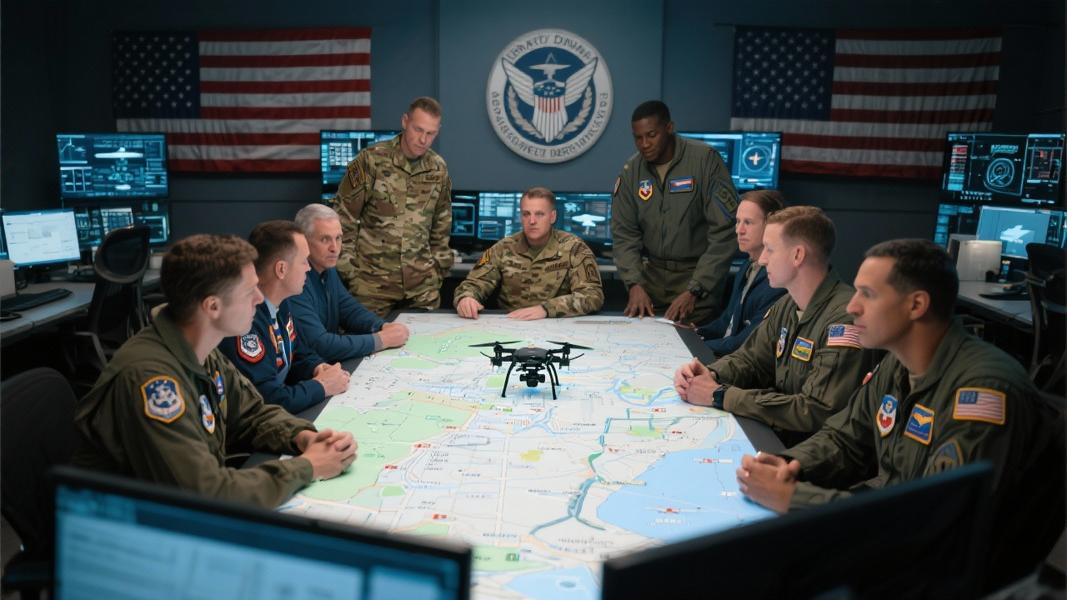
The Pentagon is taking dramatic steps to reclaim America’s airspace from a growing drone threat that’s been steadily eroding U.S. military advantages for over a decade.
Defense Secretary Pete Hegseth announced Thursday the establishment of the Joint Interagency Task Force 401 (JIATF 401), a specialized counter-drone unit with extraordinary powers to cut through traditional bureaucratic red tape and deliver rapid solutions to what officials describe as an urgent national security challenge. The task force will report directly to the Deputy Secretary of Defense, reflecting its high-level priority within the department.
“To ensure that American airspace remains secure, Secretary Hegseth directed Secretary of the Army to formally establish the Joint Interagency Task Force 401 (JIATF 401) — a new, unified team that will bring together our best talent from across all agencies to counter these threats and restore control of our skies,” the Pentagon announced in a statement.
Why Drones, Why Now?
The urgency behind JIATF 401’s creation stems from a sobering reality: the democratization of drone technology has fundamentally changed the battlefield. What was once the exclusive domain of advanced militaries is now accessible to virtually anyone with a credit card.
“Commercial technology has evolved in recent years such that drones on the civilian market are extremely cheap to buy and simple to operate,” defense experts noted in an analysis of the threat. “This has made it significantly easier for nation-states and terrorist groups to procure these types of systems and strap bombs to them, allowing adversaries to level the playing field against higher-tech combatants such as the U.S. military.”
The task force represents a significant shift in how the Pentagon approaches the drone threat. Rather than allowing each military service to develop its own counter-drone capabilities — potentially duplicating efforts and wasting resources — JIATF 401 will consolidate expertise and funding under a single command structure.
“We’re moving fast — cutting through bureaucracy, consolidating resources, and empowering this task force with the utmost authority to outpace our adversaries,” said Secretary Hegseth, who emphasized the administration’s commitment to innovation.
Built to Expire
Interestingly, the task force isn’t designed to become a permanent Pentagon fixture. According to a Defense Department memo, “The JIA TF 401 will have a sunset review at 36 months” — suggesting that officials expect to make significant progress on the counter-drone challenge within three years.
The task force’s mission aligns with both the Department of Defense Strategy for Countering Unmanned Systems and Executive Order 14305, which specifically addresses restoring sovereignty of American airspace. Its mandate includes protecting U.S. personnel, equipment, and facilities both at home and abroad.
Can the military actually solve a problem that’s been building for years in just 36 months? That remains to be seen, but the creation of JIATF 401 signals that the Pentagon is bringing unprecedented focus and resources to the challenge.
The task force will prioritize affordable and rapidly procurable counter-small unmanned aircraft systems (C-sUAS) solutions — an acknowledgment that the U.S. can’t rely solely on expensive, cutting-edge technology to counter threats that adversaries can deploy for a few hundred dollars.
Secretary Hegseth framed the effort in unambiguous terms: “Make no mistake — under this administration and President Trump’s leadership, we will innovate, we will lead, and we will win.”
