
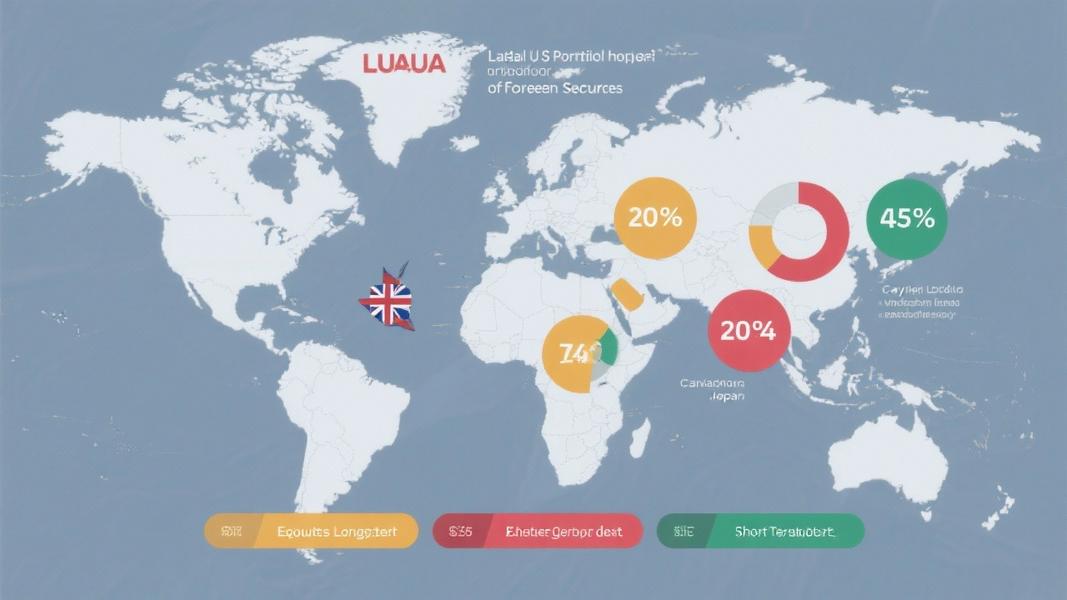
U.S. investors are betting big overseas, holding a record $15.8 trillion in foreign securities at the end of 2024, even as America’s own debt increasingly stays home.
New Treasury Department data reveals American portfolios now include $12.1 trillion in foreign equities, $3.3 trillion in long-term debt securities, and $393 billion in short-term debt instruments. The figures represent a modest increase from the $15.3 trillion total recorded at year-end 2023.
Offshore Financial Centers Dominate U.S. Foreign Holdings
Where exactly is all this American money flowing? Perhaps unsurprisingly, the Cayman Islands tops the list of destinations, attracting a staggering $2.76 trillion in U.S. investment. The British territory, known for its favorable tax policies and minimal regulatory oversight, has become a magnet for American capital seeking both returns and potential advantages.
The United Kingdom ($1.63 trillion), Canada ($1.47 trillion), Japan ($1.2 trillion), and Ireland ($1.06 trillion) round out the top five destinations for U.S. foreign investment, according to Treasury data.
What’s driving these investment patterns? Financial experts point to a combination of factors: global diversification strategies, search for higher yields abroad, and corporations utilizing international financial centers for operational flexibility.
America’s Growing Debt Stays More Local
Meanwhile, an interesting countertrend is emerging. While U.S. investors are sending trillions abroad, foreign investors are holding a decreasing share of America’s rapidly expanding national debt.
Foreign countries still hold a substantial $8.5 trillion in U.S. Treasury securities as of December 2024 — with Japan ($1.06 trillion) and China ($759 billion) remaining the largest foreign creditors. That’s an increase of $1.2 trillion in absolute terms, but it represents a smaller piece of America’s total debt pie, according to Congressional Research Service analysis.
“Because the total debt has increased faster than the debt held by foreigners, the share of federal debt held by foreigners has declined in recent years,” notes the report. “In December 2024, foreigners held 30% of the publicly held debt.”
This marks a significant shift from the peak of foreign ownership. In 2008, international investors held nearly half (49%) of all U.S. public debt — a figure that has been trending downward ever since.
America’s Deepening Investment Gap
The cross-border investment patterns highlight America’s complex position in the global financial system. The latest Bureau of Economic Analysis figures show the U.S. net international investment position stood at negative $23.6 trillion in the third quarter of 2024 — meaning Americans’ foreign assets ($37.86 trillion) were far outweighed by foreign claims on U.S. assets ($61.46 trillion).
Why the growing imbalance? One factor is that “the supply of U.S. debt has grown faster than foreign purchases of that debt,” explains the Bipartisan Policy Center. This has forced the U.S. to offer higher interest rates to attract investors, both domestic and foreign.
The changing dynamics of who holds America’s debt could have significant implications. With foreign investors owning a smaller share of U.S. Treasuries, the federal government may face different constraints and considerations in its fiscal policy decisions.
The shift also raises questions about the dollar’s long-term status as the world’s reserve currency. If foreign governments and investors continue to reduce their relative exposure to U.S. debt, it could eventually impact America’s borrowing costs and global financial leverage.
Still, the absolute numbers remain enormous. The $15.8 trillion that Americans have invested abroad and the $8.5 trillion that foreigners have invested in U.S. Treasuries alone represent massive financial ties that bind the global economy together — even as the balance of those relationships continues to evolve.
