
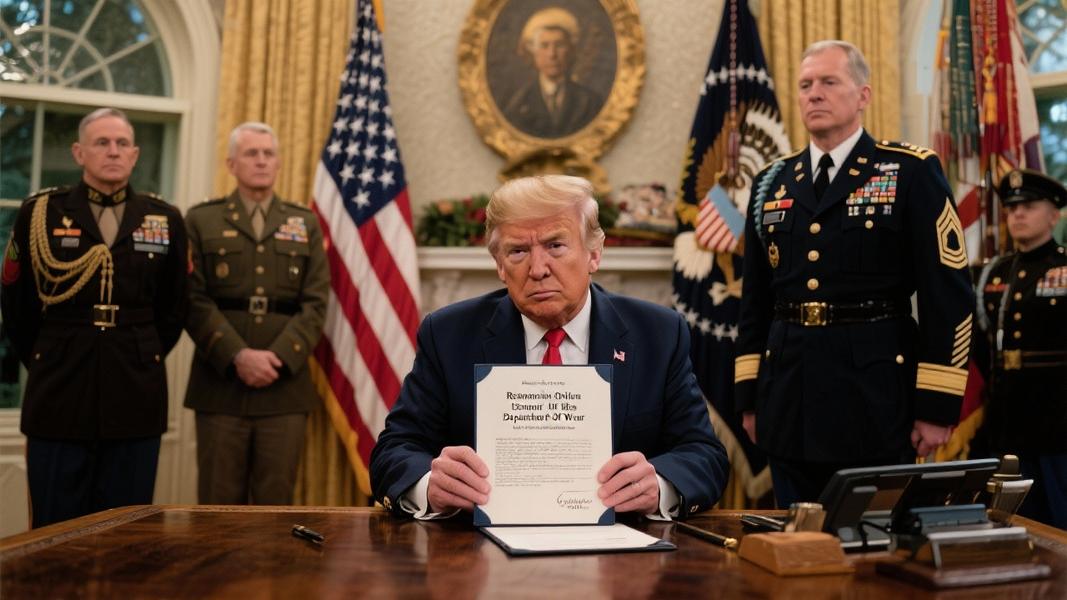
President Donald Trump has formally restored the title “Department of War” as a secondary designation for the Defense Department, signing an executive order Thursday that resurrects a name that hasn’t officially existed for more than 75 years.
The order, which took effect immediately, designates “Department of War” as an alternative title for the Department of Defense and “Secretary of War” as a secondary title for the Secretary of Defense. Trump’s administration has indicated this could be the first step toward permanently renaming the department.
“The name ‘Department of War,’ more than the current ‘Department of Defense,’ ensures peace through strength, as it demonstrates our ability and willingness to fight and win wars on behalf of our Nation at a moment’s notice, not just to defend,” Trump wrote in the executive order.
Reviving a 158-Year Legacy
The original Department of War was established on August 7, 1789, during the Washington administration, and survived for nearly 16 decades before being reorganized after World War II. The department existed “from August 7, 1789, to September 18, 1947, when, under the National Security Act of 1947, it split into the Department of the Army and the Department of the Air Force.”
But the historical Department of War functioned quite differently from today’s Defense Department. It primarily oversaw the Army rather than coordinating all military branches. “There was never a unified cabinet level defense secretary of war. There was a secretary of war, but that was the secretary of the Army,” military historians have noted. “The War Department did not run the nation’s wars. It ran the nation’s Army at war.”
What’s behind this symbolic shift? The move appears designed to project a more aggressive military posture internationally, though critics have already questioned whether rebranding serves any practical purpose.
The Truman-Era Transformation
The current Department of Defense emerged from a major post-World War II reorganization under President Harry Truman. In 1947, Truman merged the Navy, War, and Air Force departments into what was initially called the National Military Establishment.
Two years later, the entity was renamed the Department of Defense, removing Cabinet-level positions for the individual service secretaries and establishing the position of Secretary of Defense to oversee all branches. The reorganization also created the position of chairman of the Joint Chiefs of Staff.
That consolidation represented a fundamental shift in how America organized its military power, bringing the various service branches under unified civilian control and creating the structure that has served for over seven decades.
Symbolic Change or Substantive Shift?
Trump’s executive order doesn’t immediately dismantle the Department of Defense or radically reorganize the military. For now, it simply adds alternative titles while preserving the existing structure.
Still, the language in the order suggests this could be the beginning of a more permanent change. The administration has indicated it plans to work with Congress on legislation that would formally restore the Department of War name.
Defense experts remain divided on whether the name change represents mere symbolism or signals a deeper shift in military doctrine. Some military historians point out that the original Department of War was specifically designed for a much smaller military establishment in a different era.
Has America come full circle? In some ways, the move represents a rhetorical return to an earlier conception of military power, one that emphasizes offensive capability rather than defensive posture.
For now, Pentagon letterhead won’t change, and the massive Defense Department complex in Arlington, Virginia, will retain its current signage. But the psychological impact of reviving the “War Department” name may prove significant both domestically and in international relations.
“Names matter,” a senior administration official told reporters on background. “And this name tells our adversaries exactly what they need to know.”
