
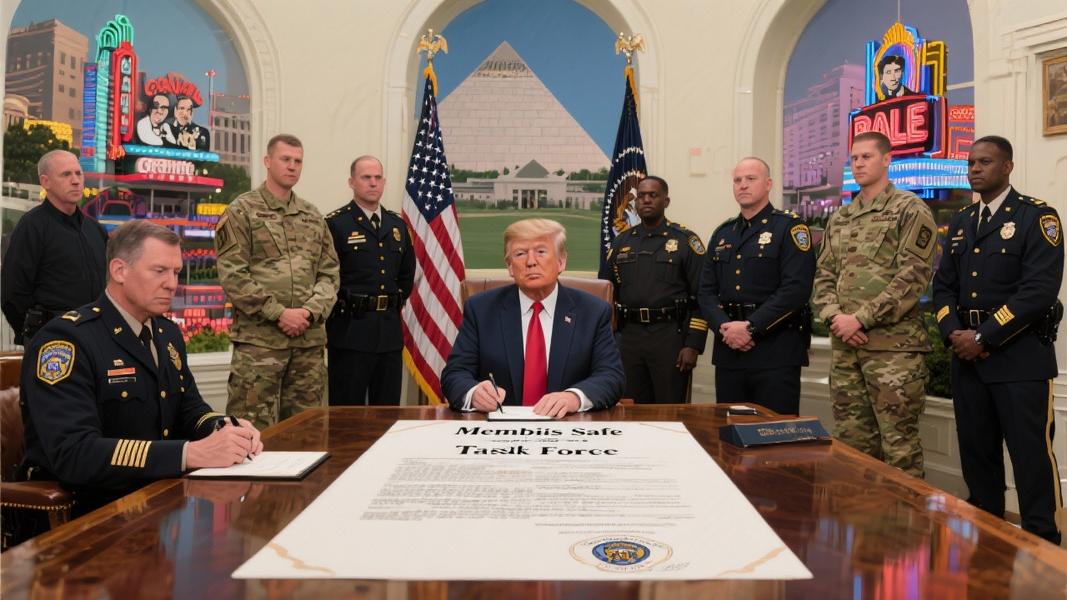
President Trump has ordered the formation of a special task force aimed at tackling Memphis’s soaring crime rates, a move that could potentially include deploying the Tennessee National Guard to city streets.
The Presidential Memorandum, signed earlier this week, establishes the “Memphis Safe Task Force” to coordinate with state and local officials in addressing what has become the highest violent crime rate of any major city in America. The directive specifically authorizes coordination with National Guard units — not just from Tennessee but potentially from neighboring states — to support overwhelmed local law enforcement.
A City Under Siege
How bad is it? Memphis currently holds the unfortunate distinction of having America’s highest violent crime rate among major metropolitan areas. The statistics paint a grim picture: murder, robbery and assault rates far above national averages in a city known for its rich cultural history and musical heritage.
The task force represents an unusual federal intervention into what has traditionally been a local or state matter. While federal agencies routinely partner with local law enforcement, the potential deployment of National Guard troops signals a more dramatic approach to urban crime fighting.
Rep. Steve Cohen (D-Tenn.), who represents Memphis, has previously characterized similar proposals to deploy National Guard units to Memphis streets as “a dangerous situation,” though he has not yet issued a formal response to this specific memorandum.
Coordination Across Jurisdictions
The presidential directive emphasizes coordination between federal resources and state and local officials, suggesting an acknowledgment that crime fighting requires multi-jurisdictional approaches. The Memphis police department has struggled with staffing shortages in recent years, a challenge faced by many urban police forces nationwide.
Law enforcement experts have long debated the effectiveness of National Guard deployments for crime reduction. While the additional personnel can provide visible presence and support to police operations, critics question whether military-trained personnel are equipped for the nuances of urban policing.
The White House has not provided specific metrics for what would constitute success for the task force, nor a timeline for how long any National Guard deployment might last.
Political Context
This initiative comes as crime rates have become an increasingly central theme in national political discourse. Trump has frequently highlighted crime statistics in Democratic-led cities during his campaign speeches.
Memphis Mayor Jim Strickland, a Democrat in his final term, has made public safety his administration’s top priority, though his office hasn’t yet issued an official response to the federal intervention. The city has implemented several initiatives aimed at reducing violent crime in recent years, including technology investments and community intervention programs.
Still, the persistent crime rates have frustrated residents and business owners, many of whom have expressed support for additional resources — whatever their source.
As the task force begins its work, Memphis residents are left wondering whether this federal intervention will bring meaningful change to their neighborhoods or simply add another layer to an already complex challenge. In a city that prides itself on resilience, the true measure will come not in memorandums or press releases, but in whether people ultimately feel safer on their streets.
