
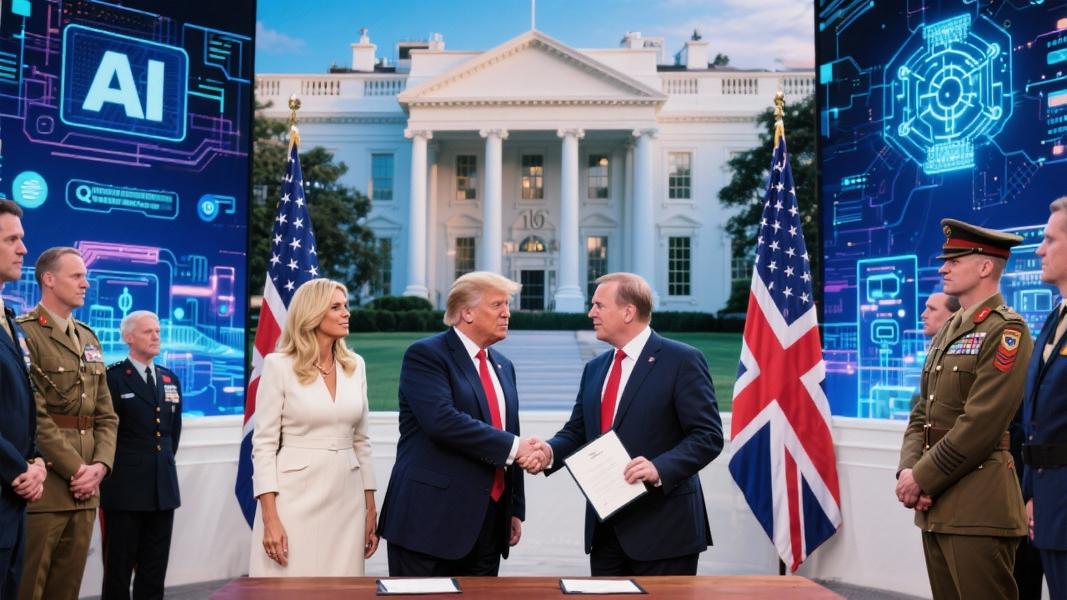
President Donald Trump made history this week as the only American president to receive two British state visits, marking a significant diplomatic milestone as he returned to the United Kingdom in his second term.
The three-day visit, which began September 16, saw Trump and First Lady Melania Trump warmly received by King Charles III and Queen Camila at Windsor Castle, with a ceremonial welcome that included a carriage procession alongside the Prince and Princess of Wales. The presidential couple later paid respects at Queen Elizabeth II’s tomb in St George’s Chapel, laying a wreath in a private moment that sources described as “deeply meaningful” to the president.
Technology Prosperity Deal Takes Center Stage
Beyond the pageantry, the visit’s substantive centerpiece emerged during Trump’s meeting with Prime Minister Keir Starmer at Chequers, where the leaders signed the ambitious Technology Prosperity Deal (TPD). This landmark agreement commits both nations to collaboration on artificial intelligence, quantum computing, and nuclear energy — technologies seen as critical to maintaining Western technological dominance in the coming decades.
“The Deal commits our nations to working together on the cutting-edge technologies of the future: AI, quantum computing, and nuclear energy,” the White House noted in a fact sheet distributed to journalists. The agreement includes establishing an AI for Science research program focused particularly on biotechnology and precision medicine.
What’s the economic impact? The TPD aims to generate $350 billion in new commercial outcomes benefiting both nations. Specific commitments include the UK government purchasing over $80 billion in U.S. tech and defense goods over five years, British pharmaceutical giant GSK investing $30 billion in AI R&D in America, and BP investing $5 billion in energy production mainly in the Gulf of America, according to White House documents.
Nuclear Cooperation Accelerates
A significant portion of the agreement focuses on nuclear energy cooperation, with regulatory bodies from both nations agreeing to streamline processes. “It also aligns the U.S. Nuclear Regulatory Commission, the UK Office for Nuclear Regulation, and the UK Environment Agency to streamline and accelerate licensing, targeting reactor design reviews within two years and site licensing within one year,” the White House confirmed.
In a move clearly aimed at Russia, “the United Kingdom will match U.S commitments to achieving full independence from Russian nuclear fuel by the end of 2028,” according to official statements. This timeline represents an acceleration of previous plans and signals growing Western determination to reduce energy dependence on Moscow.
Defense Innovation Partnership Strengthened
The visit also yielded significant defense cooperation agreements. The U.S. Defense Innovation Unit and UK Defence Innovation Organisation signed a joint declaration to advance what they’re calling a “next generation strategic partnership” on defense innovation. This partnership will focus on “prototyping of critical emerging and disruptive technology from the commercial sector,” as detailed in official releases.
Even before Trump’s arrival, the groundwork for tech collaboration was being laid. The UK awarded a $540 million contract to Google Cloud to support the UK Ministry of Defence and drive innovation, a move that observers saw as clearing the path for the broader technology agreement.
The Politics Behind the Pageantry
Despite policy differences on several fronts, Prime Minister Starmer appeared eager to establish a productive relationship with the returning president. Both leaders emphasized the “special relationship” between their nations, with Starmer using the state visit to build what analysts described as “a warm personal relationship with Trump” as part of a diplomatic strategy to curry favor with Washington.
The visit wasn’t without controversy, however. A “massive security operation” surrounded the royal residence as demonstrators protested Trump’s presence, highlighting the polarizing nature of the American president even on foreign soil. “The US president’s presence is bringing mixed reactions from residents,” one media outlet reported.
Still, officials from both countries emphasized that the TPD would “create thousands of new jobs, make energy more affordable, and keep our two nations ahead in science and technology,” suggesting that practical cooperation might transcend political differences.
As Trump departed British soil, the visit left behind both ceremonial memories and substantive agreements — a combination of pomp and policy that may define the special relationship for years to come, even as both nations navigate increasingly complex global challenges.
