
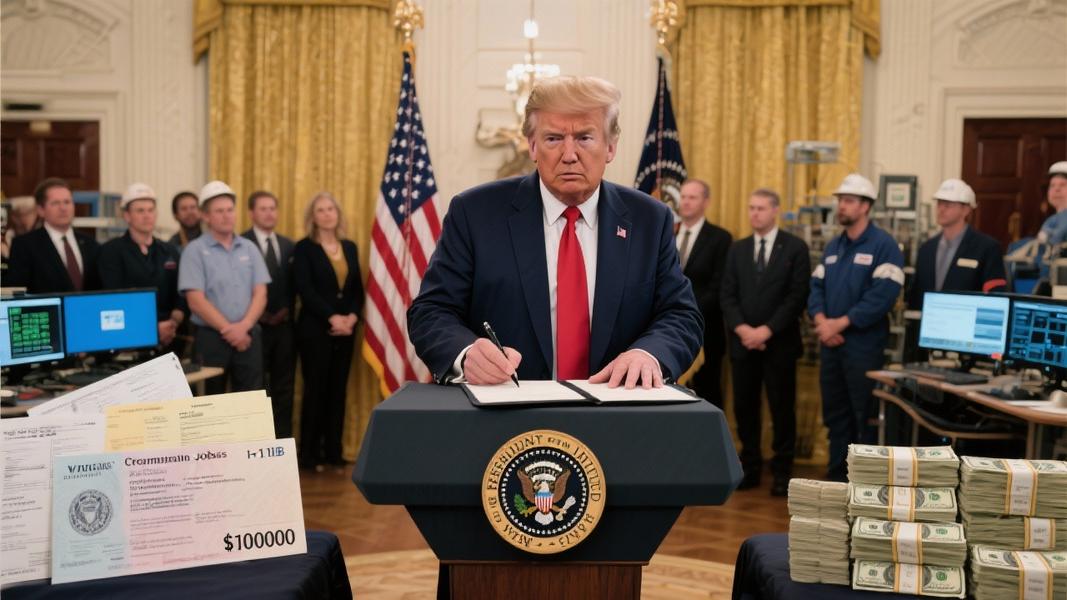
President Trump has signed a sweeping proclamation that will dramatically reshape the H-1B visa program, imposing a hefty $100,000 payment requirement for companies seeking to bring in foreign specialty workers — a move the White House describes as necessary to protect American jobs and national security.
The new restrictions target what the administration characterizes as widespread abuse of the program, amid growing concerns that U.S. tech workers are being displaced by foreign labor. Under the proclamation, employers must make the substantial payment for each H-1B worker entering from abroad, with the Departments of State and Homeland Security tasked with verifying compliance and denying entry to those who don’t meet the new requirements.
“The Proclamation restricts entry for aliens as nonimmigrants to perform services in specialty occupations in the H-1B program unless their petition is accompanied by a $100,000 payment,” according to a White House fact sheet released alongside the executive action.
Tech Companies in the Crosshairs
The move comes as the administration points to troubling trends in the IT sector, where the share of H-1B visa holders has more than doubled over two decades — from 32% in 2003 to over 65% in recent years. Meanwhile, unemployment for recent computer science and engineering graduates has reached alarming levels.
“Unemployment among recent computer science graduates has reached 6.1% and 7.5% for computer engineering graduates — more than double the rates for biology or art history majors,” the White House noted.
The administration specifically called out several major companies that have been approved for thousands of H-1B workers while simultaneously laying off American employees. One unnamed company was approved for 5,189 H-1B workers for fiscal year 2025 while laying off approximately 16,000 U.S. employees this year, while another received 1,698 H-1B approvals despite announcing 2,400 layoffs in Oregon in July, according to White House figures.
Perhaps most controversially, the White House claimed that “American IT workers have even been reportedly forced to train their foreign replacements under nondisclosure agreements” — a practice that’s drawn fierce criticism from labor advocates.
National Security Concerns
Beyond the immediate economic implications, the Trump administration has framed the H-1B issue as a matter of national security. The White House argues that the current system creates disincentives for American students to pursue STEM careers, potentially undermining the country’s technological edge.
“The H-1B program is creating disincentives for future American workers to choose STEM careers, which threatens our national security,” the administration stated.
The proclamation includes provisions for case-by-case exemptions when deemed in the national interest, though details on what might qualify remain unclear. It also directs the Departments of Labor and Homeland Security to issue joint guidance on verification, enforcement, audits, and penalties related to the new requirements.
What happens to companies that can’t — or won’t — pay the $100,000 fee? The proclamation instructs the Secretary of Homeland Security to restrict approvals for petitions from aliens currently outside the United States if they’re not accompanied by the required payment.
Broader Economic Strategy
The H-1B restrictions represent just one part of what the White House characterizes as a comprehensive “America First” economic agenda. Since returning to office, the administration highlights that “all employment gains have gone to American-born workers—unlike last year during the same period under President Biden, when all employment gains went to foreign-born workers.”
The administration has also issued new guidance to exclude undocumented immigrants from accessing federal workforce development resources and related grants, a move it says will protect training opportunities for American workers.
On the trade front, President Trump has “aggressively and successfully negotiated new trade deals to bring manufacturing jobs back home and attract new investments to the U.S.,” the White House asserted. The administration has implemented several Section 232 tariffs aimed at protecting domestic manufacturing from what it describes as unfair trade practices and global excess capacity.
Critics will likely question whether the $100,000 payment requirement effectively prices smaller companies out of the H-1B program, potentially concentrating access to foreign talent among only the wealthiest corporations. There may also be questions about how the funds collected will be used, as the proclamation doesn’t specify a destination for the payments.
Still, for American tech workers who’ve felt the squeeze from H-1B competition, the move represents perhaps the most dramatic overhaul of the specialty visa program in decades — one that fundamentally alters the economics of importing foreign tech talent.
