
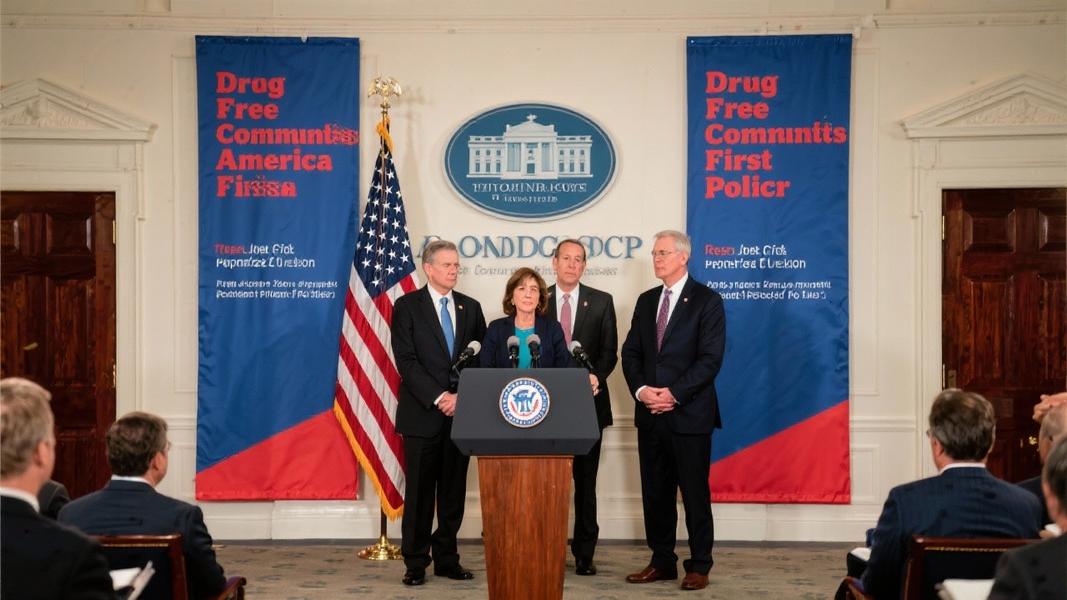
The White House drug policy office has announced it will recompete the 2025 Drug-Free Communities (DFC) Support Program awards to ensure recipients comply with President Trump’s executive orders, framing the move as protection against “the radical left’s agenda.”
“We are performing due diligence to ensure that absolutely no taxpayer dollars go to furthering the radical left’s agenda,” the Office of National Drug Control Policy (ONDCP) said in a statement. “The money remains available for awards. We want to ensure that the money entrusted to our office is being responsibly allocated to the communities that are actually working to protect our youth from drugs.”
A Program With Deep Roots
The DFC Support Program, created in 1997, provides grants of up to $125,000 annually to community coalitions fighting youth substance abuse. Currently, more than 750 coalitions across the country receive this funding, which helps local organizations strengthen collaboration and create infrastructure to reduce youth substance use.
The program has shown measurable success. National evaluations have documented significant declines in past 30-day substance use among both middle and high school students in communities served by DFC coalitions, spanning alcohol, tobacco, marijuana, and prescription drugs.
So why the sudden recompetition? The ONDCP’s decision aligns with broader Trump administration priorities that emphasize what it calls an “America-First policy agenda.” This comes as the administration has also proposed significant changes to other drug enforcement programs, including a 35% funding cut to the High Intensity Drug Trafficking Areas (HIDTA) program and moving it from ONDCP to the Justice Department.
The ONDCP isn’t facing budget cuts itself, though. Its FY 2026 budget request remains steady at $21,785,000 with 72 full-time equivalents, unchanged from FY 2025, according to its congressional budget submission.
Broader Drug Policy Context
The recompetition announcement comes months after ONDCP released the Trump Administration’s Drug Policy Priorities in April 2025. These priorities focus on reducing overdose fatalities (particularly from fentanyl), securing drug supply chains, preventing drug flow, discouraging drug use, providing recovery treatment, and advancing research.
As the lead coordinator for the nation’s drug policy, ONDCP oversees a massive $44 billion budget involving 19 federal agencies. The office states its mission is to improve “the health and lives of the American people” through addressing addiction and overdose.
Critics might question the timing of this recompetition decision. Will it disrupt services at a time when many communities are still battling substance abuse challenges? The administration has emphasized that funding remains available, but the process of reapplying could create delays or uncertainty for organizations currently receiving grants.
“Historically, the High Intensity Drug Trafficking Area programs have been administered from the Office of National Drug Control Policy, and it’s been a very successful model over the years,” noted one source familiar with federal drug enforcement programs, highlighting concerns about other proposed changes to drug policy implementation.
For now, community coalitions that have relied on DFC funding must prepare to navigate a new application process while continuing their work to prevent youth substance use — all under heightened scrutiny about their alignment with the administration’s policy priorities.
