
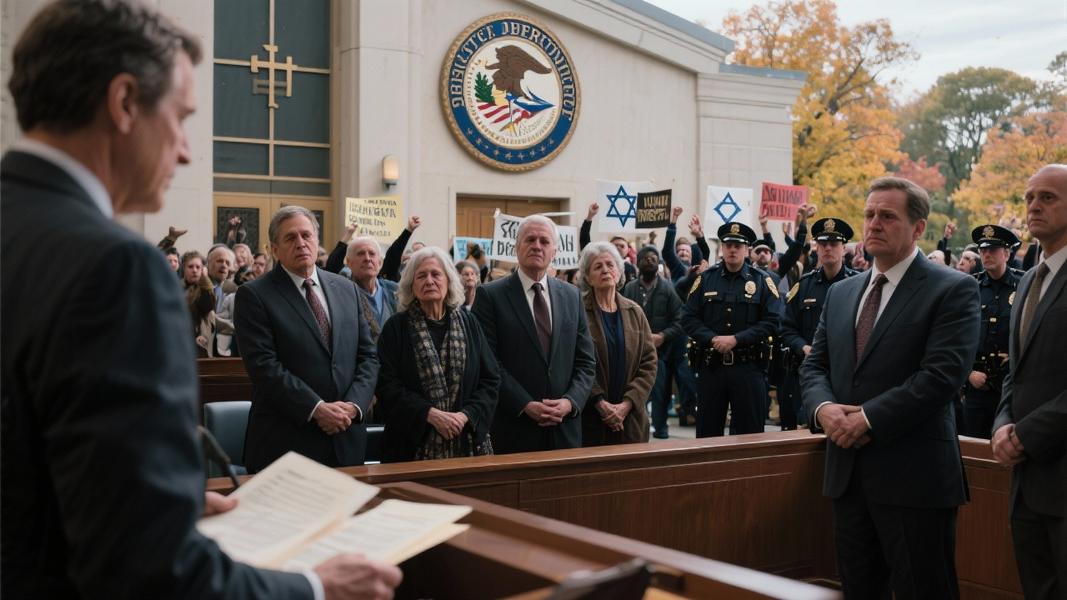
The Justice Department has filed a civil lawsuit against protesters who allegedly targeted a New Jersey synagogue during a violent demonstration last November, marking a significant escalation in federal protection of religious worship sites.
The legal action, filed under the Freedom of Access to Clinic Entrances (FACE) Act, targets individuals who participated in protests at Congregation Ohr Torah synagogue in West Orange that reportedly turned violent. Attorney General Pamela Bondi didn’t mince words about the department’s position.
“No American should be harassed, targeted, or discriminated against for peacefully practicing their religion,” Bondi stated when announcing the lawsuit. “Today’s lawsuit underscores this Department of Justice’s commitment to defending Jewish Americans — and all Americans of faith — from those who would threaten their right to worship.”
Escalating Tensions at Houses of Worship
The November 13, 2024 incident is part of what authorities describe as a troubling pattern of confrontations at religious sites. The protest at the West Orange synagogue led to several arrests and charges, including bias intimidation and aggravated assault against David (Solomon) Silberberg and Moshe Glick, according to court records.
Dr. Glick, one of those arrested during the chaotic scene, later described his experience. “Being charged, arrested, fingerprinted, and having my mugshot taken was not a fun experience,” he admitted. “At that moment, I wished I hadn’t seen ‘Shawshank Redemption’ so many times. But I wore my kippa, held my head high, and knew everything is… *B’yedei Shamayim* (in God’s hands).”
What exactly prompted the demonstrations? The protests appear linked to broader objections against events promoting real estate sales in Israeli settlements, which some international organizations consider illegal under international law. Protesters claim these events sometimes take place at synagogues and Jewish community centers.
“If they would stop having illegal stolen land sales events hidden in their synagogues and Jewish community centers, we wouldn’t be going there protesting,” said Tova, identified as a Jewish organizer with PAL-Awda NY/NJ, who was quoted in recent coverage of similar protests.
Legal Battle Lines Drawn
The FACE Act, originally passed in 1994, makes it “unlawful to use force, threats of force, or physical obstruction to intentionally injure, intimidate, or interfere with any person lawfully exercising their rights to seek or provide services or to worship,” according to Justice Department documents.
Though initially created to protect abortion clinics from violent protesters, the law has increasingly been used to safeguard houses of worship facing similar threats.
But the case isn’t straightforward. Some advocacy groups have suggested there’s pressure being applied to influence the legal outcomes. “There is no coincidence here. CAIR is using every opportunity to flip the scenario, assert blame elsewhere, and pressure law enforcement to acquit violent pro-Palestinian protesters who break the law,” according to concerns raised in Jewish community publications.
Assistant Attorney General Harmeet K. Dhillon emphasized the government’s resolve: “This Justice Department will vigorously enforce the right of every American to worship in peace and without fear,” she declared.
The violence in West Orange represents a flashpoint in the ongoing tensions between pro-Palestinian activists and Jewish institutions in the U.S., tensions that have intensified following conflicts in the Middle East. While protesters claim they’re targeting specific political activities, Jewish community leaders argue the demonstrations have crossed a line into religious intimidation.
As federal authorities step in with this FACE Act lawsuit, one question remains particularly thorny: Where should the line be drawn between protected political protest and unlawful interference with religious freedom?
The case will likely test not only the boundaries of First Amendment protections but also the federal government’s role in safeguarding religious communities increasingly caught in the crosshairs of global political disputes.
