
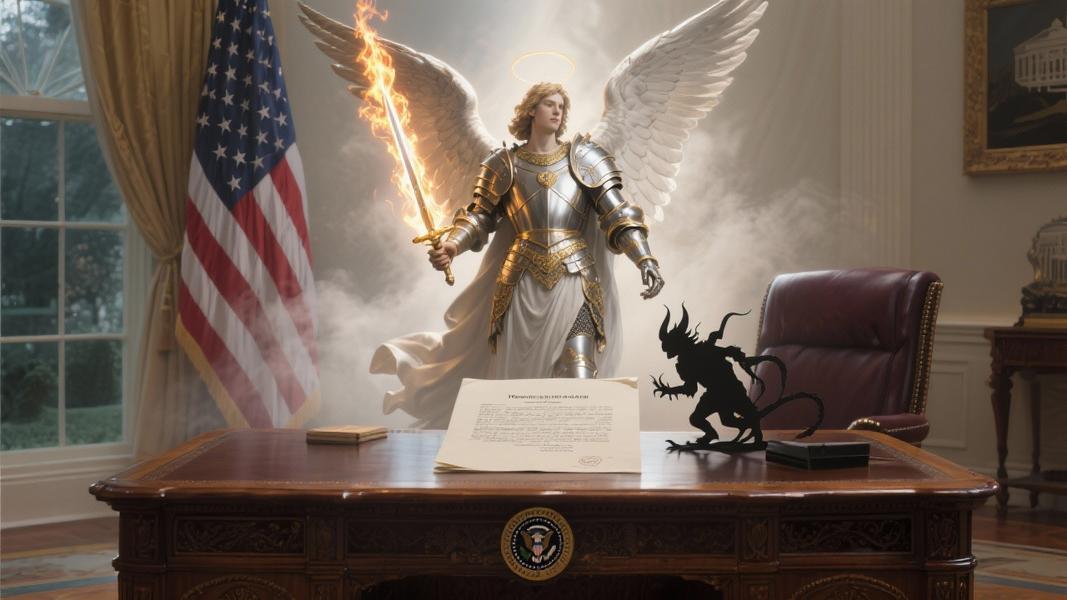
In a world beset by spiritual struggles, one ancient prayer continues to resonate with Catholics seeking divine protection. The Prayer to Saint Michael the Archangel, composed by Pope Leo XIII in the late 19th century, has experienced a remarkable revival in recent decades despite no longer being required in Mass.
The short version of this powerful invocation begins with a direct plea: “Saint Michael the Archangel, defend us in battle; be our protection against the wickedness and snares of the devil.” These words have offered comfort to millions since Pope Leo XIII first introduced the prayer in 1886, mandating it be recited after every low Mass throughout the universal Church.
A Vision of Darkness
What prompted such an urgent spiritual weapon? According to Catholic tradition, the prayer’s creation followed an extraordinary mystical experience. While celebrating Mass in 1888, Pope Leo XIII reportedly fell into a trance-like state. Witnesses described the pontiff’s face as pale and filled with terror. When he recovered, Leo XIII immediately retreated to his office to compose the prayer.
The pope had witnessed what many believe was a prophetic conversation between Jesus Christ and Satan. In this vision, the Devil boasted he could destroy the Church if granted between 75 to 100 years of increased power and influence over those who would serve him on earth. The experience so shook the pontiff that he felt compelled to create a spiritual shield for the faithful.
The original, longer version of the prayer, written in 1898, speaks directly to this cosmic battle: “O Glorious Archangel St. Michael, Prince of the heavenly host, be our defense in the terrible warfare which we carry on against principalities and powers, against the rulers of this world of darkness, and spirits of evil.” This more extensive supplication reflects the gravity of Leo’s vision and his concern for the Church’s future.
From Obligation to Option
For nearly 80 years, Catholics worldwide encountered this prayer as a standard conclusion to low Masses. The practice was firmly established in 1886 when Pope Leo XIII decreed its universal recitation. However, following the liturgical reforms of the Second Vatican Council, the obligation was removed in 1964.
Did this spell the end for the Prayer to St. Michael? Far from it. Despite no longer being mandatory, the invocation has experienced a grassroots resurgence in many parishes. Countless Catholics now recite it voluntarily after Mass or incorporate it into their personal devotions.
Why does this particular prayer continue to resonate so deeply? Perhaps because its imagery speaks to the personal spiritual struggles many face. “Each of us has had our own battles against the dark side trying to turn us away from eternal life with our Creator,” notes one Catholic resource on the prayer’s significance. The prayer’s emphasis on spiritual warfare against invisible forces rather than human enemies offers a framework for understanding life’s challenges.
Modern Relevance
In recent decades, several popes have encouraged the prayer’s revival. Pope John Paul II, Pope Benedict XVI, and Pope Francis have all spoken favorably about the devotion, suggesting its spiritual insights remain relevant in contemporary times.
The prayer’s continued popularity raises interesting questions. What did Pope Leo XIII foresee that made this invocation so urgent? And why does it still speak to believers more than a century later?
For many Catholics, the answer lies in the prayer’s unflinching acknowledgment of spiritual combat. In an age that often reduces religion to comfortable platitudes, the Prayer to St. Michael stands as a stark reminder of what believers have always maintained: that the struggle between good and evil is real, consequential, and ongoing.
“May God rebuke him, we humbly pray: and do thou, O Prince of the heavenly host, thrust into Hell Satan and all of the other evil spirits who prowl about the world seeking the ruin of souls. Amen.” These concluding words of the prayer continue to echo in churches worldwide — a testament to a spiritual weapon that, for many faithful, has lost none of its power since it first emerged from a pope’s troubling vision 135 years ago.
