
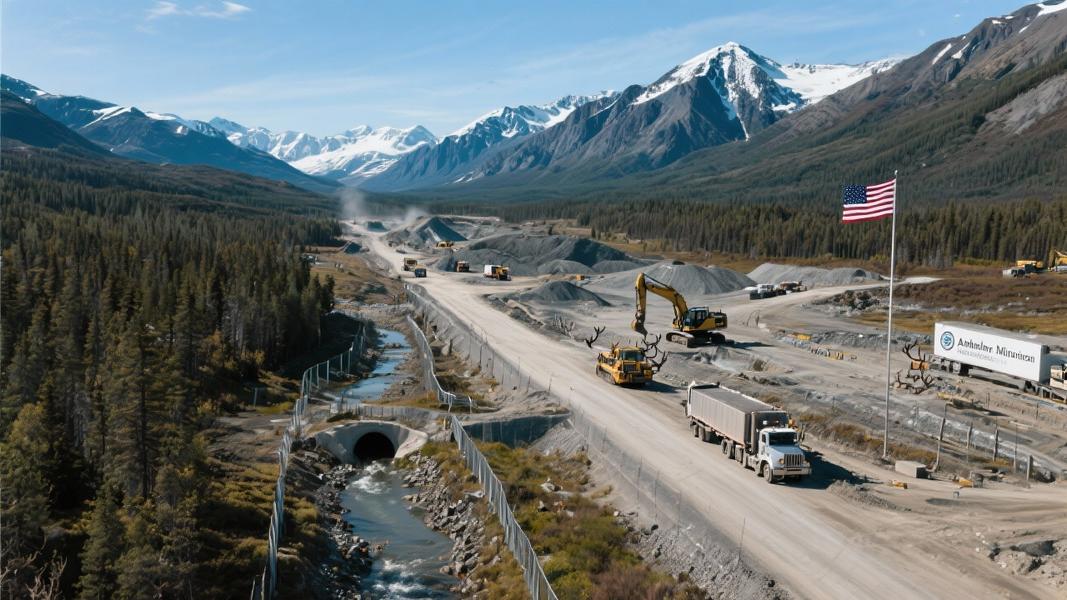
President Trump has revived the controversial Ambler Road Project, a 211-mile industrial access route into one of Alaska’s most mineral-rich and environmentally sensitive regions. The executive action, announced today, overturns Biden administration decisions that had effectively halted the project.
The road would connect Alaska’s Dalton Highway to the remote Ambler Mining District, unlocking access to what proponents describe as “large deposits of copper, cobalt, gallium, germanium, and more” – minerals deemed critical for America’s defense and technology sectors. Trump’s decision directs federal agencies to “promptly issue authorizations” for the project, delivering a major victory to mining interests and Alaska’s development authority.
Economic Boom or Environmental Bust?
The Ambler Road represents a significant pivot in resource development policy. After the Biden administration selected the “no action” alternative in an April 2024 environmental impact statement, effectively blocking the project, Trump’s reversal puts it firmly back on track. “They undid it and wasted a lot of time and a lot of money and a lot of effort,” Trump said of the previous administration’s decision. “And now we’re starting again, and this time, we have plenty of time to get it done and it’s going to be done properly.”
The project’s economic impact could be substantial. Construction alone is projected to support 2,730 jobs, with Alaska expected to receive more than $1.1 billion in revenues through mining license taxes, corporate income taxes, royalties, and claim rents, according to White House statements.
But it’s not just about opening a road. In a surprising move, the administration also announced a direct $35.6 million investment in Trilogy Metals, making the federal government a 10% shareholder in the mining company with warrants to purchase an additional 7.5% stake. This unusual public-private partnership signals how far the administration is willing to go to secure access to minerals currently dominated by Chinese suppliers.
“Mine, Baby, Mine”
Interior Secretary Doug Burgum didn’t mince words about the administration’s priorities. “President Trump, when he said, ‘drill, baby drill,’ he also was ‘mine, baby, mine.’ We’ve got to get back in the mining business,” Burgum emphasized, pointing to the need to reduce dependency on Chinese mineral supplies.
The Ambler Mining District is home to over 1,700 active mining claims across what some geologists consider one of the world’s largest undeveloped copper-zinc mineral belts. These deposits contain materials essential for everything from electric vehicles to military equipment.
Who exactly will own this new industrial artery? According to Burgum, ownership of the road is expected to be split between the state of Alaska, the federal government, and “native Alaska corporations” – a complex arrangement that reflects the competing interests at stake.
Environmental and Indigenous Concerns
Can a 211-mile industrial road cut through pristine wilderness without significant environmental impact? That’s the question environmental groups and many Alaska Native communities have been asking for years.
The project has faced persistent opposition from conservation organizations and several indigenous communities concerned about threats to subsistence hunting and fishing. The road would cross nearly 3,000 streams and rivers, including habitats crucial for caribou migration and salmon spawning.
The Biden administration’s 2024 decision to select the “no action” alternative came after years of legal challenges and regulatory reviews that highlighted these concerns. Trump’s executive order effectively wipes away those environmental determinations, reinstating his administration’s original 2020 approval.
The Alaska Industrial Development and Export Authority (AIDEA), which manages the project, has long maintained that the road is essential for economic development in a state heavily dependent on resource extraction. But critics question whether the promised economic benefits justify the potential costs to one of America’s last truly wild landscapes.
As federal agencies rush to comply with the president’s directive, one thing is clear: the battle over the Ambler Road is far from over. Legal challenges are almost certain to follow, once again testing the balance between resource development and environmental protection in America’s last frontier.
