
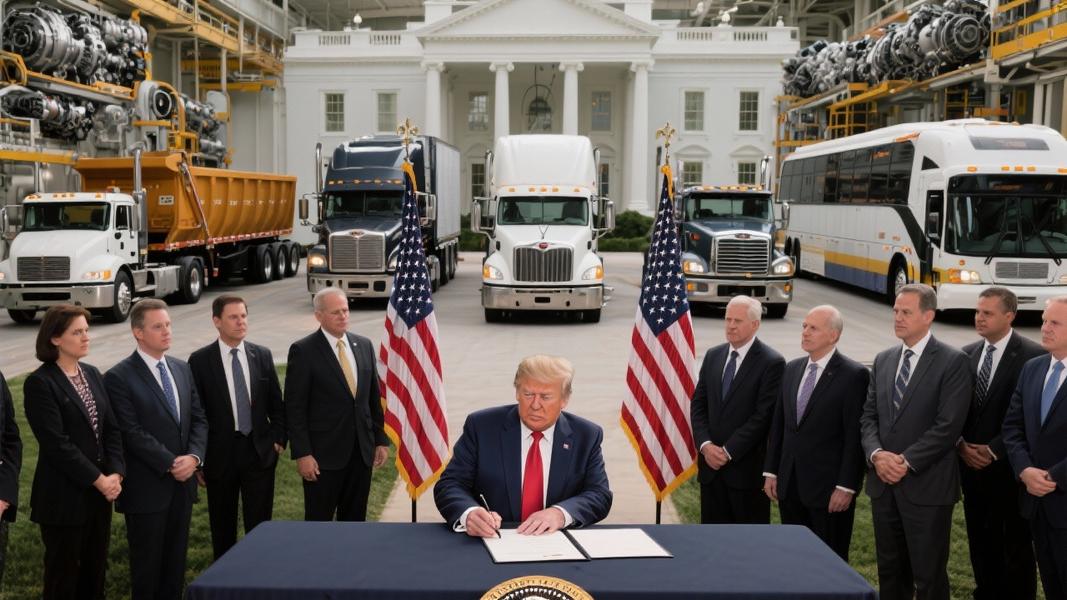
President Trump has imposed sweeping new tariffs on medium- and heavy-duty trucks and buses, citing national security concerns in a move that could reshape America’s commercial vehicle industry. The 25% tariff on trucks and parts — along with a 10% tariff on buses — represents one of the administration’s most significant trade actions since returning to office.
The White House announced the measures Thursday through a Presidential Proclamation invoking Section 232 of the Trade Expansion Act of 1962, a rarely-used provision allowing trade restrictions when imports threaten national security. “Today, President Donald J. Trump signed a Proclamation invoking Section 232 of the Trade Expansion Act of 1962 to impose tariffs on imports of medium- and heavy-duty vehicles and parts, and buses, to bolster American industry and protect national security,” the White House statement read.
What’s covered by the tariffs?
The tariffs will apply to a wide range of commercial vehicles, from Class 3 to Class 8 — essentially covering everything from large pickup trucks to the massive eighteen-wheeler tractor units that dominate America’s highways. Also included are moving trucks, cargo vehicles, and dump trucks. For parts, the 25% tariff targets critical components including engines, transmissions, tires, and chassis — the building blocks of the commercial vehicle industry.
But there’s a notable carve-out. The Proclamation grants special treatment to vehicles and parts compliant with the United States-Mexico-Canada Agreement (USMCA). For USMCA-qualifying trucks, the tariff will only apply to the non-U.S. content in the vehicle — sparing the American-made portions from additional costs.
USMCA-compliant truck parts get an even better deal, at least temporarily. They’ll be exempt from the tariffs until the Commerce Department establishes procedures to apply tariffs specifically to their non-U.S. content, according to the White House statement.
Incentives for domestic production
The Trump administration isn’t just wielding the tariff stick — it’s also offering a carrot. The Proclamation creates an offset program designed to incentivize domestic manufacturing, allowing companies to reduce their tariff burden by producing more vehicles in the United States.
“The Proclamation incentivizes domestic medium- and heavy-duty truck production by offering an offset to a portion of tariffs for medium- and heavy-duty truck parts equal to 3.75% of the aggregate value of all trucks assembled in the United States from 2025 through 2030,” the White House explained. A parallel program will apply to truck engine manufacturers based on U.S. assembly value.
The administration is also extending its automobile tariff offset program through 2030, allowing car manufacturers to offset a portion of tariffs on parts equal to 3.75% of the MSRP of vehicles assembled domestically — creating consistency across vehicle manufacturing sectors.
The national security argument
Why invoke national security for what some critics might view as purely economic protectionism? The Commerce Department’s Section 232 investigation found that the U.S. has grown dangerously dependent on imports, with foreign trucks now accounting for about 43% of all medium and heavy-duty trucks sold in America.
The White House cited several concerns: these vehicles are critical for military readiness and emergency response; they transport over 70% of American freight; and the U.S. increasingly relies on foreign suppliers for crucial components like engines, batteries, and transmission shafts.
“America also increasingly relies on foreign suppliers for several important categories of medium- and heavy-duty truck parts, including engines, batteries, transmission shafts, castings, and forgings,” the administration stated.
Economic impact remains uncertain
What will this mean for prices? So far, the commercial vehicle market has shown remarkable resilience. S&P Global reports that year-over-year price increases on new medium and heavy-duty commercial vehicles remained below 2% in the first half of 2025 — “well shy of the more-than 10% increase that had previously been seen as a worst-case scenario.”
Analysts expect the full pricing impact to be delayed until 2026, as weak demand and supplier countermeasures temporarily cushion the blow. Still, some industry observers worry that higher costs could eventually filter down to consumers through increased shipping expenses.
Several details remain unclear. S&P Global notes uncertainty about whether all vehicle types over 5 tons GVWR will face the same tariff treatment, and questions remain about specific exemptions.
A familiar playbook
This isn’t President Trump’s first use of Section 232 tariffs. His administration has previously applied similar measures to steel, aluminum, copper, and automobiles — all justified on national security grounds. And more may be coming.
“The Department of Commerce is currently conducting additional investigations, including investigations on semiconductors, commercial aircraft, wind turbines, robotics, unmanned aircraft systems, and personal protective equipment,” the White House revealed.
For America’s truck manufacturers and their suppliers, the message is clear: the administration is betting that short-term pain from tariffs will lead to long-term gain for domestic production. Whether that bet pays off — and at what cost to consumers and international trade relationships — remains to be seen.
