
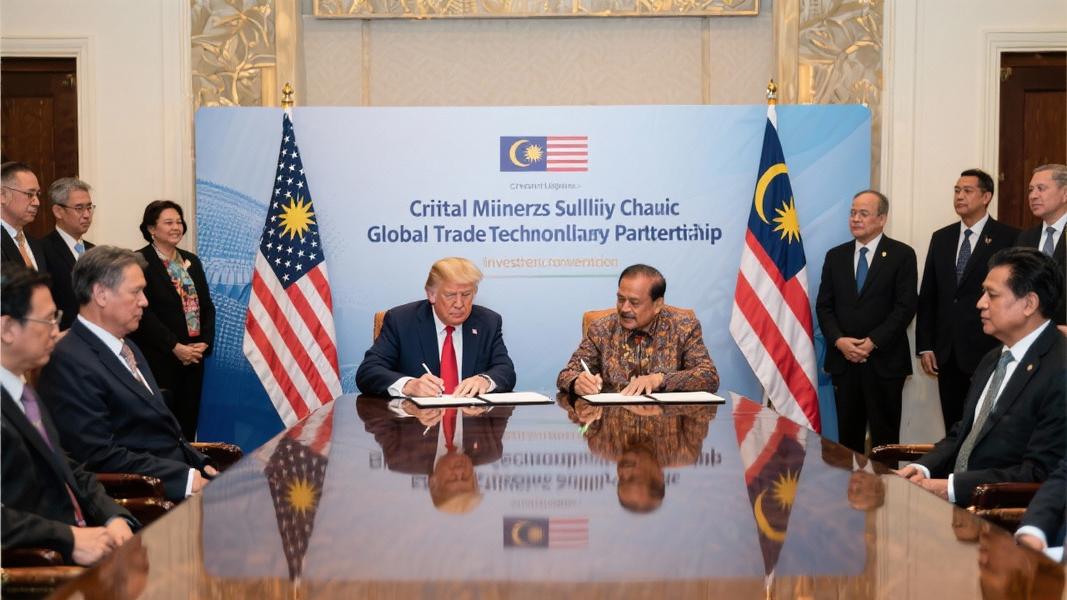
The United States and Malaysia have inked a landmark trade deal that promises to dramatically reshape economic relations between the two nations, opening unprecedented access to each other’s markets amid growing competition in the Asia-Pacific region.
The agreement, signed this week, represents what officials are calling a “substantive and comprehensive” reciprocal trade pact that addresses everything from tariffs to critical minerals supply chains. It comes as both nations seek to strengthen economic ties in a rapidly evolving global marketplace.
Breaking Down the Deal
Under the new agreement, Malaysia will provide preferential market access for U.S. exports across a wide range of sectors, including chemicals, machinery, electrical equipment, and agricultural products like dairy, poultry, and rice, according to officials who announced the deal.
The U.S., for its part, will maintain a 19% reciprocal tariff on Malaysian goods, though certain products will receive a zero percent tariff rate — a nuanced approach that reflects the complex balance of interests at play.
“We have drafted a substantive and comprehensive agreement on reciprocal trade,” said Jamieson Greer, a U.S. trade representative involved in the negotiations, highlighting the significance of the deal that required Malaysia to modify both tariffs and non-tariff barriers to American goods in several key sectors.
Beyond Traditional Trade
What makes this agreement particularly noteworthy? It goes well beyond conventional trade provisions to address emerging economic concerns.
The deal includes significant environmental and labor commitments from Malaysia, including pledges to maintain high levels of environmental protection, enforce labor rights, and prevent forced labor — issues that have previously complicated trade relations between the nations.
Digital trade also features prominently, with Malaysia agreeing to refrain from imposing discriminatory digital services taxes on U.S. companies and ensuring data transfer protections. Both countries have also committed to enhancing intellectual property protection and enforcement, a key concern for American technology and content companies.
Critical Minerals Focus
Perhaps most strategically significant is the agreement’s emphasis on critical minerals supply chains, which aims to secure vital resources needed for advanced technology manufacturing.
Under the deal, Malaysia has committed not to ban or impose quotas on critical minerals exports to the U.S. and will partner with American companies to develop its critical minerals sector. This provision comes as global competition for these resources — essential for everything from smartphones to electric vehicles — continues to intensify.
The agreement also mentions several notable commercial deals between U.S. and Malaysian companies, including significant procurement arrangements for aircraft, semiconductors, and liquefied natural gas, though specific financial details weren’t immediately disclosed.
Regional Implications
Trade experts view this agreement as part of a broader U.S. strategy to strengthen economic ties in Southeast Asia amid increasing regional competition. Malaysia, with its strategic location and growing economy, represents an important partner in this approach.
The deal establishes a framework that could potentially serve as a template for future U.S. trade agreements in the region, emphasizing reciprocity and addressing non-tariff barriers that have often proved more challenging than traditional tariffs in opening markets.
Still, implementation will be the true test. Both countries will need to navigate domestic political considerations and competing economic interests as they work to translate the agreement’s provisions into tangible benefits for their businesses and citizens.
As global trade patterns continue to evolve amid geopolitical tensions and technological change, this U.S.-Malaysia agreement signals that bilateral deals may increasingly complement multilateral frameworks in shaping the future economic landscape of the Asia-Pacific region.
