
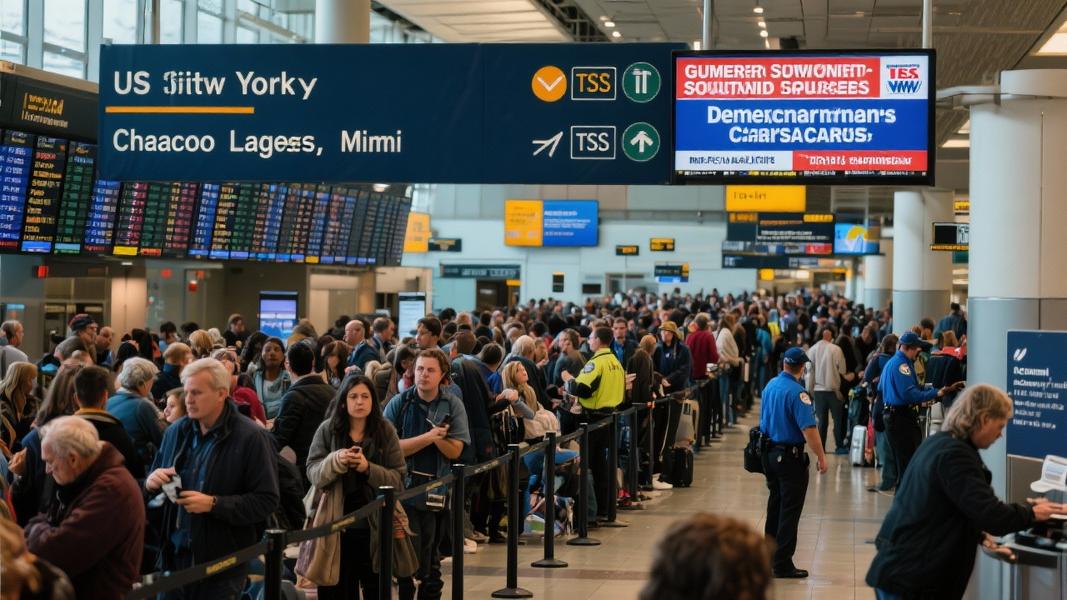
Travelers across the U.S. are facing a nightmare scenario as the ongoing government shutdown has pushed airport security lines to unprecedented lengths, with some passengers at Houston’s Bush Intercontinental Airport enduring waits of up to five hours to clear TSA checkpoints.
The situation has reached crisis levels at major transportation hubs nationwide, where staffing shortages among unpaid federal workers have created a perfect storm of delays, cancellations, and increasingly frazzled travelers. At Bush Airport, officials have taken to social media to warn passengers: “TSA wait times may exceed 3 hours. We ask that passengers continue to arrive early and expect extended security wait times until the federal government shutdown is resolved.”
Air Travel System Under Extreme Strain
The chaos isn’t limited to Houston. William P. Hobby Airport is also experiencing security wait times routinely exceeding 60 minutes, while half of the nation’s busiest airports faced severe staffing shortages over the weekend. Air traffic control facilities are now reporting roughly four times more staffing triggers compared to the same period last year, according to data tracking the crisis.
How bad has it gotten? Passengers in New York City are being warned of “schedule changes, gate holds, and missed connections,” while similar disruptions have hammered Chicago, San Francisco, San Diego, Los Angeles, and over a dozen other major cities. The ripple effects are being felt across the entire commercial aviation network as unpaid federal workers call out sick or seek temporary employment elsewhere.
“Since the start of the shutdown, 393 facilities have reported a staffing trigger – roughly four times as many as were reported on the same dates last year,” notes a federal assessment of the situation. This staffing crisis has created a cascade of operational problems that’s getting worse by the day.
Economic Impact Mounting
The travel industry is bleeding money as the political standoff continues. Each additional week of the government shutdown results in over $1 billion lost in travel-related spending, according to an analysis by the U.S. Travel Association. These losses are mounting as travelers cancel plans and businesses reconsider necessary travel.
The deteriorating situation has created unusual unity among typically competing stakeholders. Air traffic controllers, pilots, and the nation’s largest airlines have joined forces in demanding lawmakers pass a clean, nonpartisan continuing resolution to end the government shutdown and avoid further travel disruption.
“There’s a reason every major travel stakeholder — from air traffic controllers to pilots to the nation’s largest airlines — is begging Democrats to stop the insanity by passing Republicans’ clean, nonpartisan continuing resolution,” a White House statement read, highlighting the partisan finger-pointing that has characterized the shutdown.
Meanwhile, across the country, passengers are being advised to arrive at airports hours earlier than normal. At Houston’s Bush airport, some travelers reported missing flights despite arriving three hours ahead of departure — a previously unthinkable cushion for domestic travel.
No Relief in Sight
The shutdown has turned what should be routine travel into an exercise in patience and planning. Major disruptions have been reported at airports in Atlanta, Miami, Orlando, Jacksonville, Austin, Cleveland, Seattle, Boston, Indianapolis, Nashville, Phoenix, Washington, D.C., “and countless others.”
Transportation experts warn that the situation will only worsen if the shutdown continues, with the potential for more widespread flight cancellations and even temporary airport closures if staffing levels become critically low.
For now, the nation’s air transportation system continues to function, albeit under extraordinary strain. But with each passing day, that strain increases — and the billion-dollar question remains: how much more can the system take before something breaks?
