
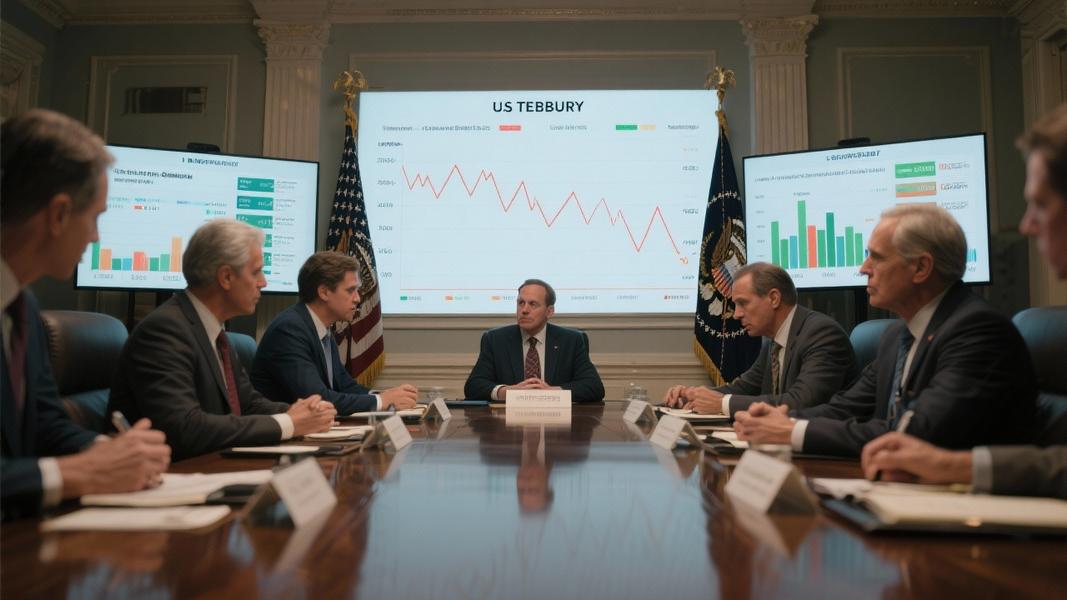
Financial markets have settled into an unusual calm as 2025 winds down, with the S&P 500 climbing 16.3% this year despite — or perhaps because of — a government shutdown that has delayed critical economic data releases. The eerie tranquility comes amid the Federal Reserve’s pivot to rate cuts and growing questions about Treasury financing needs.
Behind the scenes, the Treasury Borrowing Advisory Committee (TBAC) is navigating complex decisions about how to finance America’s growing debt pile, which now requires careful calibration between short and long-term borrowing strategies. The committee’s latest meeting revealed a financial landscape shaped by diminished market uncertainty, resilient economic activity, and the information vacuum created by Washington’s budget impasse.
Market Calm Amid Data Drought
The market quietude is striking. Ten-year Treasury yields have declined about 40 basis points to 4.0% since late July, while two-year yields have fallen to approximately 3.5%. Options on ten-year interest rate swaps now imply just 72 basis points of annualized volatility — the lowest level since 2021 and dramatically down from the 120 basis points observed in early April.
Equity markets tell a similar story. The VIX index, which measures expected stock market volatility, has remained at unusually benign levels since July, following a spike to its highest level in five years this past spring. The U.S. dollar, after depreciating earlier in the year, has stabilized over the past three months.
Could the government shutdown actually be contributing to this market serenity? Many analysts think so. “The ongoing government shutdown may be contributing to the lack of volatility in financial markets, as key US economic data have been delayed,” the TBAC noted in its quarterly assessment. The committee warned that once the government reopens and delayed data is released, “we may see investors and policymakers rapidly update their outlook for the US economy.”
Slowing Growth Before the Lights Went Out
What was happening in the economy before Washington’s budget standoff? The picture shows resilience but with clear signs of deceleration. Real GDP growth slowed to 1.6% annualized in the first half of 2025, down from 2.6% in the latter half of 2024. More tellingly, real final private domestic demand — which strips out inventory swings and import fluctuations — decelerated from 3.1% to 2.4%.
Consumer spending has remained relatively solid, while business investment has been buoyed by capital spending on electronics, particularly investments related to artificial intelligence. The housing sector, however, continues to struggle under the weight of elevated prices and mortgage rates, with single-family housing starts and permits falling in recent months.
The labor market has cooled considerably more than other economic indicators. From June through August — the last months for which data is available — nonfarm payrolls increased by an average of just 29,000 per month. Yet the unemployment rate has held steady at 4.3%, suggesting that the economy now requires fewer new jobs to maintain stability due to reduced immigration and slower labor force growth.
Weekly jobless claims data, which continue to be published during the shutdown, have remained stable, indicating no sharp deterioration in labor market conditions since the government impasse began.
Inflation: Still Not Where the Fed Wants It
What about inflation? It remains stubbornly elevated, with core Personal Consumption Expenditures (PCE) inflation projected at 2.8% year-over-year in September. Goods price inflation has stayed high partly due to tariff pass-through, though the impact has been less severe than many economists anticipated.
At the October Federal Open Market Committee meeting, Chair Powell suggested that without tariff effects, core inflation might be running closer to the Fed’s 2% target — approximately 2.3% year-over-year. Shelter price inflation has moderated to pre-pandemic rates, with soft increases in house prices and rents over the past year.
Non-shelter services inflation presents a more mixed picture. Some categories have shown concerning strength in recent months, worrying certain Fed officials, while others remain sanguine given the loosening labor market.
Fed Pivots as Treasury Cash Pile Grows
Against this backdrop, the Federal Reserve has begun its long-anticipated pivot away from restrictive monetary policy. The central bank cut its benchmark interest rate by 25 basis points in both September and October 2025, signaling a gradual move toward a neutral stance.
The Fed’s September Summary of Economic Projections showed a median “dot” implying 75 basis points of rate cuts in 2025. But don’t count on automatic quarterly reductions. Chair Powell emphasized that a December rate cut is “not a foregone conclusion” and that further easing will depend on incoming economic data.
Meanwhile, the Treasury’s cash balance has swelled to a striking $1 trillion in late October. Why so much? Treasury policy aims to maintain sufficient funds in the Treasury General Account (TGA) to cover at least one week of cash needs, which can sometimes exceed the stated quarter-end target of $850 billion when multiple payment obligations converge.
“The Committee felt that market participants may not appreciate the need for flexible TGA balances intra-quarter vis-a-vis stated quarter-end assumptions,” the TBAC observed, suggesting Treasury officials might want to improve their communication about this practice.
Balancing the Nation’s Credit Card
How is the Treasury planning to finance America’s growing debt? The government’s borrowing needs remain substantial, with deficits projected at $1.940 trillion for fiscal year 2026 and $2.052 trillion for FY2027 — though these figures represent a $106 billion downward revision compared to last quarter’s estimates.
Interestingly, tariff revenue has become a significant variable in these projections, making trade negotiations and court decisions about tariff implementation increasingly relevant to the fiscal outlook.
The TBAC has updated its Optimal Debt Model, which indicates that current issuance patterns are near the “efficient frontier” — balancing cost and risk considerations. Treasury’s recent move toward issuing more T-bills has somewhat reduced expected costs but increased volatility in debt service expenses.
A key question for Treasury officials: is minimizing borrowing costs worth the potential volatility? Alternative economic scenarios suggest that decreasing bill issuance, increasing medium-term note issuance, and decreasing long-bond issuance could lower volatility with only minimal cost increases under adverse economic conditions.
For now, the Committee has recommended keeping nominal coupon sizes and Treasury Inflation-Protected Securities (TIPS) issuance unchanged. However, current projections could warrant increases in coupon issuance in fiscal year 2027.
The Auction Calendar
The Treasury’s November 2025 refunding operations will include auctions of $58 billion in 3-year notes, $42 billion in 10-year notes, and $25 billion in 30-year bonds. These sales will
