
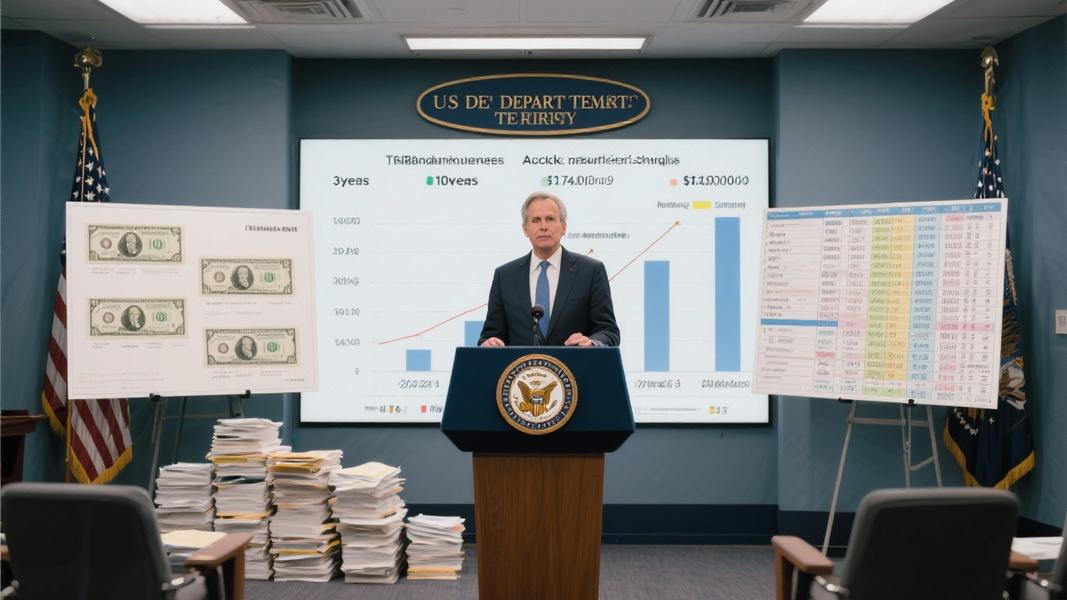
The U.S. Treasury is planning a $125 billion securities offering next month, aiming to refund maturing notes while raising nearly $27 billion in fresh cash from private investors amid ongoing fiscal pressures.
The November issuance, announced today, will include a $58 billion three-year note, a $42 billion ten-year note, and a $25 billion thirty-year bond — all scheduled to be auctioned between November 10-13 and settled by November 17. This massive debt sale comes as Treasury officials navigate persistent deficit concerns while maintaining their commitment to predictable, regular market operations.
Steady Course for Now, Changes on Horizon
Despite the substantial borrowing needs, Treasury officials indicated they’ll maintain current nominal coupon and Floating Rate Note (FRN) auction sizes for “at least the next several quarters.” But change is in the wind. The department has begun “preliminarily considering” future increases to auction sizes, with officials weighing structural demand trends against potential costs and risks of various issuance profiles, according to Treasury documents released today.
For Treasury Inflation-Protected Securities (TIPS), the plan includes holding the November 10-year reopening steady at $19 billion while boosting the December 5-year reopening by $1 billion to $24 billion. The January 10-year TIPS new issue will remain at $21 billion.
How will Treasury handle short-term debt? Officials expect to maintain benchmark bill sizes into late November before implementing “modest reductions” to short-dated bill auctions in December, coinciding with mid-month corporate and non-withheld tax receipts. By mid-January 2026, those bill auction sizes will likely increase again as fiscal outflows ramp up, Treasury stated.
Buyback Program Continues with Adjustments
Treasury’s buyback operations will continue through the refunding quarter with a detailed schedule. The department plans four operations of up to $2 billion each in both the 10-20 year and 20-30 year nominal coupon buckets. One liquidity support buyback of up to $4 billion will target other nominal coupon buckets, while TIPS buybacks will include two operations up to $750 million in the 1-10 year bucket and one operation up to $500 million in the 10-30 year range.
“Cash management buybacks paused in September,” Deputy Assistant Secretary Brian Smith noted during the Treasury Borrowing Advisory Committee meeting, “but will resume in December 2025.” In total, Treasury expects to repurchase up to $38 billion in off-the-run securities for liquidity support and $25 billion in the 1-month to 2-year bucket for cash management throughout the quarter.
Smith also acknowledged the current lapse in federal appropriations while reassuring markets that Treasury has contingency procedures in place, including for TIPS index calculations if CPI data becomes unavailable.
Deficit Outlook Improves Slightly
The Treasury Borrowing Advisory Committee’s projections show deficits of $1.94 trillion for fiscal year 2026 and $2.05 trillion for FY2027. That’s a combined $106 billion lower than last quarter’s estimates — a modest improvement in the grand scheme of trillion-dollar shortfalls.
Interestingly, tariff revenue has become an increasingly important factor in these calculations. “Markets are watching the outcome of trade negotiations as well as court decisions that could affect tariff implementation,” according to meeting materials.
Despite these enormous debt figures, Treasury officials appear unconcerned about market appetite for U.S. securities. “Overall, demand at auctions remains robust, with bid-to-cover ratios in normal ranges,” the committee noted.
Treasury also plans a small-value contingency auction test within the next three months — a routine procedure to ensure its backup auction infrastructure remains functional. Officials emphasized this test “should not be viewed by market participants as a precursor or signal of any pending policy changes.”
As the government continues its massive borrowing program, the stability of auction demand remains a critical factor. But with deficits projected to remain above $1.9 trillion annually for the foreseeable future, Treasury’s balancing act between market stability and fiscal reality shows no signs of getting easier.
