
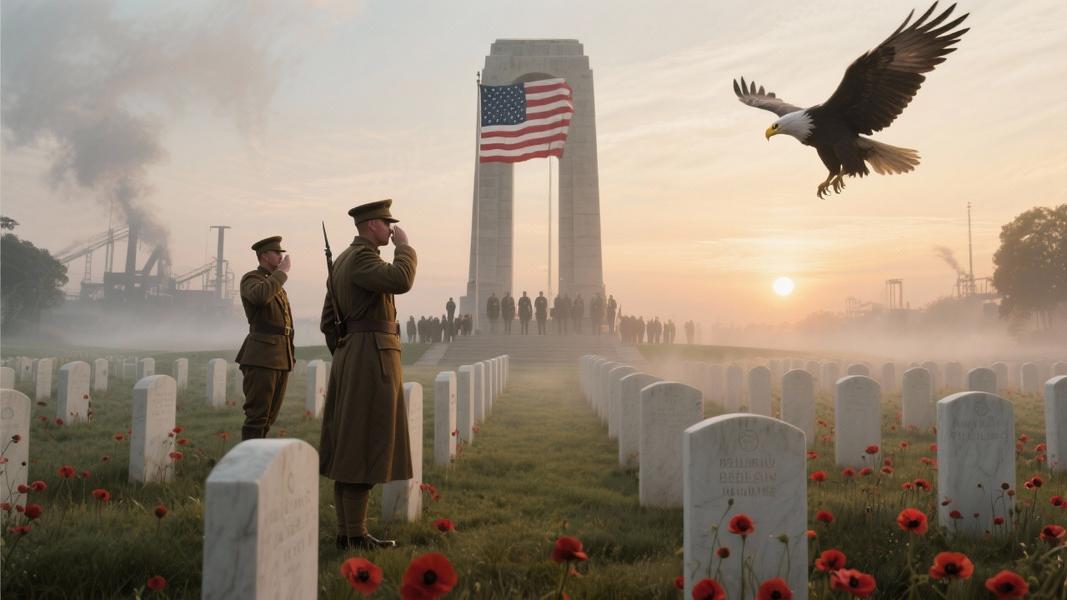
The staggering human cost of the First World War remains nearly incomprehensible more than a century later: approximately 40 million total casualties, including up to 22 million dead and 23 million wounded, ranking it among history’s deadliest conflicts, according to historical records.
America’s Sacrifice: Late Entry, Heavy Toll
Though the United States entered the war relatively late in April 1917, American forces suffered devastating losses in a compressed timeframe. Official Department of Defense figures indicate 116,516 total American deaths through December 31, 1918 — with 53,402 killed in battle and 63,114 dying from disease and other non-combat causes.
What’s often overlooked is the brutal efficiency of these casualties. American soldiers endured their losses in less than six months of active combat, as documented by the National Park Service. The rapid accumulation of American casualties reflects the war’s industrialized killing capacity, with machine guns, poison gas, and artillery transforming the battlefield into unprecedented killing grounds.
The Meuse-Argonne Offensive alone — the largest battle in American history — claimed more than 26,000 American lives over just 47 days beginning September 26, 1918. During this massive push, American forces drove German troops back 40 miles in what would become a decisive action toward ending the conflict.
Global Scale of Suffering
How extensive was the worldwide devastation? Military deaths across all nations totaled approximately 8.5 million soldiers, with an additional 21.2 million wounded, according to Encyclopedia Britannica. The conflict mobilized over 65 million soldiers globally, fundamentally altering the demographic landscape of Europe and beyond, as statistics compiled by Statista reveal.
“The casualties suffered by the participants in World War I dwarfed those of previous wars,” notes Britannica, reflecting the tragic reality of mechanized warfare on a global scale.
Perhaps even more sobering, civilian deaths likely exceeded military casualties. Approximately 13 million civilians perished due to starvation, exposure, disease, military encounters, and massacres, researchers at the University of Kansas Medical Center have found.
The American Army ultimately suffered 52,947 killed and 202,628 wounded by war’s end. These figures, however, tell only part of the story. Medical operations treated far greater numbers of casualties than battle statistics suggest, with disease and psychological trauma creating lasting impacts that extended well beyond the armistice.
Legacy of Loss
The scale of human suffering during the First World War fundamentally transformed how societies viewed armed conflict. The war that was optimistically billed as “the war to end all wars” instead set the stage for even greater horrors to come.
As we reflect on these staggering numbers more than a century later, they serve as a stark reminder of the human cost of global conflict — and why the study of World War I remains critically relevant in understanding modern international relations and military history.
