
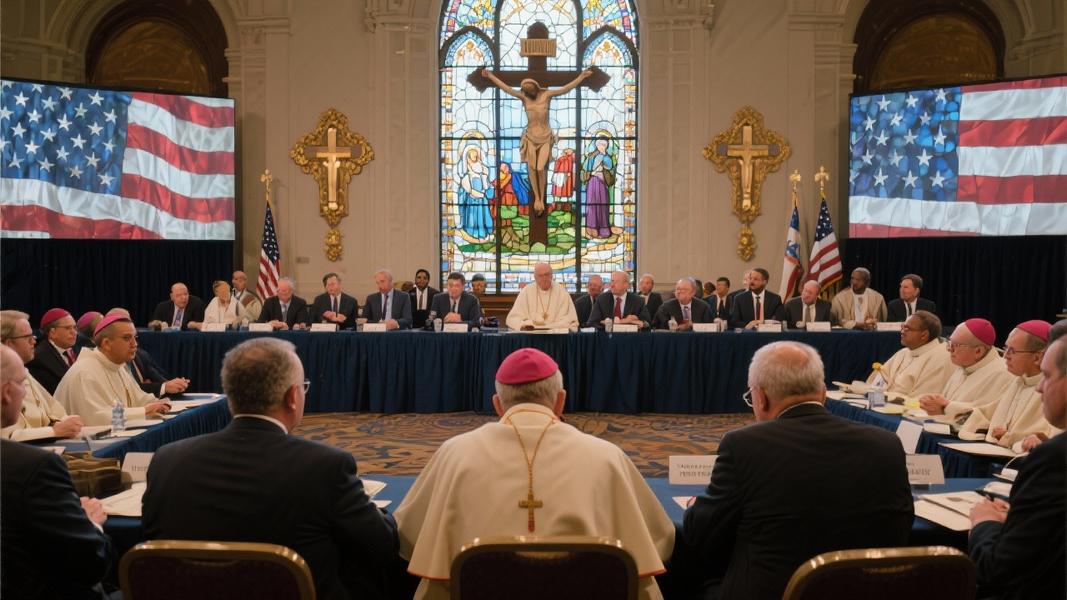
U.S. Catholic Bishops to Select New Leadership Amid Church Divisions
The United States Conference of Catholic Bishops will elect new leadership this November, setting up what could be a pivotal moment for the American church as it navigates deepening political and cultural divides.
Ten bishops have been nominated to replace outgoing USCCB president Archbishop Timothy Broglio and vice president Archbishop William Lori during the Fall Plenary Assembly in Baltimore on November 11. The election comes at a time when American bishops find themselves increasingly split between traditional conservatives and those aligned with Pope Leo XIV’s more progressive approach.
A Divided Slate
Among the frontrunners, Archbishop Paul Coakley of Oklahoma City stands as a strong contender. Currently serving as USCCB secretary and leading his archdiocese for nearly 15 years, Coakley has positioned himself as a defender of traditional values while maintaining some moderate positions. He has criticized both abortion and the death penalty, and expressed concerns about gender ideology, while also questioning aspects of Trump’s mass deportation efforts.
The candidate list also includes Bishop Robert Barron of Winona-Rochester, Bishop Daniel Flores of Brownsville, Archbishop Nelson Perez of Philadelphia, and six others. To secure victory, a candidate must receive a majority of votes from fellow bishops.
“The slate of 10 candidates perfectly reflects the dynamics of the American hierarchy in that it’s split down the middle,” one analyst noted, pointing to the division between more conservative bishops focused on abortion and LGBTQ+ issues, and those prioritizing care for marginalized communities, poverty, and environmental concerns.
Immigration Takes Center Stage
What makes this election particularly noteworthy? Immigration policy looks to dominate discussions during the November assembly, an issue that has taken on renewed urgency following the Trump administration’s border policies.
Bishop Daniel Flores represents an interesting possibility in this context. Leading a diocese along the U.S.-Mexico border, Flores holds what observers call an “ideologically unusual perspective” — maintaining traditional views on sexual ethics while being outspoken in defending migrants. He’s also played a key role in the Vatican’s synod process aimed at modernizing church practices.
Despite the bishops’ deep divisions on many issues, immigration has emerged as a rare point of general agreement. “On many issues, they appear as divided and polarized as their country, but on immigration, even the most conservative Catholic leaders stand on the side of migrants,” according to church observers.
Still, significant differences remain on how forcefully the bishops should oppose harsh immigration tactics that have reduced refugee resettlement and caused fear in some parishes.
Pope Leo’s Influence
Looming over the election is Pope Leo XIV’s recent call for “deep reflection” in the United States regarding immigration policies. The pontiff specifically highlighted the plight of migrants held in detention, saying “many people who have lived for years and years and years, never causing problems, have been deeply affected by what is going on right now.”
How much will the papal emphasis on migrant concerns influence the bishops’ selection? That remains one of the election’s central questions.
The Catholic Church in America continues to face declining Mass attendance in many regions, with some parishes reporting that immigration enforcement fears have contributed to the drop. Whoever takes the USCCB leadership will need to navigate these challenges while maintaining unity in an increasingly fractured religious landscape.
When the bishops gather in Baltimore this November, they won’t just be selecting new leadership — they’ll be signaling which direction the American church might take in responding to a nation that seems as divided as the bishops themselves.
