
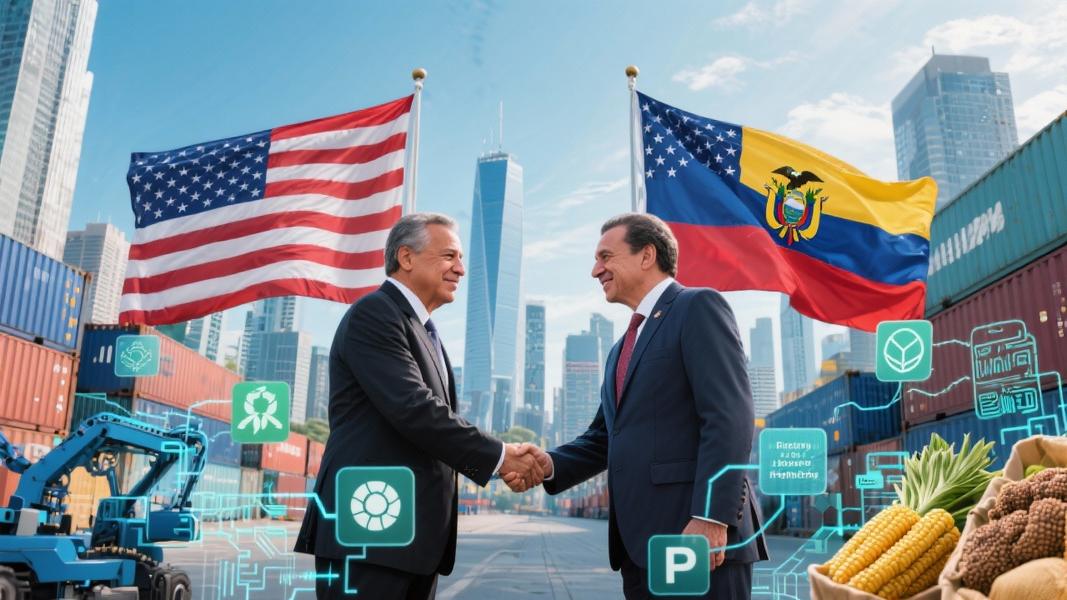
U.S. and Ecuador Forge New Trade Framework to Boost Market Access
Presidents Donald Trump and Daniel Noboa have unveiled an ambitious trade framework aimed at dramatically expanding market access between the United States and Ecuador, signaling a new chapter in economic relations between the two nations.
The framework, which builds upon decades of economic engagement, comes as both countries seek to strengthen their commercial ties while addressing longstanding barriers to trade. Market liberalization sits at the heart of the agreement, with Ecuador committing to reduce or eliminate tariffs across several key sectors including machinery, health products, and motor vehicles, according to details released by the White House.
“President Donald J. Trump and President Daniel Noboa affirm a shared vision of growth for both of our countries, grounded in democratic values, private initiative, and a rules-based environment for commerce and innovation,” the joint statement reads.
Building on Historical Ties
This isn’t a relationship that materialized overnight. The new agreement expands upon the U.S.-Ecuador Trade and Investment Council Agreement (TIC), originally established in 1990 and updated in 2020. But the latest framework represents a significant deepening of economic integration.
What’s in it for American businesses? Ecuador has pledged substantial market access improvements, particularly in agricultural products, chemicals, and information technology goods. In exchange, the United States will remove reciprocal tariffs on certain Ecuadorian exports that “cannot be grown, mined, or naturally produced in the United States in sufficient quantities,” the agreement stipulates.
Regulatory Reforms and Trade Facilitation
For American agricultural exporters, long frustrated by Ecuador’s complex regulatory landscape, the deal offers tangible relief. Ecuador has committed to reforming its import licensing and facility registration systems to enhance transparency and reduce what the framework describes as “onerous and unnecessary barriers to U.S. agricultural exports.”
Cheese and meat producers might find particular reason to celebrate. Ecuador has promised to ensure “market access will not be restricted due to the mere use of certain cheese and meat terms” — a nod to ongoing disputes over geographical indications that have limited American food exports in various markets.
The red tape that has historically slowed trade between the countries is also getting addressed. Ecuador pledged to end pre-shipment inspection mandates and expand its Authorized Economic Operator program to include express delivery carriers within the next three months, significantly streamlining customs procedures.
Beyond Traditional Trade: Labor and Environment
Is this simply about moving more goods across borders? Not quite. The framework incorporates significant labor and environmental provisions that reflect evolving standards in international trade agreements.
Ecuador has committed to strengthening enforcement of its labor laws and will prohibit the importation of goods produced by forced or compulsory labor. On the environmental front, the South American nation has pledged to combat illegal logging and wildlife trade, while also fully implementing its obligations under the World Trade Organization Agreement on Fisheries Subsidies.
Digital Economy and Services
The agreement also ventures into newer territory with provisions targeting the digital economy. Ecuador has committed not to impose digital service taxes that discriminate against U.S. companies and supports a permanent WTO moratorium on customs duties for electronic transmissions.
For service providers, Ecuador has promised to remove barriers on advertising services and refrain from introducing new discriminatory barriers to services more broadly.
National Security Dimensions
Perhaps most notable in the current geopolitical climate is the framework’s attention to economic security concerns. Both nations have committed to strengthening cooperation on supply chain resilience, combating duty evasion, and coordinating on investment security and export controls.
These provisions align with broader U.S. efforts to diversify supply chains away from geopolitical competitors and secure critical economic infrastructure.
The framework still requires finalization and signature following domestic approval processes in both countries. Once completed, it will mark a significant milestone in what officials hope will develop into a more balanced and mutually beneficial economic relationship between the United States and Ecuador.
“Given Ecuador’s commitments to take significant steps to advance a more reciprocal trade relationship, the United States will remove its reciprocal tariffs on certain qualifying exports from Ecuador,” the White House confirmed.
For a region where U.S. economic influence has sometimes waned in recent decades, the agreement may signal Washington’s renewed commitment to deepening commercial ties with strategic partners in Latin America.
