
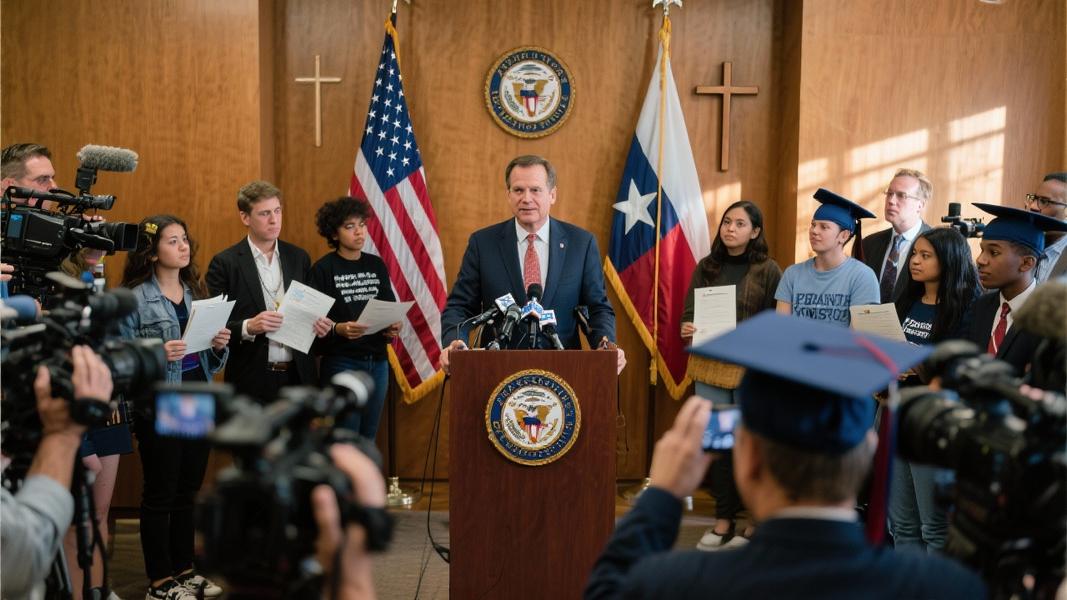
Texas Attorney General Ken Paxton has launched a legal battle against three state-funded higher education work programs, claiming they discriminate against religious students and institutions in violation of the First Amendment.
The lawsuit, filed this week, targets the Texas College Work-Study Program, the Texas Working Off-Campus: Reinforcing Knowledge and Skills (WORKS) Internship Program, and the Texas Innovative Adult Career Education (ACE) Grant Program — all taxpayer-funded initiatives that Paxton alleges exclude religious organizations and students pursuing religious education.
Religion-Based Exclusion at Issue
At the heart of the complaint is the programs’ requirement that funded activities be “nonsectarian,” which effectively bars certain individuals from accessing state benefits solely because of their religious studies. This exclusion, according to Paxton, runs counter to constitutional protections and recent legal precedents.
“These anti-Christian laws targeting religious students must be completely wiped off the books,” Paxton stated. “Our nation was built by patriotic Americans who had the freedom to express their religious beliefs without fear of being targeted, and we will honor that heritage by upholding the First Amendment in Texas.”
The Attorney General’s office has asked the court to declare these programs unconstitutional, pointing to what they consider a clear pattern of discrimination against faith-based institutions and religiously-minded students.
Legal Foundations
Why now? The lawsuit appears to build on recent U.S. Supreme Court decisions that have increasingly sided with religious freedom claims in similar contexts. The complaint argues that excluding religious organizations from state-funded programs creates an unconstitutional burden on free exercise of religion.
Critics may question whether this represents genuine religious discrimination or simply appropriate separation between state funding and religious activities. That tension — between preventing discrimination and maintaining boundaries between government and religion — has been at the center of numerous high-profile Supreme Court cases in recent years.
The case centers specifically on how these work-study and internship programs exclude otherwise qualified students and employers based solely on religious character or affiliation.
If successful, the lawsuit could significantly change how these educational funding mechanisms operate throughout Texas higher education institutions, potentially opening the door for religious schools and organizations to participate in programs that have historically maintained secular requirements.
For now, the programs remain operational while the court considers Paxton’s challenge — a process that could take months to resolve but might ultimately reshape the relationship between state educational funding and religious institutions across Texas.
