
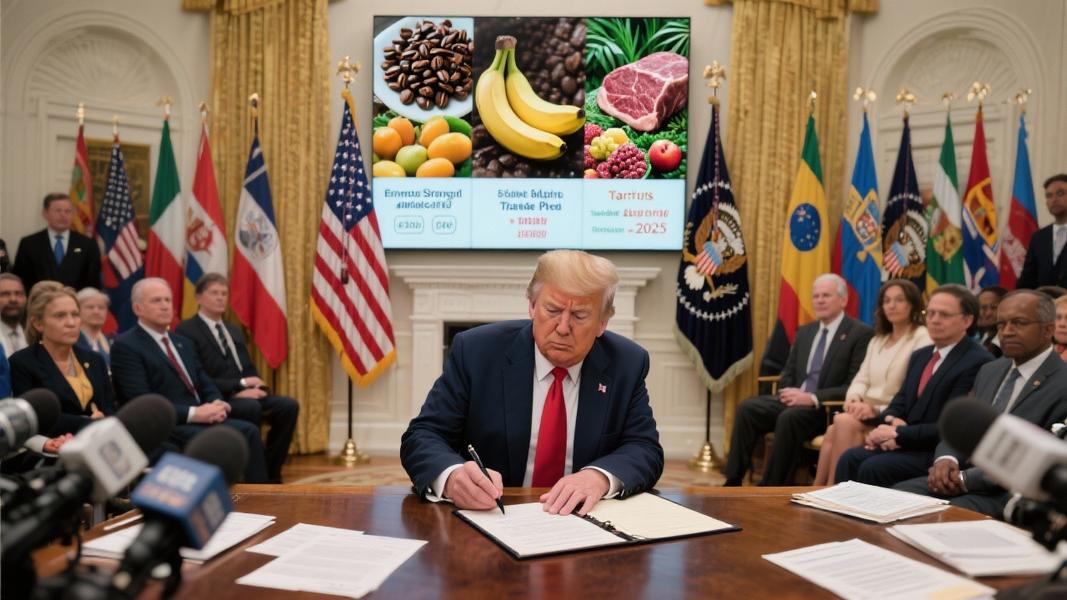
President Trump has exempted coffee, bananas and several other agricultural products from his sweeping global tariff regime, signing an executive order that marks a significant shift in his administration’s trade policy ahead of the Thanksgiving holiday.
The tariff modifications, set to take effect on November 13, remove a range of tropical fruits, beef, tea, and certain fertilizers from the list of products subject to the reciprocal tariffs first announced in April. The move comes after what the White House characterized as “substantial progress in reciprocal trade negotiations” that has yielded nine framework deals and several final agreements.
Coffee, Cocoa and Bananas: The Tariff-Free Shopping List
What’s coming off the tariff list? Essentially, foods that America doesn’t grow in sufficient quantities. The executive order specifically exempts coffee, tea, tropical fruits, fruit juices, cocoa, spices, bananas, oranges, tomatoes, beef, and additional fertilizers from the tariff regime.
“This is primarily food and agriculture products that we simply don’t make in the United States,” U.S. Trade Representative Jamieson Greer explained. “We look at Southeast Asia and South America, that’s where we get a lot of this stuff — the coffee, the cocoa, the bananas, those kinds of things — so this is a natural outgrowth, exactly what the president signaled.”
The exemptions reflect a pragmatic recognition of American agricultural limitations. Many of the products now freed from tariffs are climatically impossible to grow in sufficient quantities within U.S. borders, making them natural candidates for trade rather than domestic production.
A Strategic Realignment
This isn’t Trump’s first modification to his tariff strategy. On September 5, he adjusted the scope by both adding and removing certain goods from the tariff list while establishing a framework for implementing current and future trade deals.
The White House has been busy on the trade front. The administration has secured Agreements on Reciprocal Trade with Malaysia and Cambodia, while establishing framework agreements with numerous countries including El Salvador, Argentina, Ecuador, Guatemala, Thailand, Vietnam, the United Kingdom, the European Union, and Switzerland. Investment deals with Japan and South Korea have also materialized.
But why now? According to administration officials, the timing reflects a critical mass of successful negotiations.
“With the deals from the summer with the EU and the U.K., the president’s successful… swing through Asia … we’ve really reached that critical mass where we started to reshape the global trade system in a way we think is better for America, and so now is the right time to … release some of these items,” a senior trade official stated.
Latin America in Focus
The administration appears to be paying particular attention to Latin America. White House economic advisers indicated plans to roll out tariff reductions for coffee and other agricultural products that can’t be produced domestically in sufficient quantities, including Argentinian beef.
These changes represent more than just a shopping list adjustment. They’re part of a broader strategy to reshape global trade relationships in America’s favor while acknowledging certain agricultural realities.
The products removed from reciprocal tariffs have been added to Annex II of Executive Order 14257 and removed from the “Potential Tariff Adjustments for Aligned Partners” (PTAAP) Annex. That annex still contains other natural resources unavailable in the United States, generic pharmaceutical inputs, and aircraft parts — items that could see tariff relief upon conclusion of reciprocal trade and security deals.
Is this a softening of Trump’s hard-line trade stance? Not exactly. The modifications appear more strategic than conciliatory, designed to enhance market access for U.S. exporters by offering reciprocal benefits to key partners while maintaining pressure on others.
The original April 2 tariffs were announced to address what Trump declared a “national emergency” caused by large and persistent U.S. trade deficits, which he attributed to a lack of reciprocity in trade relationships. Even then, certain critical minerals, energy, and energy products were excluded from the tariff regime.
For American consumers, the practical impact is that their morning coffee, bananas, and various tropical fruits should avoid price increases that might have resulted from the tariffs — just in time for holiday grocery shopping.
